Ok you guys, we all know that Tumblr runs primarily in English

seagreeneyes:

seagreeneyes:

BUT WE ALSO KNOW THAT A SIGNIFICANT PART OF TUMBLR USERS ARE NOT NATIVE SPEAKERS

Here’s the deal: my first language is Italian. I know plenty of people on this website whose first language is Italian. Nevertheless, when we’re interacting with each other on Tumblr, we speak English.

I am not objecting to this system, it’s actually good practice for some people, to be able to speak a second language extensively.

BUT I HAVE A PROPOSITION FOR YOU.

Why not have a “Speak Your Own Language Day” where all of us exclusively speak in our native language?

(No but apart from the small rebellion from the US-centric and generally Anglophone-centric environment we got here, think about trying to speak to people from other countries via excessive use of Google Translate it’ll be a blast)

Ok, since this post has finally reached 100 notes I think it’s a good time to give a date, and since no one else has advanced suggestions I’m gonna do it

I’m proposing Wednesday 7th May, so the post has a chance to do a couple more laps and more people get a chance to participate (French Friday sounded hilarious, but I don’t wanna wait until next friday and this friday seems a bit too soon).

How it’ll work:

  • If you’re native language is something other than English, speak that!
  • If you have multiple languages you can pick from the choice is yous friend, speak all, speak one, whatever’s best for you
  • You’ll blog in your language all day: text posts, replies, tags (except triggers and organizational tags), the whole nine yards. Regardless of what language people choose to speak to you, you answer in your own.
  • Midnight to midnight according to your own time zone
  • English native speakers, if you wanna participate maybe you could practice a second language you’re learning
  • If anyone makes fun of anyone else for their language (and I’m including English native speakers that might choose to speak a second language on the day) I’m gonna come for you (◕‿◕✿)
  • The tag is gonna be #Speak Your Language Day if you wanna tag your posts with that!

Tags:

#language #oh hey are we doing this again this year? #neat #I think that qualifies it for the tag #Tumblr traditions
archiemcphee:

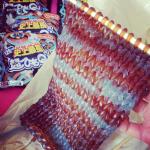
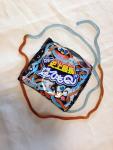
Candy + Crafts = Awesome

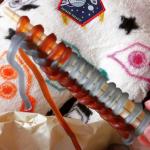
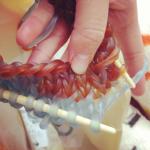
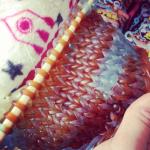
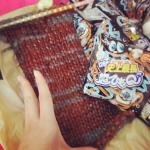
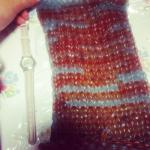
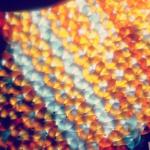
When Japanese Twitter user Overtime Queen noticed the resemblance between Ultra-string Q gummy candy and yarn, she decided to postpone eating it and try knitting with it instead. Each piece of the citrus and soda flavored candy measures 126 cm (50 in) long, so she bought 15 packages – amassing roughly 18.9 meters (62 feet) of gummy candy and set to work knitting with a pair of chopsticks, using a standard stocking stitch (18 stitches across), resulting in a lovely scarf that’s 100% edible.

There’s no word on whether or not Overtime Queen ate her crafty confection, but she did resport that the process of knitting the gummy scarf made her hands smell delicious:

“My hands smell like citrus soda and cola! They smell so good!”

After working on it for three hours, the completed scarf measured 25 cm x 15 cm (9.8 in x 5.9 in), and weighed 450 grams (1 lb). It may not be a long scarf, but it’s still completely awesome. We’d like nothing better than the opportunity to take a big bite out of it.

[via RocketNews24]


Tags:

#food #neat

foxxxynegrodamus:

capitalveg:

theflemface:

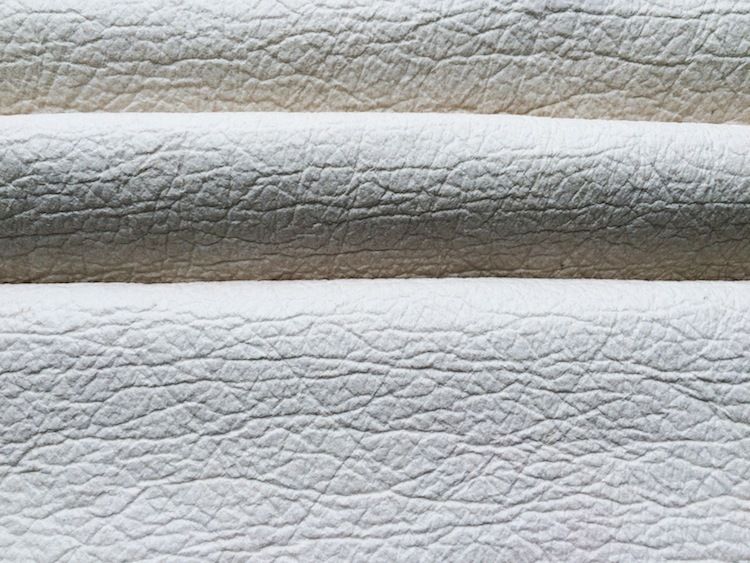
What you see above isn’t in fact leather made from animals- it’s made out of pineapples.

””It was one of those coincidences of life,” said Carmen Hijosa, founder of Piñatex, a new sustainable textile made from pineapple leaf fibres. Hijosa was speaking of her trip to the Philippines that led to a career change, which involved going back to university to get a PhD from London’s Royal College of Art, starting her own business, Ananas Anam, and patenting her own textile. 

A small coincidence, and a big change.

Hijosa had been working in the leather industry for over 15 years in Ireland, when she was invited to consult on the exportation of leather in the Philippines. When Hijosa arrived, she was exposed to the poor quality of the materials, the working conditions and the toxic impact of leather on the environment. Hijosa advised, rather than try and export leather, why don’t you work with what you got, and what the Philippines has is an abundance of natural fibres.

She began to explore different fibres and came upon the pineapple leaf. “I realized they are very strong and flexible,” she says. “I wanted to see if I could make them into a non-woven mesh textile [like leather] and to do that I had to do full research and development that only a degree could provide.”

“Piñatex is a byproduct of the food industry,” explained Hijosa. “Once the pineapples are harvested the plants are left to rot.” Instead of letting that happen, pineapple farmers gather the leaves, extract the fibres and degum them in closed tanks. Once they have been degummed, the fibres become soft and breathable and can be put through a mechanical process that turns them into a non-woven mesh material that ends up feeling much like felt. 

The entire process does not use any extra water, pesticides or fertilizer beyond what is used to cultivate the pineapples. By comparison, to produce 1kg of cotton – enough for one t-shirt and a pair of jeans – it takes up to 20,000 litres of water.”

This demonstrates that not only is the leather industry cruel, but it is also unnecessary. This product will hopefully be one of the future; one that manufactures waste to create something fashionable and hopefully successfully overtakes and thus eradicates the current industry.

Hope to see this on the markets soon!

OH MY FUCKING GOD


Tags:

#neat

bogleech:

did-you-kno:

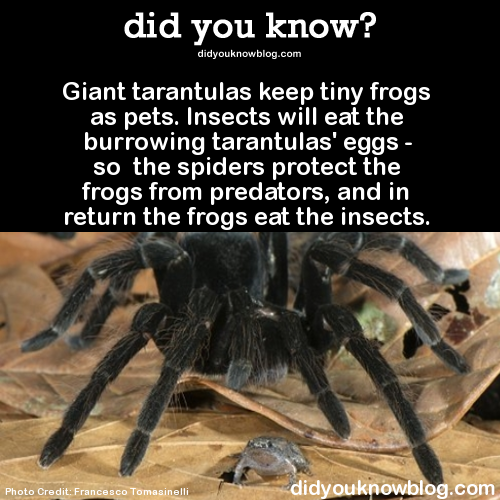
Giant tarantulas keep tiny frogs as pets. Insects will eat the burrowing tarantulas’ eggs – so the spiders protect the frogs from predators, and in return the frogs eat the insects. Source

This has blown my mind for years. It’s so unreal. It’s almost the same exact reason humans and cats started living together.

Tiny frogs are tarantula housecats. A science fact seldom gets to sound that much like meaningless word salad.


Tags:

#biology #neat #the more you know

theolduvaigorge:

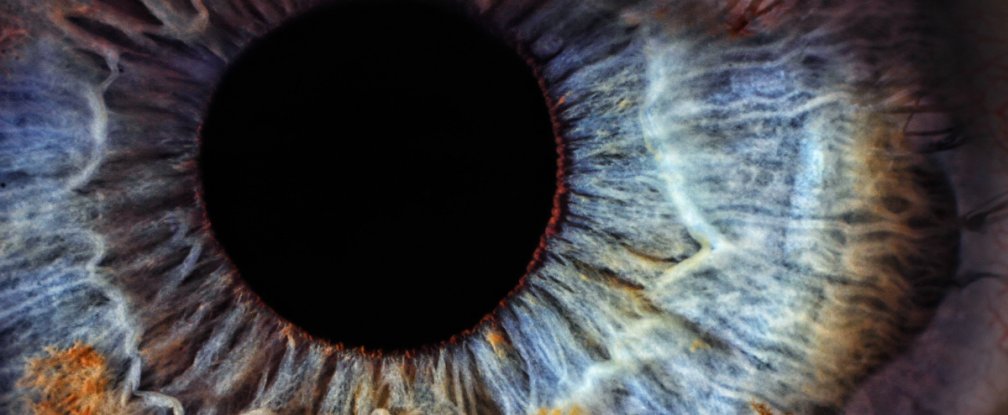
This is how blue eyes get their colour

Blue eyes don’t get their colour from pigment – it’s actually way more fascinating than that.

  • by Fiona MacDonald

Your eyes aren’t blue (or green) because they contain pigmented cells. As Paul Van Slembrouck writes for Medium, their colour is actually structural, and it involves some pretty interesting physics. As he explains, the coloured part of your eye is called the iris, and it’s made up of two layers – the epithelium at the back and the stroma at the front.

The epithelium is only two cells thick and contains black-brown pigments – the dark specks that some people have in their eye is, in fact, the epithelium peaking through. The stroma, in contrast, is made up of colourless collagen fibres. Sometimes the stroma contains a dark pigment called melanin, and sometimes it contains excess collagen deposits. And, fascinatingly, it’s these two factors that control your eye colour.

Brown eyes, for example, contain a high concentration of melanin in their stroma, which absorbs most of the light entering the eye regardless of collagen deposits, giving them their dark colour.

Green eyes don’t have much melanin in them, but they also have no collagen deposits. This means that while some of the light entering them is absorbed by the pigment, the particles in the stroma also scatter light as a result of something called the Tyndall effect, which creates a blue hue (it’s similar to Rayleigh scattering which makes the sky look blue). Combined with the brown melanin, this results in the eyes appearing green” (read more).

(Source: Science Alert)


Tags:

#eyes #biology #the power of science #neat

kqedscience:

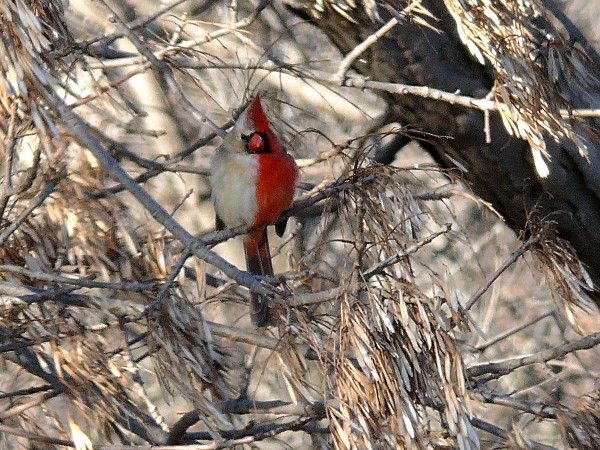
This bird might look like a holiday ornament, but it is actually a rare half-female, half-male northern cardinal

Researchers have long known such split-sex “gynandromorphs” exist in insects, crustaceans, and birds. But scientists rarely get to extensively study a gynandromorph in the wild; most published observations cover just a day or so. Observers got to follow this bird, however, for more than 40 days between December 2008 and March 2010.”

Learn more at Science.


Tags:

#bird #biology #neat #didn’t know birds could do that #I think previously I’ve only seen pictures of gynandromorphic butterflies and dragonflies