Anonymous asked: Are you good as far as having drugs to make having the flu not suck so bad?

{{previous post in sequence}}


stealthbaguette:

justice-turtle:

brin-bellway:

sinesalvatorem:

What type of drugs? Where can I get them? Will they cost more than $25? I’ve never bought flu medication back home. We use ~traditional herbs~ and suffering it out, because that’s the cheapest thing for it.

(will use chemical names because over-the-counter medicine brand names are ever-changing, often overly broad, and generally confusing)

(I spent long enough composing this that I’ve quite possibly been ninja’d, but hopefully this helps anyway.)

Relevant contents of my family’s basic medicine stock, available at any ordinary pharmacy (Pharmasave, Shoppers Drug Mart, stuff like that, also most grocery stores):

Pseudoephedrine: de-clogs stuffy noses. I don’t think it does anything for runny noses, or at least it didn’t seem to during my recent cold. While not particularly psychoactive itself (apparently it can be a stimulant, but not at the doses you’d be taking), is an ingredient in making meth, so you will likely be required to show ID and be forbidden from buying quantities that look suspiciously industrial. IME, wears off after 3 – 4 hours, but can only be taken every 6 (although you’re officially allowed to take another dose after only 4 as long as you don’t do it too often; see box for details). Plan your off times accordingly.

(Phenylephrine: …actually, let me just quote Wikipedia here. “Phenylephrine is marketed as an alternative for the decongestant pseudoephedrine, though clinical studies show phenylephrine to be no more effective than placebo.“ You might be tempted by it because it’s less restricted than pseudoephedrine, but don’t bother. If you have trouble obtaining pseudoephedrine, just go without.)

Dextromethorphan: reduces cough frequency, though not always to nothing. Taken twice a day, and also cannot be relied upon to actually last the whole time.

Guaifenesin: if you are having the kind of cough where you can feel there’s phlegm clogging your lungs but the cough’s not clearing it out, turns your coughing into the kind of cough that does clear it out. Kind of gross while the “productive” cough is going on, but you can breathe better afterward.

Dimenhydrinate: anti-nauseant, in case you need that sort of thing at the moment. Is also a sedative, so don’t take it if you want to be awake. Has a similar name to anti-allergy (and also sedative) diphenhydramine because it’s a similar chemical: you might be able to use them interchangeably in a pinch, but probably better to keep separate stocks of them if possible. Definitely don’t take them both at once, though. (Mind you, it’s general good policy to never take any sedative with another sedative, or any stimulant (including pseudoephedrine) with another stimulant.)

(With flus you probably don’t need an anti-diarrheal, but for future reference that’s loperamide. Half a pill renders you unable to poop for 24 – 36 hours. I recommend against taking a whole pill.)

The four main OTC pain relievers are ibuprofen, aspirin, acetaminophen, and naproxen. I generally use ibuprofen, but I’m not sure the difference is that important if you don’t have any medical issues forbidding one or another. (Oh, although, ibuprofen is nearly tasteless, so if you have trouble swallowing the pill, you can just chew it and it won’t be horrible.)

I don’t normally bother with topical anesthetic for sore throats (you open your mouth, aim the spray bottle at the back of your throat and press the button) because I find the feeling of numbness it replaces the pain with to be just as bad, but Mom uses phenol spray.

Note: all of these are sold in quantities too big for one cold suffered by one person. Rather than buying your own supply and having it expire before you can use it all, you may want to consider buying partial containers off of classmates. Possibly. Don’t blame me if something goes wrong with this plan.

Not relevant to the flu, but throwing in that the four OTC painkillers have vastly different effects on period cramps (ibuprofen is the most effective, acetaminophen the least). Also, if you have trouble swallowing a pill, I know both ibuprofen and acetaminophen come in chewable or flavored-liquid “children’s” forms. I’ve used the liquid form of ibuprofen when period cramps were upsetting my stomach too badly for a solid pill.

Re: runny and stuffy noses – use a nasal spray containing xylometazoline HCl (hydrochloride I think that abbreviation is?) and ipratopium Br (dunno what the fuck that is. Bromide????). (It’s marketed as Otrivin Duo in Holland, if you want to see the complete list of ingredients) 
It works to both temporarily stop the stuffy feeling AND the Niagra Falls in your nose.

Be advised you can’t use it for too long as you’ll experience nose bleeds with prolonged use as it dries out your nose like nobody’s business! It only relieves the symptom though (for 8ish hours), so do couple it with some fever reducers and painkillers that DON’T make you drowsy if you can’t afford to skip work. Optionally, have some moisturiser at hand because your nose is going to take a beating from all the dryness!

Also, shitloads of vitamine C, at least 1000 grams. Even if it won’t do much, it’ll at least get rid of the blegh pill taste ;).

(see also)

(Also, I later switched from ibuprofen to naproxen, and so far I’ve been finding it much more effective. If the first OTC painkiller you try doesn’t really seem to do much for you, consider trying another rather than assuming that’s just the amount of painkilling on offer.)

(also also, when considering taking multiple drugs at once, unless you’ve seen them marketed as a combo pack make sure to check for interactions, including with anything you were already taking)


Tags:

#(October 2015) #conversational aglets #illness tw #the more you know #medical cw

So much adulting today.

Got up a bit early for an appointment at the doctor’s office, because starting a few months ago most of my menstrual periods have been significantly worse than usual, and after the 2.5th bout of debilitating dizziness (the .5 was a time where it felt like it was *going* to happen but never quite got bad enough that I couldn’t stand up) I figured there was enough of a pattern developing here that I shouldn’t bet on it going away on its own.

The first-line treatment is daily iron supplements, plus two naproxen twice a day around the onset of menstruation (apparently, in addition to the painkilling effect, higher-dose naproxen can also make periods lighter). If the OTC stuff doesn’t cut it, the next step is to “”sample”“ some birth control pills. (She is one of those doctors who, when possible, keep their poorer patients supplied with enough ”“samples”“ of a medication that they never actually have to spend money on it.)

Then my brother and I went to the bank and signed up for index-fund RRSPs [link]. It’s not so much that I’m planning for retirement per se (though my brother might be thinking of it that way, I’m not sure), but after many hours of very stressful research regarding which forms of investment fall in the intersection of “non-awful returns”, “low fees”, and “won’t piss off the IRS [link]”, this is the only entry that I am sufficiently confident is on that list.

(I came scarily close to buying some non-RRSP index funds this autumn–even set up the account for it!–and only found out that doing so would incur the IRS’s wrath because my brother mentioned he was thinking of getting a TFSA, and this inspired me to read the Wikipedia article on them [link] (they are also terrible, for some of the same reasons). Thank you for telling me this extremely important information, Wikipedia, because nobody *else* fucking did!)

It looks like we are allowed to have *some* ETFs [link] under *some* circumstances, but I don’t have a clear sense of which ETFs/circumstances those are. Once we’ve reached a point in our lives where [18% of all the post-immigration income we’ve ever had] isn’t enough room to keep our savings in, we will have to find an appropriate specialist to consult about exactly how to tell when an ETF is permissible.


Tags:

#sometimes I wonder if I should go into U.S. tax preparation so maybe one day I can actually fucking understand what my own taxes are doing #but I think I’d rather do something more in the realm of bookkeeping or cost-benefit analysis #this stuff does not seem to *quite* be my style #but it’s even less everyone else’s style so I took the research upon myself #(at least I get to cost-benefit-analyse the various types of investment?) #adventures in human capitalism #oh look an original post #home of the brave #our home and cherished land #medical cw #menstruation #the more you know

@acemindbreaker​, I didn’t want to directly reblog this thread (there were some pretty pressuring bits in previous parts of the reblog chain, and I follow a no-guilt-trips policy), but I did want to try and answer your question.

You live in Saskatchewan, right? It looks like this is Saskatchewan’s version of the medication assistance program my family’s on.

IIRC, the Ontarian program specifies that to qualify for it your household must spend more than 4% of its collective income on prescription meds†, and the program acts to cap your spending at 4% of income (each quarter you only pay up to that figure, and then the program kicks in and pays for the rest of your meds that quarter). The Saskatchewan page seems rather more vague about what its qualifiers and effects are, but the information might be buried in there somewhere, and presumably it has *some* effect for *some* people.

I was not involved in the decision to make No Frills our primary pharmacy (it was a while ago), but I assume my parents had their reasons to switch over from Pharmasave, and they were probably financial reasons. The No Frills website says there are only three of them in all of SK, so you might very well not live near one, but the general idea might hold. I don’t know what websites might help you in determining which pharmacies are cheaper than others, though: search listings seem to be clogged with places trying to smuggle(?) Canadian meds into the United States.

(And the smuggling brings up something that may be worth noting, that in some cases the efforts of Americans to get cheaper meds are just trying to bring prices down to a level Canadians would consider full price, and to some extent the reason there is less Canadians can do is because there is less to be done. I still remember, shortly after we moved, how horrified our new friends were when they heard what my parents had been paying for their medications. But I don’t want to put too much emphasis on that: even when things are better than they *could* be, it’s often important to try to make them better still.)

†so I suspect we’re going to get kicked out at the next assessment now that we’re making more, but anyway


Tags:

#this post technically qualifies as: #oh look an original post #but is closer to the spirit of: #reply via reblog #our home and cherished land #adventures in human capitalism

fuckyeahfluiddynamics:

Blocking blood vessels by creating embolisms is, under most circumstances, very bad. But researchers are exploring ways to fight cancer by intentionally and strategically creating these blockages. In gas embolotherapy, researchers inject fluid droplets, which can carry chemotherapy drugs, into the bloodstream. Once they circulate into a cancerous tumor, they use ultrasound to vaporize the droplet and create a gas bubble. Those bubbles lodge inside the capillaries of the tumor, starving it of fresh blood and trapping the chemotherapy drugs inside. It’s a one-two punch to the cancer. Without blood flow, the cancer cells die, and, since the cancer-killing drugs get mostly trapped inside the tumor, patients may require lower dosages and endure fewer side effects. The technique is currently in animal testing, but hopefully it will be a valuable therapy for human patients in the future. (Image credit: Chemical & Engineering News; research credit: Y. Feng et al.; via AIP)


Tags:

#cancer #the power of science #I agree with Anomaly #(”nifty if it pans out”)

shedoesnotcomprehend:

I have some medication bottles with timers built into the lids that automatically tell you how long it’s been since you last took a dose (opened the lid), and these things are so convenient I’m actually kind of stunned they’re not more common.

You don’t have to go through the whole rigamarole of “wait, did I just take my meds five minutes ago, or did I just think about doing it? … great, should I maybe miss a dose or maybe take a double dose?” every other time you take them. You don’t have to try to remember what time it was when you woke up in the middle of the night and groped around for the bottle and took the next dose and fell back asleep. If you’re taking more than one medication, you don’t have to keep track of which you took when. And of course doing all that when you’re sedated or have a fever or are just in pain is extra fun.

Plus: pediatric medicines. When I or any of my siblings got sick as babies, my parents used to write up a chart on the whiteboard, every time, with medications and dosages and times. Because they’d be switching off taking care of us, and it would just be way too easy for Mom to give the baby something that Dad had just given them ten minutes before but not thought to mention (and with a baby, that can be pretty dangerous). With timer-caps, you’ve got perfect information-sharing: you don’t just know what’s the last time you gave the baby the medication, you know what’s the last time the medication was used.

So it really seems like this should be more of a thing! I mean, ordering them online cost me a couple of bucks each; so if the manufacturers were just building in timers by default, what should that actually add to the price, maybe a quarter for each bottle? A dollar at the outside? That’s definitely within the store brand – name brand variation for even cheap over-the-counter medications. I’d happily pay fifty cents extra to buy a bottle of advil off the shelf at the grocery store that had a timer built into the lid to count out four-to-six-hours for me.

At the very least, I’m kind of surprised that this isn’t a default feature on, like, prescription painkillers. My parents did the whiteboard thing again for me after I had jaw surgery, because I was on the good drugs and in no condition to keep track of whether I’d had a dose recently or not. I strongly suspect that having a timer that set itself automatically – so that even someone pretty drugged up could look at it and see if it had reached 6:00:00 and turned green – would make a nontrivial difference in the rate of accidental overdoses. And given how much those drugs cost, adding a dollar timer to the lid is completely insignificant.

So I’d really expect consumers to be demanding these for the convenience, federal regulations to be pushing them for safety, and drug manufacturers to be happily showing them off as a “check out the cool fancy bonus gadget our brand has, because we care.” And yet as far as I know this happens literally zero – you can buy the timer lids online, if you know they exist, but no medication I’ve ever seen is just sold in bottles that have timer lids by default.


Tags:

#… #interesting idea #the more you know #remind me to get some of these #(right now I’m only on iron pills) #(where it doesn’t really matter if you skip a day or two) #(so when I’m not sure if I’ve taken any today I just don’t take it and it’s not a big deal) #(but I expect at *some* point in my life I’ll be on important-timing meds for *some* length of time) #(I was going to use one of those pillboxes with separate divisions for each day of the week) #(but that gets rapidly less helpful with anything more complicated than once-a-day)

somnilogical:

somnilogical:

Whenever I post something with p values, tumblr deletes the part after the less than sign. This is very frustrating!

I had commentary on that article tumblr! And you deleted it! I just got to the point that stopped copying everything before posting it because I trusted you. Arggggh!

Textarea Cache? (That way you never have to decide whether you trust a text field enough to not copy it.) I don’t know if there’s a Chrome equivalent, and unfortunately I’m pretty sure there isn’t an Android Firefox equivalent.


Tags:

#Textarea Cache saved me this very afternoon #from having to rewrite a complaint I filed with Canadian Blood Services #(they used to test you for anemia as the *first* part of the screening) #(but the higher-up rearranged things and now it’s *last*) #(so I had to wait *40 minutes* to learn my iron hadn’t recovered from my previous donation) #(when previously I would only have wasted 5 minutes) #((it really ought to have recovered by now though)) #((it’s been four months)) #((going to talk to my doctor about iron supplements)) #anyway #Tumblr: a User’s Guide #reply via reblog #tangents

Endometriosis

jumpingjacktrash:

quillusquillus:

thehalfrolatina:

glowhq:

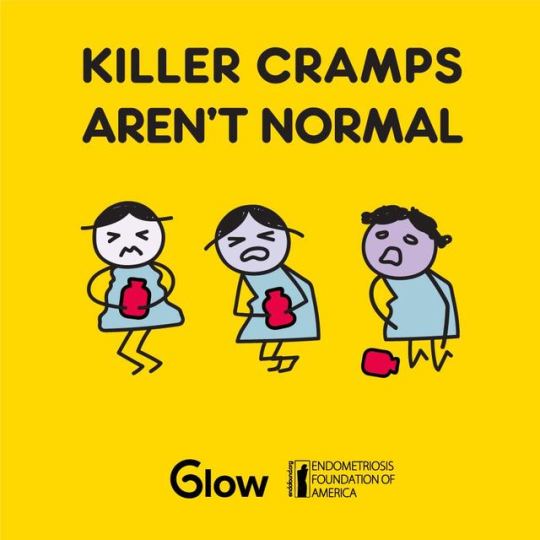
Killer Cramps Aren't Normal

Endometriosis—the struggle is real.  Killer cramps are NOT normal.  Periods that last longer than 7 days are NOT normal. Heavy bleeding that soaks through a tampon every 2 hours is NOT normal; pain during sex is NOT normal. Bouts of diarrhea and vomiting that accompany every menstrual cycle are NOT normal. No, no, and no!  For many people, this reality is just endometriosis at work.

Sad truth: Many of us are taught to downplay these symptoms. Our pain is diminished by parents, siblings, friends and even health care professionals who convince us that everyone goes through this.

Maybe that is why, according to the Endometriosis Foundation of America, it takes 10 years on average to receive an accurate endometriosis diagnosis. That’s a decade, people! That’s 130 periods of agony, 912 days of someone asking you to take Advil and suck it up.  That…is not okay.

Endometriosis is pervasive.  It affects 1 in 20 Americans of reproductive age and an estimated 176 million people worldwide. It occurs when tissue similar to the endometrium (the lining of the uterus) is found outside the uterus on other parts of the body.  

There are lots of symptoms that can vary among patients.  Pelvic pain is most common, as well as pain that coincides with menstruation.  Other symptoms include heavy cramps, long-lasting bleeding, nausea or vomiting, pain during sex and, unfortunately, infertility.  Some people may even experience symptoms throughout their entire cycle—a real drag.

In addition to these physical symptoms, endometriosis takes a toll on someone’s personal and professional life. Chronic pain can severely affect quality of life day-to-day; medical care can be extremely costly. Furthermore, absenteeism can alter relationships in the workplace and at home.

Despite the intense discomfort, many people do not realize they have endometriosis until they try to get pregnant. And because the disease tends to get progressively worse over time, approximately 30-40% of people who have endometriosis experience fertility challenges.

There is no simple diagnostic test for endometriosis—no blood, urine, or saliva testing can confirm the condition. The only way to verify endometriosis is to undergo a diagnostic laparoscopy with pathology confirmation of biopsy specimens.  

On the bright side, many endometriosis symptoms— including infertility—can be addressed after diagnosis. The gold standard for endometriosis treatment is laparoscopic excision surgery. This involves a careful removal of the entire endometrial lesion from wherever it grows.

The first step to getting there is recognizing that your pain is not normal and seeking timely intervention. The earlier endometriosis is detected and treated, the better the results. Tracking your symptoms will make you better informed for your next doctor’s visit, and set you on a path to better (and less painful!) menstrual health.

For more information about Endometriosis, visit www.endofound.org

oh shit.

Can’t stress enough the early diagnosis part. My mum recently had to have a hysterectomy due to endometriosis and the doctors were like “well, if we’d known about this sooner, a much smaller operation would have been fine and we could have kept the uterus”. Get this shit checked early, guys

beeps, idk who you are on tumblr but if you’re following me, THIS THIS THIS


Tags:

#endometriosis #menstruation #PSA #(sometimes I wonder if I should talk about menstruation more) #(because as it stands you only ever hear period talk from people with miserable periods because they’re the ones complaining) #(and so if you don’t have any contradicting personal experience it’s easy to think that all periods are miserable) #(and if you *do* have contradicting personal experience) #(since you have nothing to complain about you don’t speak up and you don’t get included in the cultural osmosis) #(not to mention the…not sure what the term is) #(the thing where if something that’s a big deal for other people isn’t a big deal for you) #(you’re discouraged from talking about your experiences because it’s seen as delegitimising the problems of those for whom it is a big deal) #(my brain’s coming up with ‘respectability politics’ but I’m not sure that’s quite it) #anyway point being #if you have horrible periods you might be able to fix that #maybe you too can know the -joys- absence of negative emotion of not-a-big-deal periods #tag rambles

lizardywizard:

withasmoothroundstone:

chronicillnessproblems:

marauders4evr:

See, the problem with people who aren’t in wheelchairs writing about and/or drawing people who are in (manual) wheelchairs is that the people who aren’t in wheelchairs tend to think that there’s only like four movements that you do in a wheelchair. You can either push forward, push backwards, turn left, or turn right. And the characters do it all while sitting up straight or bending forward so that their noses touch their knees.

But the amount of motions that I go through on a daily basis are actually amazing. And the body language…you could write an entire book on the body language of someone in a wheelchair.

Like right now, I’m more relaxed, so I’m slouching slightly. I’ve got my right foot on its footrest and the left foot on the ground. Every so often, as I stop to think of something to say, I’ll push with my left foot to rock the chair slightly.

But usually, I sit mostly upright with my upper-half slightly leaned forward. When I’m wheeling across the campus, especially if I have somewhere that I need to be, I’ll lean and shift my weight in whichever direction it is that I’m going. It helps make the wheelchair glide that much more smoothly. How far/dramatically I lean depends on how fast I’m going, the terrain, if there’s a turn, etc.

Plus people who don’t use wheelchairs don’t understand the relationship between grabbing the wheels, pushing, and the chair moving. Like I’ve seen things written or have seen people try to use a chair where the character/that person grabs the wheel every single second and never lets go to save their lives. Which isn’t right. The key is to do long, strong, pushes that allow you to move several feet before repeating. I can usually get about ten feet in before I have to push again. It’s kind of like riding a scooter. You don’t always need to push. You push, then ride, then push, then ride, etc.

And because of this, despite what many people think, people in wheelchairs can actually multitask. I’ve carried Starbucks drinks across the campus without spilling a single drop. Because it’s possible to wheel one-handed (despite what most people think), especially when you shift your weight. And if I need to alternate between pushing both wheels, I’ll just swap hands during the ‘glide’ time.

I’ve also noticed that people who don’t use wheelchairs, for some reason, have no idea how to turn a wheelchair. It’s the funniest thing. Like I see it written or, again, have seen people ‘try’ a wheelchair where they’re reaching across their bodies to try to grab one wheel and push or they try to push both wheels at the same time and don’t understand. (For the record, you pull back a wheel and push a wheel. The direction that you’re going is the side that you pull back.)

Back to body language. Again, no idea why most people think that we always sit upright and nothing else. Maybe when I’m in meetings or other formal settings, but most of the time, I do slightly slouch/lean. As for the hands…A lot of writers put the wheelchair user’s hands on the armrests but the truth is, most armrests sit too far back to actually put your hands on. There are times when I’ll put my elbows on the edges of the armrests and will put my hands between my legs. Note: Not on my lap. That’s another thing that writers do but putting your hands in your lap is actually not a natural thing to do when you’re in a wheelchair, due to the angle that you’re sitting and the armrests. Most of the time, I’ll just sort of let my arms loosely fall on either side of the chair, so that my hands are next to my wheels but not grabbing them. That’s another form of body language. I’ve talked to a few people who have done it and I do it myself. If I’m ever anxious or in a situation where I want to leave for one reason or another, I will usually grip my handrims – one hand near the front , one hand near the back. And if I’m really nervous, you’ll find me leaning further and further into the chair, running my hands along the handrims.

Also, on a related subject – a character’s legs should usually be at 90 degree angles, the cushion should come to about their knees, and the armrests should come to about their elbows. You can always tell that an actor is not a wheelchair user when their wheelchair isn’t designed to their dimensions. (Their knees are usually inches away from the seats and are up at an angle, the armrests are too high, etc.) Plus they don’t know how to drive the chair.

Let’s see, what else? Only certain bags can go on the back of the chair without scraping against the wheels, so, no, your teenagers in wheelchairs can’t put their big, stylish, purses on the back. We don’t always use gloves since most gloves actually aren’t that helpful (as stated above, wheeling is a very fluid motion and gloves tend to constrict movements). Height differences are always a thing to remember. If you’re going for the “oh no, my wheelchair is broken” trope, nobody really has ‘flat’ tires anymore thanks to the new material for the wheels but it is possible to have things break off. We use the environment a lot. I always push off of walls or grab onto corners or kick off of the floor etc. Wheelchair parkour should really become a thing. 

This is all of the physical things to think about. I could write a thesis on the emotional treatment of your characters with disabilities. But for now, I think that I’ll stop here. For my followers in wheelchairs, is there anything that I left out?

Also why isn’t wheelchair parkour a thing? Somebody make wheelchair parkour a thing.

I have a power wheelchair so a lot of this is very different for me (and I feel like non-elderly in power chairs are represented less too (but I could be wrong.))

But yeah- include problems like people in public who don’t realize that my 300lb wheelchair doesn’t stop on a dime (it’s actually a safety feature for people without good balance, there aren’t breaks and it won’t jerk to a stop or else some people might fall off it or get hurt by the jerking) so if you walk in front of my wheelchair while I’m moving, or stop in front of it, there’s absolutely nothing I can do to not run you over. (this drives me up the wall in public places, like in stores people usually have personal space but museums and zoos no way.) Also kids will actually climb on your chair in public places like aquariums and museums.

Canceling plans because of a “flat tire” not so much, but I’ve had to cancel plans because my wheelchair lift broke last minute and my chair wouldn’t go in, and I’ve had it die out in public because I didn’t charge it enough. (Thanks CJ for being there that time and pushing it for me lol.) I also had it randomly say it was dead though it had a half full battery, and just stop working every two feet- so like all electronics, who even knows.

And all that stuff about holding things in your hands or carrying bags gets easier in a power chair, plus you can get extensions to hold cups or water bottles or even cell phones. (Though I have a phone holder and it’s obnoxious, it just makes my chair bigger and makes it hard to get through chairs.) Provided you have a power chair with controls used by hands and have use of both hands, it’s easy to hold one thing and use the other hand for the controls. Not so easy to use the wrong hand for the controls though. I also have hangers and handles on the back of my chair (though the airline broke my favorite handle last time I flew and I’m not strong enough to fix it…) so it’s designed for shopping bags and such, but also really helps when I go places with friends and we all have bags and I can very easily carry them on my chair (or lap if they’re small) but again that’s only with giant, 300 lb type power chairs. (and I wouldn’t do it somewhere I was worried about pickpocketing.)

And yeah, tons to say on the emotional side of disability and how your other characters treat their disability too, but that’s a different story.

Also don’t forget that most people who use wheelchairs can stand or walk at least a little.

And also that there’s a very sizeable number of manual chair users who use their feet to push their wheechairs, either partly or fully. Like, there’s an entire kind of wheelchair specifically built to be pushed with the feet, because it’s such a common thing to do.

And when you push with your feet, you’re using the opposite muscles to the ones that you would use to walk with. I used to really wish I could challenge every single person who told me “Why don’t you just get up and walk?” to a race in a foot-driven wheelchair. Unless they specifically worked out those muscles for some reason, or walked backwards everywhere, they would not make it a block before getting exhausted and out of breath. Because most people don’t even use the muscles involved very often at all. If someone’s pushing a wheelchair with their feet, it’s because they need to. Not because they’re too lazy to stand. It takes far more effort to foot-propel a wheelchair than it does to walk, unless you have a condition that makes you need the wheelchair.

That actually goes for almost all wheelchair propulsion methods though, whether it’s manual chairs or power chairs – unless you need the chair, it’s far easier to walk. Not that there would be something wrong if using the chair were actually easier. But generally using a chair takes a physical and/or cognitive toll that’s much higher than walking is for someone who actually could walk. So if someone’s deliberately using a wheelchair, it’s almost always because they need it badly enough that their need to use it outweighs every possible inconvenience of using a wheelchair.

Including the inconvenience of ripping up the innards of your joints so badly that you render them unusable over time. One reason powerchairs are becoming more comonly used, is because even people who are in very good physical shape and can push a manual chair with relative ease (and I say relative ease, not ease, because it’s never truly easy) are in great danger of permanently trashing their joints through long-term use. People are just not designed to push wheelchairs long-term. So more and more often, people are being given powerchairs to save their joints.

And that’s when you don’t have a disease affecting the joints. I have a friend who has rheumatoid arthritis and uses a wheelchair, and she’s ripped so many tendons and ligaments in her legs that she can’t push a manual wheelchair and has even lost a lot of walking mobility just from the long-term effects of the wheelchair on joints that are already under stress from an autoimmune disease.

Also, generally by the time someone needs a powerchair badly enough to actually deliberately go out and get one, there’s a good chance that even driving the powerchair is exhausting on either a cognitive or physical level. When I got my powerchair, I had really bad stamina problems from a combination of myasthenia gravis and severe adrenal insufficiency (both undiagnosed at the time – with treatment I don’t need the powerchairr at all for the moment). I was in bed close to 24/7 and used the powerchair when out of bed. And I remember clearly that even going out for a few blocks in the powerchair was more exhausting than walking miles and miles ever was before I needed a wheelchair of any kind. Like, if you are not disabled you have no context in your mind for the kind and level of exhaustion I’m describing here. Like if you ran a marathon you still wouldn’t be that exhausted – you’d be run down for a short period of time, but it wouldn’t affect you on every level the way actual medical fatigue causes, nor would it endanger your life the way it can when you truly run out of energy in a way that your body can’t replenish. (In my case, partly through running through my stores of cortisol without being able to make more of it rapidly enough to sustain life long-term. So I could literally get so tired I could stop being able to breathe, or pump blood properly, if I wasn’t careful. When I say you have no context for this without having been severely ill, I really mean it.)

So don’t ever assume that because someone is sitting down, they’re not working. if they’re using a wheelchair, they’re working in ways you likely never have to work. You’re used to thinking of sitting down in the context of sitting in a regular chair or a couch, not sitting in a wheelchair. Sitting in a wheelchair means sitting in something that you can move and sit down at the same time, and that means you can get quite the workout doing so. And even sitting in a powerchair means doing a fair bit of work.

Oh and as far as the work that goes into driving a powerchair – to negotiate even vaguely uneven terrain without doing things like tipping over sideways, you’re doing things that would normally be involved in kinds of driving that even able-bodied people find taxing. Like, imagine you’re driving a car on ice after a combination of snow and sleet have been falling. That’s everyday powerchair driving for a lot of people. Because negotiating even a good sidewalk takes a fair degree of effort, and negotiating a bad sidewalk takes a huge amount of concentration and effort to avoid falling over, jarring yourself, or getting stalled or trapped at various points. Some people end up risking their lives driving their powerchairs in the street just to avoid bad sidewalks, that’s how hard it is. And a number of people die every year from getting run over because of driving in the street to avoid either sidewalks they can’t get onto in the first place because they’re wheelchair-inaccessible, or sidewalks that are so hard to drive on that they’d rather risk death than drive on them. And yes, you read that right – driving on many sidewalks is so difficult that many wheelchair users will risk death rather than do it.

Also, using a scooter is generally harder than using a regular powerchair, so don’t act like scooter users are just lazy. I don’t know where people get the idea that scooters and powerchairs are driven by different types of people, or that “real” disabled people can always obtain a powerchair and only “fake” disabled people get scooters, but if you say these things, you’re full of shit and need to stop. You simply don’t know what you’re talking about, I don’t care if you’re disabled or not (and in this context, it’s worse if you are, because you’re basically throwing your fellow disabled people under the bus for not having lives identical to yours), you need to stop picking on scooter users.

Which reminds me, a lot of people pick on scooter users who are fat, especially. They assume that they use scooters because they’re fat. And a lot of people pick on other wheelchair users who are fat, too, regardless of the type of wheelchair. The assumption is again that it’s easier to use a wheelchair than to walk, and that wheelchairs are just a sign of the laziness that fat people are assumed to always have.

The reality is, as far as I’ve observed anyway, and many other disabled people I know have observed this too – wheelchair users often seem to be at the extremes of both ends of weight. Far more often than nondisabled people are. And while I don’t know this for sure, a lot of us have speculated along these lines: Generally if you’re disabled enough to need a powerchair, one of two things is going to happen. Either the inactivity is going to lead to at least some degree of weight gain. Or else something about your disability actively prevents a lot of weight gain, which is likely to lead to your being skinnier than average anyway. Hence, people in powerchairs often being either very fat or very thin, but less being of average weight. In most cases, if there’s any correlation between our weight and our disability, it’s that we’re fat because we have a condition that makes physical activity difficult (and may affect our metabolism of food, as well), not that we use a wheelchair because we’re fat.

If you’re not fat, you probably have no idea how much or how little being fat affects your mobility. For most fat people who are healthy, it doesn’t affect your mobility much at all until you get pretty extreme in weight. Like, I’m fat – 5’2″ and 220 pounds, roughly, so well into the realm that doctors consider ‘morbidly obese’ (I hate that term), but not too far outside the norm for fat people. Like, I have many friends who are much larger than I am,, who deal with a whole other level of weight discrimination than I’ve ever encountered. (Although for whatever reason, people who see my photo online tend to add about 100-200 pounds when estimating my weight, regardless of what my weight is at the time. Maybe they think I’m taller than I am. I don’t know. Maybe it’s something about weight distribution on my body, which is certainly not evenly distributed.)

And anyway, even at my heaviest (245 pounds), my weight did not impact my mobility in any way whatsoever. It didn’t make me out of breath, it didn’t slow me down, it didn’t put any noticeable wear on my joints, it just didn’t affect me. My disabilities did enormously affect my stamina, which in turn had some effect on my weight. But my weight itself did not affect my stamina, despite being much heavier than is normally considered a healthy weight for my height. You really have to get pretty heavy, as a healthy person (or even in many cases as an unhealthy person) before your weight affects your stamina in any direct manner.

Most skinny people (and some fat people) are totally unaware of that and think that being even slightly fat makes you get exhausted at the slightest movement. Or they confuse being out of shape (in terms of stamina – like the kind of out of shape that makes you get out of breath from a short walk), with being fat, and attribute being out of shape to being fat. When you can be out of shape and thin, or have very good physical stamina and weigh 300 pounds. There’s not necessarily any correlation there.

Not that it would be acceptable to be nasty to fat people over mobility issues if being fat did cause them. But generally speaking, most fat people aren’t fat enough for being fat to have a direct impact on their stamina or mobility. And if you are fat enough for it to actually have that effect, then that is a totally valid reason to use a wheelchair. (And this would be true even if it was possible to 100% control whether you were fat or not the way many people imagine you can. There’s tons of health conditions that are far more the person’s fault than being fat is, but that don’t carry the same stigma when people use a wheelchair for them. Like lots of people with spinal cord injuries got them from reckless behavior, but most people don’t assume that their injuries were caused by something they did, even if they were! But if you’re fat enough to need a wheelchair for it, everyone assumes there’s something you could do about it, even though for most people, there isn’t a lot you can do long-term about your weight. It’s just that being fat is looked upon in a way that spinal cord injuries aren’t, in this society.)

But for the most part, being fat won’t cause a person to need a wheelchair in the first place. Because of two things. One, as just discussed, it’s hard to get fat enough to need a wheelchair for it. Most fat people just aren’t in the extremely high weight range where being fat significantly affects your ability to walk. Two, using a wheelchair is taxing enough that unless you badly need one, it’s easier just to walk, even if you’re moderately out of shape. Like, you really need a high level of stamina problems before using a wheelchair becomes an easier option than walking is.

As I said, it would be wrong to hassle people for needing a wheelchair for being fat, no matter what the reality was of why people needed the chair. It’s just that it becomes especially ridiculous to bug fat wheelchair users for “laziness”, if you understand anything about either being fat or using a wheelchair. Most of the time, a wheelchair user is working harder to move the chair than you will ever work in order to walk.

Also, if you’ve ever tried out a scooter inside a store and think that gives you any insight into how easy it is to use a scooter or powerchair outside a store, you’d be wrong. Stores generally have a layout that makes navigating them in scooters relatively easy. There’s still a learning curve if you’re not used to the scooter, but as far as terrain goes, you’re in the best that’s available. Driving a scooter or powerchair in outdoor terrain is a totally different experience than driving one inside a store that has perfectly flat ground, wide aisles, usually climate control, and a bunch of other things that make it much easier. Outdoors, without any of that, is a whole different ball game.

So like… it’d be wrong to bug wheelchair users for laziness regardless of why we were in chairs, or how easy it was to use a chair. But using a wheelchair is much, much harder than it looks, so it’s especially ridiculous to consider it lazy. It’s sort of like considering it lazy to ride a bicycle. And don’t even get me started on the way nondisabled thin people can use a car to drive two blocks without being considered as lazy as a fat person in a manual wheelchair is considered. Even though the chair user is doing far more work on an ongoing basis just to get around, than the person driving the car is doing either while driving or while walking.

So bottom line… it’d be wrong to pick on wheelchair users for laziness regardless of the reality of the situation. But given the actual reality of the situation, it’s not even remotely realistic, let alone ethical, to judge wheelchair users as lazy. It takes so much work to move a wheelchair that for nondisabled people it’s almost 100% of the time easier to walk.

And yeah, I haven’t got into anything about wheelchair users who get pushed everywhere by other people. Even though that was something that was true of me towards the very end of my wheelchair use, just before I got properly diagnosed and treated and stopped needing a chair. So briefly:

That situation is so inconvenient – you have no direct control over where you go – that it’s very rare for a person to allow anyone to push them if they have a viable alternative. A lot of people being pushed in chairs, either have an extremely severe disability but without the money to get a powerchair they can use (if such a thing even exists for them), or are people with temporary injuries who haven’t built up the strength and stamina to push a manual chair with their arms and/or legs, or are elderly people with severe stamina problems or physical frailty that make it not very feasible to push themselves on a regular basis. Again, it’s a situation where unless the benefits greatly outweigh the downsides, people aren’t going to put up with it, they’ll just walk or otherwise propel themselves. If you’ve never been pushed in a wheelchair long-term, you don’t know how inconvenient it is to have so little control over your own movements.

And like… I still remember what things were like for me towards the end. When there were a lot of times I would need to not only be pushed, but be pushed in a specialized kind of wheelchair that tilted me back and laid me as flat as humanly possible. It was basically like a hospital bed on wheels. And by the time I needed people to be pushing me in that, even going out and being pushed was physically exhausting.

And again, by physically exhausting, I’m talking a level and kind of exhaustion that there is no context for in the life of an able-bodied person. I’m talking about so exhausting that it could wear down my ability to breathe or carry out other basic vital functions. And even disabled people with stamina problems that are “merely” exhausting without being life-threateningly exhausting, are likely experiencing a level of stamina problems that don’t have a context in the life of an able-bodied person. Clinical fatigue is not the same thing as being tired, not even very tired. It’s unfortunate that the language we use for being tired is the same language we use for medical problems resulting in fatigue(1), because they are not the same experience, either objectively or subjectively. Many of the worst misconceptions about people with fatiguing disabilities have come about because people fail to distinguish between fatigue and being tired.

So yeah, that’s probably more than you ever wanted to know about why it’s exhausting to use a wheelchair. But I figured people know as little about that, as htey know about how wheelchair users physically move their own chairs, and why.

And it’s still weird to not think of myself as a chair user. I haven’t used a chair in a couple years now I think, but I used one for so long that I still identify strongly with being a chair user.. I still experience my legs in a way that I don’t think able-bodied people ever do – it’s like they’re magic things that move me around effortlessly. Like literally they just keep going underneath me and I get where I’m going, and it feels so weird to just be able to think and appear where I’m trying to go. I don’t think anyone can appreciate how weird that is unless they’ve had the experience of how difficult it can be to move a wheelchair around, and then actually been in a wheelchair for years and never expected to not need one. The feeling of being outside of one after that is just strange – not bad, but thoroughly and completely strange.

*****

(1) Just to clarify something that people get routinely confused about (skip this if you’ve heard me describe the difference between adrenal fatigue and adrenal insufficiency before): I had adrenal insufficiency leading to physical fatigue. I did not have adrenal fatigue. Adrenal insufficiency is a well-established and life-threatening medical condition resulting from problems making enough cortisol. It is caused by problems with either the adrenal gland, the pituitary gland, or the hypothalamus (or some combination). Mine is mostly from the pituitary gland and possibly a little from resulting problems with the adrenal gland over time as well. And mine is very severe – by the time it was diagnosed I had too little cortisol to measure.

Adrenal fatigue, on the other hand, is a diagnosis created by quacks to make money off of sick people who have problems that mostly don’t have anything to do with the adrenal system. The quack blames the adrenal system, takes their money, and gives them treatments that range from ineffective to harmful while failing to diagnose and treat whatever is actually wrong.

Quacks often deliberately blur the line between adrenal fatigue and adrenal insufficiency in order to make themselves sound more legit than they are. But even without them doing that, it can be confusing because adrenal insufficiency can result in fatigue, and if you’re not well-versed in the terminology… it’s just very easy to get confused. So adrenal insufficiency is a real diagnosis that’s not even remotely controversial among doctors, and adrenal fatigue is an extremely controversial diagnosis with no scientific evidence to back up its existence.

(Although it’s applied routinely to people who are genuinely sick, ‘adrenal fatigue’ is just not the reason they’re sick. Worse, some of them have actual adrenal insufficiency and the adrenal fatigue diagnosis makes it hard for them to get the real help they’ll need to survive. Which is one among many reasons the adrenal fatigue thing makes me so angry.)

Given that there are a lot of people with BIID who use wheelchairs daily over walking because it helps them psychologically, I think this is pretty good evidence for the fact that BIID is a real and serious thing as well.

Clearly, they wouldn’t do that unless they had to. It’s not a choice for them any more than for physically disabled people; at best, it’s a trade-off between agonies.

Tags:

#wheelchairs #long post #the more you know

Anonymous asked: Are you good as far as having drugs to make having the flu not suck so bad?

sinesalvatorem:

What type of drugs? Where can I get them? Will they cost more than $25? I’ve never bought flu medication back home. We use ~traditional herbs~ and suffering it out, because that’s the cheapest thing for it.

(will use chemical names because over-the-counter medicine brand names are ever-changing, often overly broad, and generally confusing)

(I spent long enough composing this that I’ve quite possibly been ninja’d, but hopefully this helps anyway.)

Relevant contents of my family’s basic medicine stock, available at any ordinary pharmacy (Pharmasave, Shoppers Drug Mart, stuff like that, also most grocery stores):

Pseudoephedrine: de-clogs stuffy noses. I don’t think it does anything for runny noses, or at least it didn’t seem to during my recent cold. While not particularly psychoactive itself (apparently it can be a stimulant, but not at the doses you’d be taking), is an ingredient in making meth, so you will likely be required to show ID and be forbidden from buying quantities that look suspiciously industrial. IME, wears off after 3 – 4 hours, but can only be taken every 6 (although you’re officially allowed to take another dose after only 4 as long as you don’t do it too often; see box for details). Plan your off times accordingly.

(Phenylephrine: …actually, let me just quote Wikipedia here. “Phenylephrine is marketed as an alternative for the decongestant pseudoephedrine, though clinical studies show phenylephrine to be no more effective than placebo.“ You might be tempted by it because it’s less restricted than pseudoephedrine, but don’t bother. If you have trouble obtaining pseudoephedrine, just go without.)

Dextromethorphan: reduces cough frequency, though not always to nothing. Taken twice a day, and also cannot be relied upon to actually last the whole time.

Guaifenesin: if you are having the kind of cough where you can feel there’s phlegm clogging your lungs but the cough’s not clearing it out, turns your coughing into the kind of cough that does clear it out. Kind of gross while the “productive” cough is going on, but you can breathe better afterward.

Dimenhydrinate: anti-nauseant, in case you need that sort of thing at the moment. Is also a sedative, so don’t take it if you want to be awake. Has a similar name to anti-allergy (and also sedative) diphenhydramine because it’s a similar chemical: you might be able to use them interchangeably in a pinch, but probably better to keep separate stocks of them if possible. Definitely don’t take them both at once, though. (Mind you, it’s general good policy to never take any sedative with another sedative, or any stimulant (including pseudoephedrine) with another stimulant.)

(With flus you probably don’t need an anti-diarrheal, but for future reference that’s loperamide. Half a pill renders you unable to poop for 24 – 36 hours. I recommend against taking a whole pill.)

The four main OTC pain relievers are ibuprofen, aspirin, acetaminophen, and naproxen. I generally use ibuprofen, but I’m not sure the difference is that important if you don’t have any medical issues forbidding one or another. (Oh, although, ibuprofen is nearly tasteless, so if you have trouble swallowing the pill, you can just chew it and it won’t be horrible.)

I don’t normally bother with topical anesthetic for sore throats (you open your mouth, aim the spray bottle at the back of your throat and press the button) because I find the feeling of numbness it replaces the pain with to be just as bad, but Mom uses phenol spray.

Note: all of these are sold in quantities too big for one cold suffered by one person. Rather than buying your own supply and having it expire before you can use it all, you may want to consider buying partial containers off of classmates. Possibly. Don’t blame me if something goes wrong with this plan.


Tags:

#reply via reblog #the more you know #illness tw


{{next post in sequence}}

therunscape:

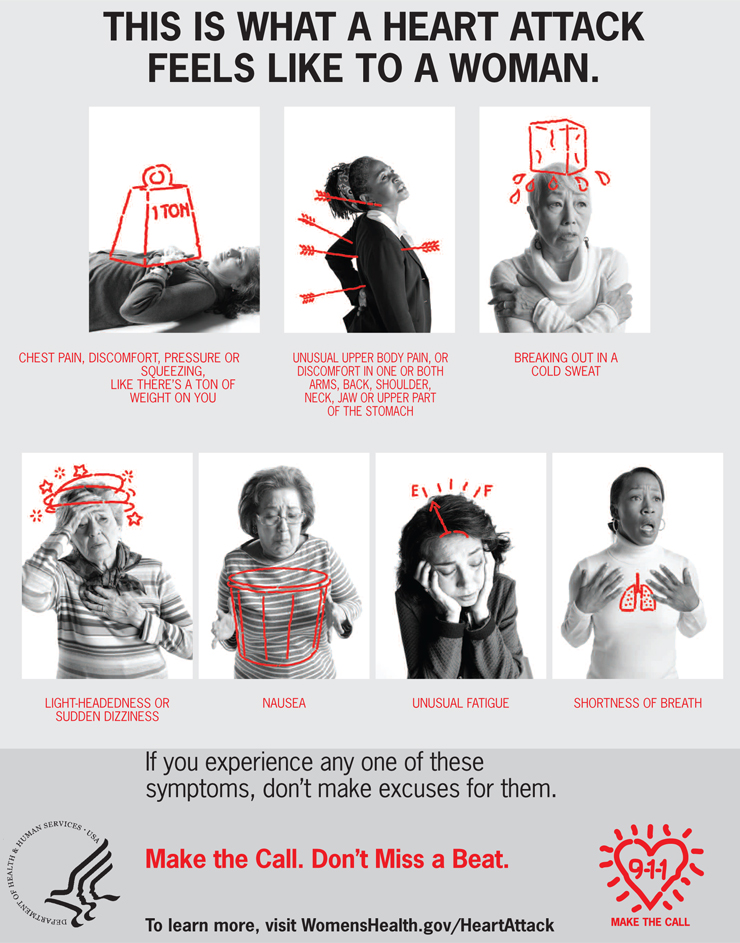
Heart attacks symptoms are different for women. I recently learned this. 


veggiebaker:

Everyone should know these things.


131-di:

thanks to mainstream media and being unable to show breasts on TV, way too few people know about female signs of cardiac distress, and impending heart attacks. they only know about the “pain in the left arm” male symptom.


lockrocksandcoke:

i had all these symptoms once and they sent me right to hospital

it was scary bc i didnt know these were the symptoms for female heart issues


dewgonair:

Please, please, PLEASE, reblog this. i don’t know if I did save or called false alarm, with my boss’ life tonight. I felt I was being a bit paranoid, overreacting, but I told Mirage my thoughts and he, after reading over the article I showed him, immediately sprung into action and then shooed her off to the hospital. I don’t know if I did or not, but I knew she’d been super stressed. She’d off-handedly commented on her arm tingling and I asked her if she felt queasy on a hunch. I went to look at the symptoms and we went from there.


francsforthememories:

Holy shit, I didn’t even think the symptoms would be different between men and women. This is so hugely important and I don’t understand why we aren’t taught this. 


moonblossom:

One of the other symptoms that doesn’t get talked about , especially in women, is a “feeling of impending doom”. I am not even kidding, that is a legitimate diagnostic criteria.

Please – if you are feeling any of these symptoms and a sudden onset of “Holy shit the world is ending” do not let anyone tell you it’s “just nerves” or “just heartburn” or something.


ursulavernon:

Buddy of mine having a minor cardiac episode DID get eventual left arm pain—but she got jaw pain first and shortness of breath. Pay attention!

Worth noting that even if you focus on cis people, heart attack symptoms don’t divide up neatly into “male” and “female”. These are symptoms disproportionately experienced by women, but be wary of them no matter what your reproductive phenotype. Conversely, be wary of the “male” symptoms regardless of phenotype.

The website listed on the infographic acknowledges this, using phrases like “women are more likely than men to” and “women are twice as likely as men to”, but I figure not everyone will look at the website.

(Does anyone else think they shouldn’t have said “any one of these symptoms” about a list including nausea? It seems like a pretty bad idea to treat every bout of nausea like it could be a heart attack.)


Tags:

#heart attack #the more you know