I Went to Disney World

{{previous post in sequence}}


{{Title link: https://www.theatlantic.com/culture/archive/2020/07/disney-world-during-pandemic-extremely-weird/614617/ }}

{{OP by bambamramfan}}

brin-bellway:

jadagul:

brin-bellway:

jadagul:

This article is amazing and wonderful.

I can’t trust any take on Disney from someone so clearly ignorant of what he’s talking about that he can say this with a straight face:

That is because in normal times you must choose perhaps four or five big rides, each lasting mere minutes, and spend hours waiting in line to be admitted to each.

Dude, just showing up at a major Disney ride and expecting to be seated is like just showing up at a fancy restaurant and expecting to be seated: in both cases *you are supposed to make a reservation*. When I went in the autumn of 2015, ride reservations (“FastPasses”) were quite flexible (one-hour usage window) and very often available on a same-day basis: while we *had* reservations months in advance, we made last-minute adjustments to them pretty much every day (you can do this on your phone, thanks to the complimentary Wi-Fi [link]).

(Also a part of me is going “you’re complaining about how expensive everything is and yet you stayed at the fucking *Contemporary*??”, while another part goes “why did the Atlantic send some poor dude with a COVID-19-naive immune system to fucking *Florida*? they’re a bunch of Americans in the summer of 2020: did they *seriously* not have anybody who’d had it already that they could send instead?”)

Still, it’s interesting to hear some reporting from the field. Just…with some caveats.

That is all relatively recent, though. Fastpass was introduced in 1999; I definitely remember the process he describes from when I was growing up. And the author is of course describing how Disney “usually” is off of secondhand reports, since he’s never been before.

But yeah, the article is great as a description of how Disney is now. And the observations about it as being part of the American civic religion aren’t original but they are fairly good points.

I *suppose* you could call 21 years relatively recent compared to the total span of Disney World’s existence, but it’s simultaneously a long time.

I guess a generational thing does add another layer to the bit about his parents refusing to go there: *I* grew up hearing Dad complain about “standing in line for hours for every five minutes of ride” as the reason he refused to go to *Six Flags*, and perhaps even specifically as a reason why Disney was better than Six Flags.

(A bit of context: I was born in 1993 to a family that *was* upper-middle-class at the time and a mom that loves Disney World. I’ve been five times: 1998, 2000, 2001 (we were there on 9/11, it was a hell of a thing), 2004, and 2015. Our trips were generally around 1.5 – 2 weeks long: trying to cram everything into a long weekend is a recipe for exhaustion and FOMO.)

In additional to the description of how things were going on the ground, I thought the bits about the Disney World government having legitimacy in the eyes of its constituents, in a way the American government does not, were an interesting way of looking at it.

P.S. Oh, also we homeschooled, which meant we could arrange to go during the school year (usually in autumn, sometimes winter). So come to think of it, that’s another reason why my experience of Disney would paint it as less crowded (and with less miserable weather!) than many people claim.

(Florida in the autumn is basically the same as New Jersey in the summer: my body was already adapted to that temperature and humidity range in general, and in most cases had the advantage of having *recently used* said adaptations (since New Jersey summer had only just ended). (Though in 2015, when I’d spent the last eight years in Canada, I was pleasantly surprised by how intact my heat tolerance was. My body walked out of the airport into the 95F-and-very-humid dusk, went “Oh hey, it’s summer! I remember summer! I haven’t had summer in *years*!”, flicked a few settings, and happily continued on its way.))


Tags:

#reply via reblog #my childhood #Disney #politics cw #illness tw #home of the brave #covid19 #homeschool #weather

{{next post in sequence}}

naxzella:

finding out people dont usually add numbers by first adding something to make a ten (for example 7+6= 7 plus 3 is 10 plus another 3 is 13) & that its actually an adhd thing is the WILDEST shit literally ive lived like 10 years (or however old i was when i learned to add and stuff) thinking thats how everyone does it. what the fuck


cabronallorona:

What


overherewiththequeers:

It’s also an autism thing, apparently.


teaboot:

W H A T


leap-yeap:

Oh yeah! This is also part of why autistic people/people with adhd struggle in math classes. Our brains process math and numbers in a totally different way. Many people on the spectrum struggle with the “show your work” part of math because we can’t exactly tell you why it works/how it works. We just kinda do it


black-infinity-parked-outside:

It’s also a maths dyslexia thing!


maryellencarter:

So I don’t innately do this but I was taught to do it? Now I’m really confused.

(I wonder if a disproportionate number of people who homeschool for primarily religious reasons, and/or of the people who create curricula marketed to that audience, are autistic or ADHD or otherwise neurodivergent. It would sure explain the absolute scathing scorn for the idea that children need “socialization”, and possibly the popularity of theme-integrated “unit studies” and self-directed “unschooling”… and it could evolve pretty easily by those originally being the kids who did a *lot* better homeschooled than in public schools… hmm.)

(Every so often I circle back around to the question of whether any of the things that make me think I’m autistic are inborn or whether they all come from my upbringing. Because my sperm donor is definitely autistic and also an abusive asshole, and my bio-incubator may be autistic or ADHD or something else along those lines but by *god* does she have the executive dysfunction in spades. And they’re both controlling as fuck. So the only way to socialize Correctly was his way, and the only way to get anything done was her way, and given childhood neuroplasticity… does it really matter if I was born autistic or whatever I am? Am I just irreversibly whatever-it-is now and I should be learning to work with it, or am I accidentally meandering back toward neurotypicality (and what does that mean for my online friendships if so), or was I actually neurodivergent all along and it’s just the extroversion confusing me? :P)

Not sure about fundies as such, but FWIW I was in secular homeschool groups (though this included a fair number of relatively laid-back religious types who didn’t mind hanging out with the rest of us) and they were very autistic. And they got distilled to increasingly high concentrations of autism the older they got, because allistics were a lot more likely to leave for public school. Groups of homeschooled teenagers tended to be upwards of 50% autistic, and a lot of the rest had autistic siblings.

The method of addition described in the OP is implicitly being contrasted with some “normal” way, and I’m curious what that normal way actually is. Anyone know?


Tags:

#autism #homeschool #my childhood #is the blue I see the same as the blue you see #abuse cw #math #reply via reblog


{{next post in sequence}}

{{previous post in sequence}}


sinesalvatorem:

brin-bellway:

I can’t remember now who it was (I know @sinesalvatorem has been talking about school lately, but I think it was before that) who was talking about the overly large grip the school system has on society, and gave the example of how “what grade are you in?” is often used instead of “how old are you?”. I was thinking this morning* about that, about my own attempts to navigate the dreaded “what grade are you in” question as a homeschooled child.

At first, when I was very young, I would just freeze in confusion. I had no idea what they wanted from me.

Eventually I learned it was a weirdly convoluted way of asking for my age. I didn’t think in grades, I thought in years. Sometimes, if I could remember the age–>grade translation algorithm well enough (it was hard to keep straight even at the best of times), I would translate for them. Other times I would try to cut to the point and give them my age in years. (Occasionally I’d get persistent people who would keep asking for a grade after being told an age. Usually I tried to explain that that’s not generally a meaningful question when you’re homeschooled**, either in that abstract way or–if I could remember the grade levels involved–saying things like “well, my math and history textbooks are designed for Xth grade, my spelling workbook for Zth grade, my writing textbook for Wth grade…”)

This all got worse after I moved to Canada, because it turns out that by Canadian standards I was born on a different side of the school birthday cutoff. While homeschooled grade levels are, as I said earlier, generally flexible, my parents had taken the lead of the American school system and started me on a kindergarten program at the same time I would have started public kindergarten, shortly before I turned six. While the grade levels of my textbooks soon diversified according to my abilities, there was a rough trajectory based on this starting point. In Canada, the birthday cutoff is in December instead of September, and a Canadian kindergarten would have wanted me shortly before I turned five.

There was no simple translation anymore, not even at the best of times. If I told them my grade, they would think of me as younger than I was. If I told them my age, they would think of me as older than I was. If I told them both, they would think to themselves “ah, she was held back a grade”, lower their estimation of my intelligence, and view me through that lens.

In an attempt to avoid all of these outcomes, I started to use longer explanations more often. For a couple of years in my mid-teens, the explanations began with “I lost count at 9th grade”, because frankly I had. I didn’t bother trying to get a grip on it again; what would it help if I were going to have to do the whole explanation anyway?

When I joined Girl Guides, soon after moving, I was placed by grade. I was placed according to the grade I was “actually in”, not the grade I “would have been in” if I’d been raised in Canada. I was a year older than people expected of me, and it tripped them up, especially in my last year after I reached age of majority.

(”You forgot the ‘parent or guardian signature’ bit on this form.”

“I’m eighteen. I am my guardian.”

“Oh, right.”)

This sort of thing seems to be a common problem across a lot of people whose lives are weird in some way. Somebody asks you what they think is a simple question, expecting a simple answer, and you’re like “oh god, do I lie? do I say something technically true but highly misleading? do I dodge the question? do I give a short answer with lots of implied weirdness*** that raises more questions than it solves? do I launch into an explanation of why [it’s not a meaningful question]/[it’s more complicated than that]?”

*An hour before waking-up time, goddammit brain.

**Sometimes you get homeschoolers who try to be very rigid and follow a strict grade system, but most of them loosen up before long and the ones who don’t are considered kind of weird.

***Example: “I’m on vacation between Xth and Yth grades,” says a child in October.

This sort of thing seems to be a common problem across a lot of people whose lives are weird in some way. Somebody asks you what they think is a simple question, expecting a simple answer, and you’re like “oh god, do I lie? do I say something technically true but highly misleading? do I dodge the question? do I give a short answer with lots of implied weirdness that raises more questions than it solves? do I launch into an explanation of why [it’s not a meaningful question]/[it’s more complicated than that]?”

I have this problem whenever someone asks me my name, because I have to look down at my clothes to figure out which name to use.

I also stumble whenever I’m asked my age, because my brain uses strong typing, and while words are sounds, numbers are pictures, which means I have to spend a lot of processing time just figuring out which sounds to make if I want to say a number. It also means numbers written in words are hard to parse.

Luckily, people rarely ask what grade you’re in in my culture. Although, the last time someone did ask me that, I said “Well, last month I dropped out of grad school…”

(see also this other branch I was in)


Tags:

#(October 2016) #conversational aglets #homeschool

{{previous post in sequence}}


ophiuchusdenied:

brin-bellway:

ophiuchusdenied:

oh, and you can get detention if you refuse to say the pledge at some schools.  or at least get scolded by your teacher, get your parents called, or be socially ostracised.  all because you refuse to swear fealty to a piece of fabric as a daily ritual.

How do they know if you refuse to say the pledge?

Being homeschooled, my first exposure to routine Pledging was when I tagged along at my little brother’s Cub Scout meetings. By which time I was nearly eleven, had read Guardians of Ga’Hoole, and therefore knew how to look like I was taking part in a group chant without actually doing so.

(Yes, that does mean not Taking a Stand, but I personally think one should not Take a Stand against brainwashing cults until after one has escaped them. And I was still slightly too young, by my parents’ standards, to stay home by myself on a regular basis. (Mom was helping out with them, so I couldn’t stay home with her.))

in smaller classrooms, it’s hard to get away with pretending, especially if you’re with a teacher who knows you/your voice or if you’re in the front row.  at assemblies, it’s obvs easier, but we had to say it in our first period class or homeroom (depending on grade), and being a C, alphabetically, and something of a teacher’s pet, i was usually on the first row anyway.  besides which, to me, standing up and mouthing along is basically the same thing as actually saying it–ymmv, of course, and if that’s not how you view it, that’s totally cool.

usually, though, in my schools at least, you get caught because you just plain don’t stand up.  it’s continue-reading-your-book-for-the-duration-of-announcements-time.  luckily, in high school, my first period class for all three years was choir, and i was not the only person who refused to say it, and our choir director was live-and-let-live enough that he wasn’t about to send a handful of his best students to detention over it.

(this thread was truncated; here is the first part)


Tags:

#(this is from later in October 2013) #conversational aglets #home of the brave #homeschool #cult cw

{{previous post in sequence}}


While I’m on the subject of alternate education methods having fewer obstacles than you might think, here is an example of how a homeschooler goes on field trips:

Mom: *looking at local teacher resources on the Internet*

Resources: Try taking your class for a tour at the nearby widget factory! They do tours for Grades 5 – 12, with a minimum class size of 10, and it’s only $5/student!

Mom: Hey kids, you want to tour a widget factory?

Me: Yeah!

Brother: Sure.

Mom, emailing the field-trip-coordination mailing list: Hey guys, if I can get at least 10 kids aged 10 and up together, I’ll call the widget factory and schedule a tour. Preliminary date is the second Thursday of next month. Cost is $5/kid, paid to me when you get there so I can pay for the group. I’ve already got two signed up. Who’s with me?

Parent: I’ve got three kids for the list!

Other parent: My 12-year-old’s not interested, but the 14-year-old will go.

[etc]

[second Thursday of next month]

Tour guide: Okay kids, time to settle down and at least pretend to listen to the spiel–wait. You’re already settled down, and you appear to be *actually* listening to the spiel. Huh. It’s almost like you wanted to be here.

Kids who wanted to be here: :D

Kids who didn’t want to be here: *at home, reading biology textbook*


Tags:

#seriously we got so many comments from tour guides surprised that the kids actually gave a shit about the tour #oh look an original post #homeschool #my childhood #there are *occasional* places that won’t deal with anyone but an Official School #but most places that do stuff for schools are open to homeschool groups as long as you designate one parent as the liaison #I went to a lot of tours and art workshops and cooking classes #almost every week sometimes #(the parents generally tried to spread things out so that there weren’t *multiple* trips for the same age in the same week) #the more you know

sinesalvatorem:

sinesalvatorem:

allthingslinguistic:

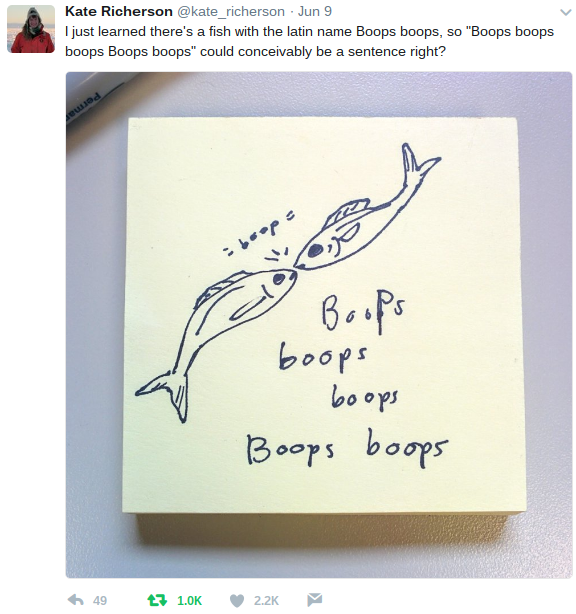
Boops boops Boops boops boops boops Boops boops is the new Buffalo buffalo Buffalo buffalo buffalo buffalo Buffalo buffalo.

@endecision@lethriloth, and @ other roommates with no Tumblrs.

Oh, actually, this is a good place to get survey data on an interesting question of linguistics. Could as many people as possible please take this survey on whether certain constructions seem grammatical to you so I can answer a problem that’s been bugging my household.

I’m not sure whether “homeschooled with English-language schoolbooks by a native-English-speaking mother” qualifies as “>10 years in an English-language school system” for your purposes. I clicked “no”, because normally when people ask me if I’ve spent >10 years in a school system the correct answer is “no”, but now I’m having second thoughts.


Tags:

#reply via reblog #survey #signal boost #homeschool

{{previous post in sequence}}


snowwhiteandhisworldofglass:

justice-turtle:

brin-bellway:

I can’t remember now who it was (I know @sinesalvatorem has been talking about school lately, but I think it was before that) who was talking about the overly large grip the school system has on society, and gave the example of how “what grade are you in?” is often used instead of “how old are you?”. I was thinking this morning* about that, about my own attempts to navigate the dreaded “what grade are you in” question as a homeschooled child.

At first, when I was very young, I would just freeze in confusion. I had no idea what they wanted from me.

Eventually I learned it was a weirdly convoluted way of asking for my age. I didn’t think in grades, I thought in years. Sometimes, if I could remember the age–>grade translation algorithm well enough (it was hard to keep straight even at the best of times), I would translate for them. Other times I would try to cut to the point and give them my age in years. (Occasionally I’d get persistent people who would keep asking for a grade after being told an age. Usually I tried to explain that that’s not generally a meaningful question when you’re homeschooled**, either in that abstract way or–if I could remember the grade levels involved–saying things like “well, my math and history textbooks are designed for Xth grade, my spelling workbook for Zth grade, my writing textbook for Wth grade…”)

This all got worse after I moved to Canada, because it turns out that by Canadian standards I was born on a different side of the school birthday cutoff. While homeschooled grade levels are, as I said earlier, generally flexible, my parents had taken the lead of the American school system and started me on a kindergarten program at the same time I would have started public kindergarten, shortly before I turned six. While the grade levels of my textbooks soon diversified according to my abilities, there was a rough trajectory based on this starting point. In Canada, the birthday cutoff is in December instead of September, and a Canadian kindergarten would have wanted me shortly before I turned five.

There was no simple translation anymore, not even at the best of times. If I told them my grade, they would think of me as younger than I was. If I told them my age, they would think of me as older than I was. If I told them both, they would think to themselves “ah, she was held back a grade”, lower their estimation of my intelligence, and view me through that lens.

In an attempt to avoid all of these outcomes, I started to use longer explanations more often. For a couple of years in my mid-teens, the explanations began with “I lost count at 9th grade”, because frankly I had. I didn’t bother trying to get a grip on it again; what would it help if I were going to have to do the whole explanation anyway?

When I joined Girl Guides, soon after moving, I was placed by grade. I was placed according to the grade I was “actually in”, not the grade I “would have been in” if I’d been raised in Canada. I was a year older than people expected of me, and it tripped them up, especially in my last year after I reached age of majority.

(”You forgot the ‘parent or guardian signature’ bit on this form.”

“I’m eighteen. I am my guardian.”

“Oh, right.”)

This sort of thing seems to be a common problem across a lot of people whose lives are weird in some way. Somebody asks you what they think is a simple question, expecting a simple answer, and you’re like “oh god, do I lie? do I say something technically true but highly misleading? do I dodge the question? do I give a short answer with lots of implied weirdness*** that raises more questions than it solves? do I launch into an explanation of why [it’s not a meaningful question]/[it’s more complicated than that]?”

*An hour before waking-up time, goddammit brain.

**Sometimes you get homeschoolers who try to be very rigid and follow a strict grade system, but most of them loosen up before long and the ones who don’t are considered kind of weird.

***Example: “I’m on vacation between Xth and Yth grades,” says a child in October.

“ This sort of thing seems to be a common problem across a lot of people whose lives are weird in some way. Somebody asks you what they think is a simple question, expecting a simple answer, and you’re like “oh god, do I lie? do I say something technically true but highly misleading? do I dodge the question? do I give a short answer with lots of implied weirdness*** that raises more questions than it solves? do I launch into an explanation of why [it’s not a meaningful question]/[it’s more complicated than that]?” ”

aka brin summarizes MY ENTIRE LIFE ;P

OH MY GOD!!! so I feel this on a deep emotional level!!! Like I’ve been homeschooled my whole life and while I managed to keep track of my grade (because of church Sunday school) I eventually just started saying something along the lines of “well so age wise I’m a (insert grade here) but actual school wise I’m like (insert higher grade level here) in (this or that subject) and (whole other grade level) in (this or that subject)
As I reached high school I started just going by my hs grade because while I was doing entirely college level stuff I just started giving people the answer they were looking for (i.e. How many years into the awkward adult limbo stage are you?) it’s always confused teachers that I’ve worked with a lot who don’t have a grasp on how weird and wobbly homeschooling is compared with how structured “normal school” is.

*fistbump*

High school grades are even worse because they also have names. Like, “freshman” means 9th grade and “senior” means 12th grade, okay sure I guess, but I could never keep “sophomore” and “junior” straight. (Unless I actively had Wikipedia open in front of me, but unfortunately you’re usually not allowed to do that in offline conversations.) In high school, even on those occasions I couldn’t dodge the grade question, I tried very hard to go by number and avoid dealing with those damned confusing names.

@justice-turtle

ngl, I was thinking of you when I wrote that bit


Tags:

#reply via reblog #homeschool


{{next post in sequence}}

{{previous post in sequence}}


And the number of people who thought a family bedtime of 2 AM was inherently abusive, because it would leave me chronically extremely sleep-deprived in order to get up for school on time the next morning. And I’m like “dude no, I just sleep until like 12 and do schoolwork in the afternoon, it’s fine”. And they’re like “school starting in afternoon?? does not compute”.

In my family when I was a kid, grocery shopping was a group effort, and we often went as late as 11 PM. I liked going grocery shopping, especially when I learned during a Girl Scout field trip to the grocery store how utterly lacking in grocery-shopping experience the other kids were and how incompetent this had left them, but dear god did we get a lot of Looks and a significant number of Questions when people saw two young children out and about that late.


Tags:

#this started as a tag ramble on the previous post #but I decided to split it off #you can still kind of see a bit of tag-register influence on the first paragraph #oh look an original post #homeschool #(I’ve shifted my sleep schedule back somewhat these days)

I can’t remember now who it was (I know @sinesalvatorem has been talking about school lately, but I think it was before that) who was talking about the overly large grip the school system has on society, and gave the example of how “what grade are you in?” is often used instead of “how old are you?”. I was thinking this morning* about that, about my own attempts to navigate the dreaded “what grade are you in” question as a homeschooled child.

At first, when I was very young, I would just freeze in confusion. I had no idea what they wanted from me.

Eventually I learned it was a weirdly convoluted way of asking for my age. I didn’t think in grades, I thought in years. Sometimes, if I could remember the age–>grade translation algorithm well enough (it was hard to keep straight even at the best of times), I would translate for them. Other times I would try to cut to the point and give them my age in years. (Occasionally I’d get persistent people who would keep asking for a grade after being told an age. Usually I tried to explain that that’s not generally a meaningful question when you’re homeschooled**, either in that abstract way or–if I could remember the grade levels involved–saying things like “well, my math and history textbooks are designed for Xth grade, my spelling workbook for Zth grade, my writing textbook for Wth grade…”)

This all got worse after I moved to Canada, because it turns out that by Canadian standards I was born on a different side of the school birthday cutoff. While homeschooled grade levels are, as I said earlier, generally flexible, my parents had taken the lead of the American school system and started me on a kindergarten program at the same time I would have started public kindergarten, shortly before I turned six. While the grade levels of my textbooks soon diversified according to my abilities, there was a rough trajectory based on this starting point. In Canada, the birthday cutoff is in December instead of September, and a Canadian kindergarten would have wanted me shortly before I turned five.

There was no simple translation anymore, not even at the best of times. If I told them my grade, they would think of me as younger than I was. If I told them my age, they would think of me as older than I was. If I told them both, they would think to themselves “ah, she was held back a grade”, lower their estimation of my intelligence, and view me through that lens.

In an attempt to avoid all of these outcomes, I started to use longer explanations more often. For a couple of years in my mid-teens, the explanations began with “I lost count at 9th grade”, because frankly I had. I didn’t bother trying to get a grip on it again; what would it help if I were going to have to do the whole explanation anyway?

When I joined Girl Guides, soon after moving, I was placed by grade. I was placed according to the grade I was “actually in”, not the grade I “would have been in” if I’d been raised in Canada. I was a year older than people expected of me, and it tripped them up, especially in my last year after I reached age of majority.

(”You forgot the ‘parent or guardian signature’ bit on this form.”

“I’m eighteen. I am my guardian.”

“Oh, right.”)

This sort of thing seems to be a common problem across a lot of people whose lives are weird in some way. Somebody asks you what they think is a simple question, expecting a simple answer, and you’re like “oh god, do I lie? do I say something technically true but highly misleading? do I dodge the question? do I give a short answer with lots of implied weirdness*** that raises more questions than it solves? do I launch into an explanation of why [it’s not a meaningful question]/[it’s more complicated than that]?”

*An hour before waking-up time, goddammit brain.

**Sometimes you get homeschoolers who try to be very rigid and follow a strict grade system, but most of them loosen up before long and the ones who don’t are considered kind of weird.

***Example: “I’m on vacation between Xth and Yth grades,” says a child in October.


Tags:

#oh look an original post #our home and cherished land #I should probably get a homeschooling tag #I’ll go for something obvious #homeschool


{{next post in sequence, branch 1}}

{{next post in sequence, branch 2}}

{{previous post in sequence}}


rendakuenthusiast:

chroniclesofrettek:

inquisitivefeminist:

brin-bellway:

sinesalvatorem:

I just watched Mean Girls! Damn, that movie is so Problematic I love it.

Mean Girls confuses me greatly.

It seemed to me like standard pro-homeschool propaganda, though with a bittersweet ending tacked on over the usual bad ending. It’s the cautionary tales homeschoolers tell each other, converted to movie format.

A movie like that is inherently niche: it can’t have mainstream appeal because the mainstream itself is the villain.

I watched it at a party with a group of public schoolers once, and I was boggled that they liked it. A movie that hated them, that called them animals (and not in the technical sense), and yet they were enjoying it.

Is this that “you aren’t stuck in traffic, you are traffic” thing? Nobody’s bothered by anti-public-schooler sentiment because everyone thinks of themselves as not counting, that the sentiment is directed at all those other people?

(Or maybe I was supposed to pattern-match it to Relatable Stories Reminding Me of My Own Life, and enjoy it on that level? But since I never went to public school, the thing in my life it best pattern-matched to was propaganda rather than personal experience, completely changing my perception of the film?)

What strikes you as homeschool propaganda, the thing where Cady is Corrupted By Popularity and ends up changing her whole personality?  Or the thing where the movie talks about how High School Is Like A Jungle/otherwise terrible?  Because both of those are very common teen movie tropes, and I’m curious if you’d react in a similar way to similar movies.

The first five minutes were a brutally realistic depiction of high school instead of the more tropey version I’m used to. Sort of like the opening of Saving Private Ryan vs a more conventional war movie. 

I went to a heavily academically-focused private high school so maybe the dynamics were different from a public school. But I mostly took the movie to be about cliques of people that weren’t mine, and really mostly about things girls did that boys didn’t do. So yeah, I pretty much didn’t think I counted, as far as the movie being about people like me. I also didn’t really like or identify with the movie, although I didn’t think it was terrible either.

You know what bugged me about mean girls? They never said where specifically in Africa they were from. Even though they make jokes about this themselves.

(I tried to fit all of my responses to this thread in the last post, but I saw another branch I wanted to respond to.)

It’s been a while since the last time I saw it, so maybe this doesn’t fit in with the canon, but I thought they weren’t from anywhere specific in Africa. Rather, they travelled around a lot within the continent. Wasn’t that why she was homeschooled, because they never settled down anywhere long enough for her to attend a school?

(I don’t know, maybe I just filled in the blanks from having occasionally met people who were homeschooled because their family was too nomadic to do otherwise.)


Tags:

#reply via reblog #Mean Girls