jtotheizzoe:

smithsonianlibraries:

In the wee hours of Wednesday morning, North America, Australia, western Asia and most of the Pacific Ocean will be treated to a full lunar eclipse in which the moon takes on a reddish hue as it passes through the Earth’s shadow.

We borrowed this moon image from The moon hoax, or a discovery that the moon has a vast population of human beings, an 1859 book that compiled the original six articles published in The Sun in 1835. A century before H.G. Wells’s The War of the Worlds induced panic about a Martian invasion of New Jersey, these six articles helped grow The Sun’s readership dramatically and establish it as a major New York newspaper. Read more about the fascinating history of The Great Moon Hoax on our blog. Rather listen to a podcast? The memory palace has an episode that might be of interest.

Eyes to the sky tonight!


Tags:

#lunar eclipse #PSA #history

The Article That Inspired Steve Jobs: “Secrets of the Little Blue Box”

{{Title link: http://www.slate.com/articles/technology/the_spectator/2011/10/the_article_that_inspired_steve_jobs_secrets_of_the_little_blue_.single.html }}

A fascinating longread about the “phone phreaks”, a subculture that sprang up around the hacking of phone networks.

I find that reading material about mid-late 20th-century history is hard to come by: it’s recent enough that a lot of people don’t think of it as “history”, so they don’t talk about it when they talk about history, and it doesn’t really come up in much detail otherwise. Here’s a piece of that history that I thought you deserved to see.

(Hat tip to Mark E., a fellow student in my introductory computer-science course who linked to this in the course’s official forum.)


Tags:

#oh look an original post #history #recs #(sorry about it being hosted on Slate) #(but you can’t have everything)

trailofdesire:

dispatchrabbi:

crime-and-puns:

*sets entire english language on fire*

So this is actually a half-cool half-frustrating phenomenon called a cran morpheme.

Cran morphemes are morphemes that don’t have a meaning outside of the thing they designate. The ur-example, of course, is cranberry. Unlike blueberry (blue + berry), where the first morpheme is somewhat descriptive of the actual berry itself (blueberries are, after all, blueish), the cran- in cranberry doesn’t give you any more help than “this designates the type of berry we call cranberries”. The snozz- of snozzberry is similar.

It is true that cran- comes eventually from “crane” and that cranberries might have been named that because cranes ate them or something, but appealing to this invokes the etymological fallacy. That is, no one who uses or learns the word today thinks of cranes when they talk about cranberries. (Etymologists, lexicographers, and linguists don’t count as native speakers, as usual.)

Even so, the etymology doesn’t help us here, because the word that the cuttle- of cuttlefish comes from just means “cuttlefish” anyway. It’s cuttles all the way down.

The most important question to me is, can I call them cudelefish to emphasize their cuddliness?

It’s like that urban legend of Hillhillhill Hill.


Tags:

#language

queenofgnarnia:

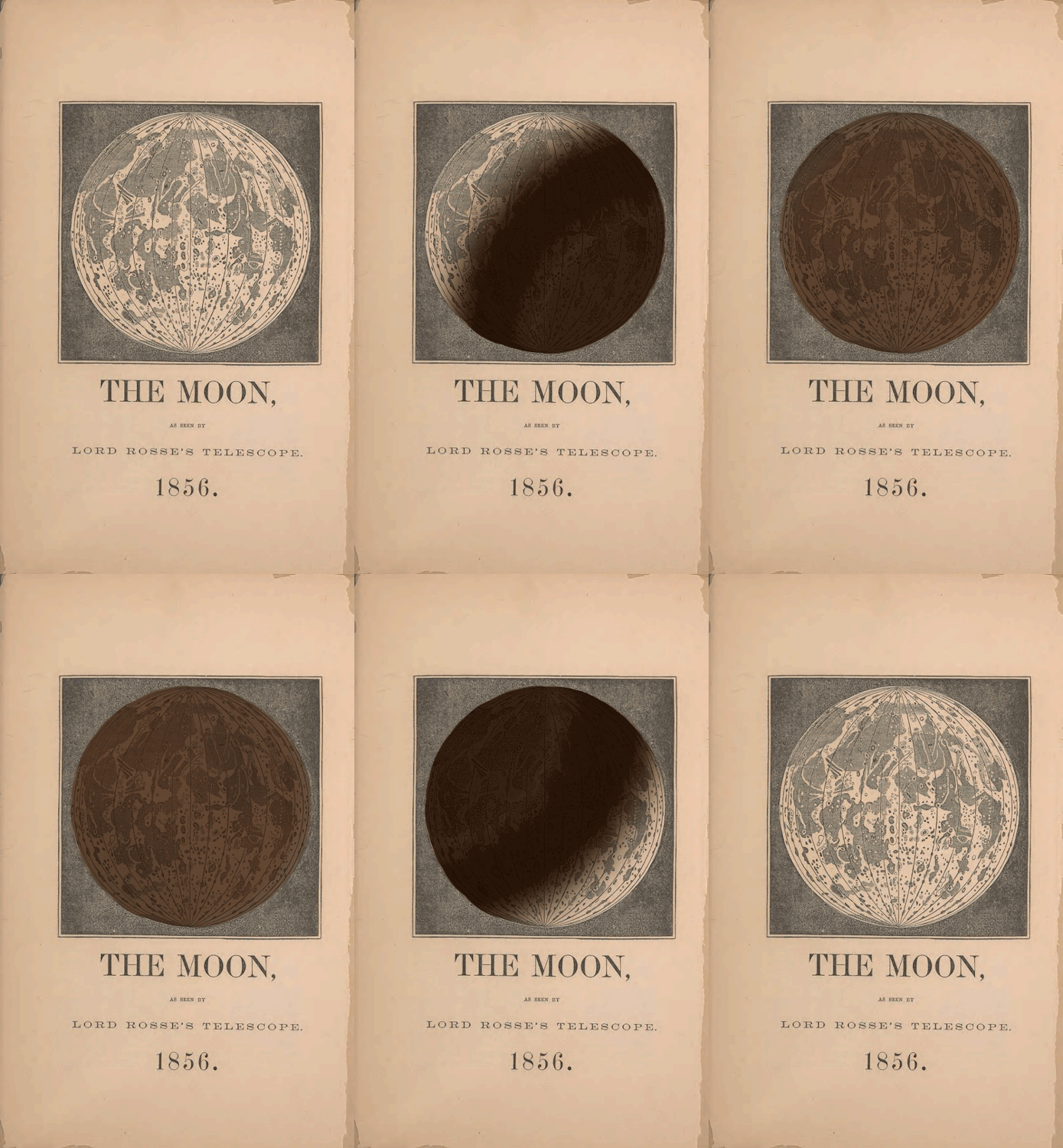
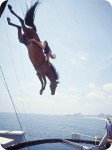
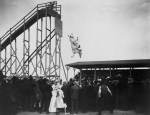
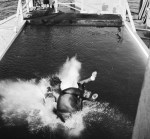
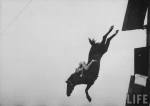
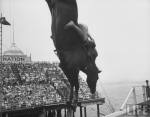
Horse diving. The eerie, bizarre old pastime that some how manages to sustain a sense of beauty.


theeventingblog:

Wasnt there a blind girl who did this? I thought someone said there was a movie or something about her…


wishhunter:

Yes there was a movie about her and her blind horse


equitating:

She lost her sight diving!


train-to-win:

Anyone know the name of the the movie? That would be interesting to see. I can’t believe people did this and got horses to do it, scary as fuck


fromthehaunches:

the movie is Wild Hearts Can’t Be Broken


equestrianchicpoverty:

what the actual fuck? how does one train a horse to jump off that high of a cliff? did the eventers start this? how many people died? i am so interested.


fivegaited:

Wild Hearts Can’t Be Broken is one of my favorite movies


lusitanoqueen:

i feel like i’m the only one who disapproves of making horses jump into water from that great of a height … even if they’re trained it must have been terrifying and i can only imagine the kind of injuries horses sustained


fivegaited:

Oh no, I think we all disapprove.  I sincerely doubt anyone is reblogging this thinking, “hey, let’s bring horse diving back!”  I hope, at least, that we’re all pretty glad to see this be a thing of the past, but we can still admire the bravery of the girls and the horses – if you watch the old videos, it’s pretty cool how the horses ran up the ramps at liberty and leapt off.  I’ve done some research on this, and from what i can tell, there are no recorded horse injuries.  The statistics I’ve found showed that the girls  broke bones pretty much annually, but everything I’ve ever read says there were zero horse injuries.  Of course, just because they weren’t recorded doesn’t mean they didn’t happen.  Probably they did, but tbh… I think a lot more horses get hurt in the show jumping ring and on cross country courses every year than ever got hurt doing this.  Horses die on cross country every year, and on the racetrack.  Once the horses were trained and knew the routine, I kind of doubt it would be more terrifying than any of the other dangerous and unnatural things we ask horses to do – like running around with humans clinging to their backs, letting people shoot guns from their backs, chasing cows with big giant horns, jumping over ditches and into water on cross country courses… I have no idea how they trained for this and it wouldn’t surprise me if it was pretty aversive and possibly downright cruel training (a lot of american horse training back then was), but I also have no doubt that a horse could be taught to do this, and to do it eagerly, using positive reenforcement – and some of what I’ve read claims they DID train with food rewards, at least in part – here’s one testimony from a former diving girl:

They went when they were ready. I can’t say the groom would not try to encourage the horse a little bit by gently nudging or pushing, but he wouldn’t dare do anything drastic. That would have upset me to no end. I wouldn’t want to be on a horse that was agitated. My life depended on that horse doing that in a calm way, so there was no electrical devices or trap doors or anything like that during my time.

Lorga (another diving horse) did take a long time. I remember Lorena Carver saying ‘Come,’ with carrots in her hand. But you waited. Sometimes it was five minutes.

I would ride the horse until he got out of the tank. Lorena Carver would be standing on the stage of the tank and the horse knew to go to her, get his reward, and the blanket was thrown on quickly. That was the end of the act.

You [the customers] could go in the stalls, along the walkway towards the end of the Pier and in front of the Ballroom, and see the horses through glass panels and how they were kept and fed. They were very well kept. They would ride the horses on the beach in the morning and they loved to go in the water and run along the waves.
We didn’t keep them if they didn’t like the water. I would have noticed if there had been anything unkind because I love animals. They were never in any way hurt or disrespected. In fact, they were taken care of better than the riders were! The ASPCA gave us plaques of approval that were always on the dressing room wall. When Gene was in the show with me he’d bring me a towel, but the horse was the one that got the blanket! The horse was the star.”

Don’t get me wrong, I think diving is pretty damn unnecessary, super dangerous, and I’m very GLAD it’s pretty much a thing of the past.  But what bothers me more than the act itself, actually, is that the horses were kept stalled all the time and led lives on the road traveling in horse vans constantly – that’s a stressful and unhealthy life for any horse (even if the horses don’t know it), and it’s a life that plenty of show and race horses still lead today.  Anyway, I think this diving stuff was ballsy as hell and to me it’s a cool part of horsey history that I enjoy learning about.  I in no way advocate it today.  Sonora, the diving girl who went blind, wrote a book that’s a fun read if you’re interested in learning more.  This article is a fun, brief summary as well :)


Tags:

#horse #history #the more you know

completed-nihilism-blog:


Tags:

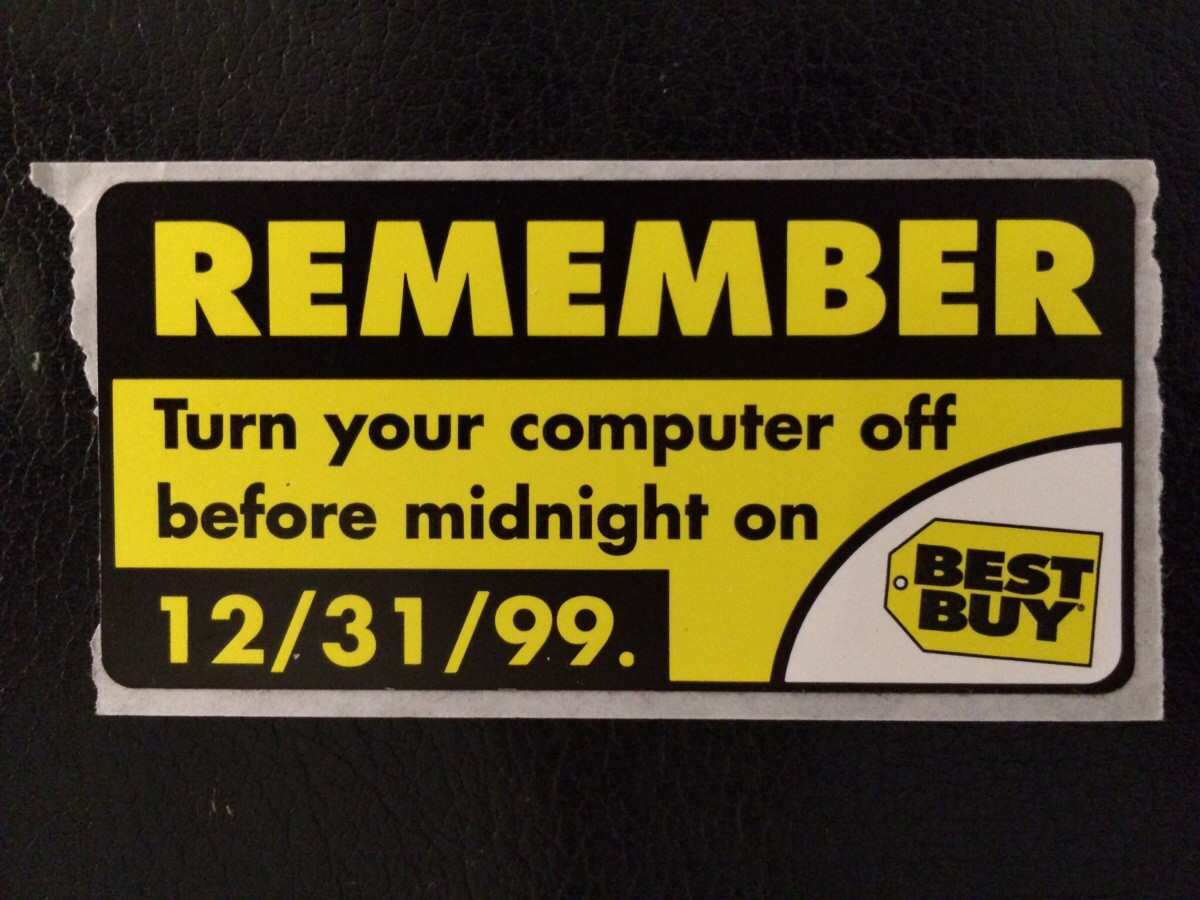
#Y2K #I very vaguely remember Y2K #(I was six) #but the main thing I think when I see this picture is #’there is *absolutely no* ambiguity in that date’ #’I wish *I* had dates with absolutely no ambiguity’ #’I can hardly wait for 2032′ #(‘is it bad that consistent date-writing is one of the things I miss most about America?’) #look dates are very important to me okay #tangents #in which Brin has a food poisoning phobia

neilcicierega:

bookshop:

solongasitswords:

nullbula:

thesylverlining:

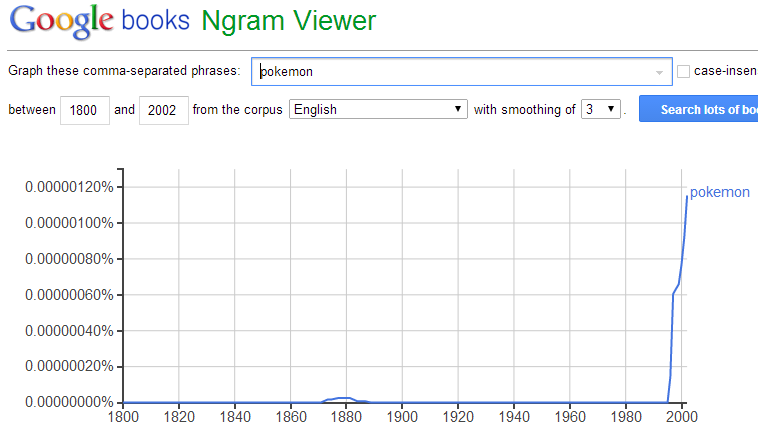
what happened in roughly 1870 though

why was there temporary internet

with a few people searching for pokemon?

It’s a search of Google books, but the question still stands, what the Fuck happened in 1870

I CAN ANSWER THIS!!

In the Cornish dialect of English, Pokemon meant ‘clumsy’ (pure coincidence).

In the mid 1800s there was a surge of writing about the Cornish language and dialect in an attempt to preserve them with glossaries and dictionaries being written. I wrote about it HERE.

zv236f

I just love that this post happened to find the ONE HUMAN ON THE INTERNET who had the answer to this question


Tags:

#duuuuude #history #language #the more you know


{{Original metadata:2014-07-15 - The 600-Year-Old Butt Song from Hell}}

feliscorvus:

lunar-lavender:

rayvenloaf:

chaoscontrolled123:

Luke and I were looking at Hieronymus Bosch’s painting The Garden of Earthly Delights and discovered, much to our amusement, music written upon the posterior of one of the many tortured denizens of the rightmost panel of the painting which is intended to represent Hell. I decided to transcribe it into modern notation, assuming the second line of the staff is C, as is common for chants of this era.

so yes this is LITERALLY the 600-years-old butt song from hell

I can’t NOT reblog a 600 year old butt song from Hell.

The 600 year old butt song from Hell is back on my dash! Happy day!

HEEEE.


Tags:

#Hieronymus Bosch #music #interesting

chead asked: hey what’s up with the “!” in fandoms? i.e. “fat!” just curious thaxxx <3

molly-ren:

I have asked this myself in the past and never gotten an answer.

Maybe today will be the day we are both finally enlightened.


molly-ren:

woodsgotweird said: man i just jumped on the bandwagon because i am a sheep. i have no idea where it came from and i ask myself this question all the time

Maybe someone made a typo and it just got out of hand?


stevita:

I kinda feel like panic!at the disco started the whole exclamation point thing and then it caught on around the internet, but maybe they got it from somewhere else, IDK.

The world may never know…


molly-ren:

Maybe it’s something mathematical?


michaelblume:

I’ve been in fandom since *about* when Panic! formed and the adjective!character thing was already going strong, pretty sure it predates them.


hosekisama:

It’s a way of referring to particular variations of (usually) a character — dark!Will, junkie!Sherlock, et cetera. I have suspected for a while that it originated from some archive system that didn’t accommodate spaces in its tags, so to make common interpretations/versions of the characters searchable, people started jamming the words together with an infix.

(Lately I’ve seen people use the ! notation when the suffix isn’t the full name, but is actually the second part of a common fandom portmanteau. This bothers me a lot but it happens, so it’s worth being aware of.)


nentuaby:

“Bang paths” (! is called a “bang”when not used for emphasis) were the first addressing scheme for email, before modern automatic routing was set up. If you wanted to write a mail to the Steve here in Engineering, you just wrote “Steve” in the to: field and the computer sent it to the local account named Steve. But if it was Steve over in the physics department you wrote it to phys!Steve; the computer sent it to the “phys” computer, which sent it in turn to the Steve account. To get Steve in the Art department over at NYU, you wrote NYU!art!Steve- your computer sends it to the NYU gateway computer sends it to the “art” computer sends it to the Steve account. Etc. (“Bang”s were just chosen because they were on the keyboard, not too visually noisy, and not used for a huge lot already).

It became pretty standard jargon, as I understand, to disambiguate when writing to other humans. First phys!Steve vs the Steve right next to you, just like you were taking to the machine, then getting looser (as jargon does) to reference, say, bearded!Steve vs bald!Steve.

So I’m guessing alternate character version tags probably came from that.


raincityruckus:

100% born of bang paths. fandom has be floating around on the internet for six seconds longer than there has been an internet so early users just used the jargon associated with the medium and since it’s a handy shorthand, we keep it.


xenophonique:

Because I’m in Bitter Old Fangirl Mode today, the fact that it took seven comments before someone explained bang paths upsets me greatly.


molly-ren:

Once you pass 1,000 notes, people start to get really annoyed about the fact that no one mentioned bang paths sooner (the above comment is actually one of the nicer ones).


Tags:

#duuuuude #the more you know #language #bang paths #history #it’s always great when stuff that’s ‘just one of those things’ turns out to have a traceable explanation