squareallworthy:

birth-muffins-death:

squareallworthy:

So anyways one inch tungsten cubes are bullshit. 25 mm, that would be fine, or 20 or even 30 mm. Sensible sizes for a cube of tungsten. But a one inch, that’s bullshit.

Compromise on a 25.4 mm cube?

Bullshit measured in metric units is still bullshit.


Tags:

#Me‚ clutching my 454g bag of flour and my 473mL carton of cream: you take that back #I *will* make delicious bilingual biscuits and you can*not* stop me #our home and cherished land #food mention #tungsten cubes #discourse cw?

3liza:

talking about flters and real beauty vs fake beauty and cultural standards etc always makes me think about all the victorian and edwardian novels i read, where the things that people thought about beauty were recorded at length. recently ive been reading a lot of Thomas Hardy (best known for Tess of the D’Urbervilles and Jude the Obscure) and there’s so much discussion of the beauty of people, particularly love interests, both men and women. and these writers, and their eras, and the culture of the eras, was of course obsessed with beauty and youth and also artificial beauty (being the eras of the really transformative corsets, not to mention some of the earliest industrialized or modernized beauty products or processes), as all human societies are to a greater or lesser extent in their own ways, but the thing that sticks out to me in reading these books is how beauty is not the singular or even the most important aspect of a person’s overall attraction. if someone has a beautiful face or figure, it is mentioned, but never to the obsessive, fixated extent that physical beauty is isolated from and elevated over all other features in modern american/western culture. there are plenty of protagonists or love interests in these books who are described as not young, or not remarkable, or not pretty, or even ugly or frightening, but nevertheless compellingly sexy and attractive, or simply interesting, or worthy in some way. 

its weird that the cultural consciousness has become seemingly ignorant of non-physical attraction. like that anon that was in my inbox talking about how they were “normal looking’ and therefore “needed” filters in order to “compete” with attractive people. it’s a weirdly mercenary and capitalist view of the social economy, first of all, which absolutely is not zero-sum no matter how badly the social networks want to convince us that it is. but there was never a single mention from that person about their ability to charm or entertain or attract using anything except a fake photo of themselves. wild. im fuckin worried about them! im worried about every young person how has brain worms

ee847b93c61ed55d368a606a13e4603e16bd99c2

when i was about 4 and starting to become aware of how much adults were obsessed with my appearance because i was dainty and blonde and could do a passable shirley temple imitation, my parents gave me a very serious lecture about what physical beauty actually meant: i didn’t work for it, it was given to me genetically. and someday, maybe sooner or more suddenly than anyone could predict, it would be gone. if accident, illness, or hardship didnt get me, old age eventually would. so with that being a certaintly, i had better build a life and a personality on something other than my looks. and i said, ok. every day i get older im more grateful for that advice and the fact i decided to take it to heart instead of trying to gamble on Being Hot for long enough to get job security. which is also a valid career choice but it’s a risky one. always better to have a fallback just in case.

Keep reading

{{below the cut:}}

im of an age rn where a lot of women in my peer group are starting to get a very hunted vibe about the impending end of their youth, which is valid. theres nothing foolish about it, its not their fault, theyre not stupid or somehow lacking because this is an issue in their lives. but im noticing that i am significantly less freaked out by, idk, how long ago the 90s were or whatever, because i have been expecting to get old since i was in kindergarten. and i had adults around me who were just like “hey this is what old people look like and what bodies do over time. its not a big deal. everything on tv is fake btw”. i didnt get out unscathed, ive had eating disorders and all sort of weird brain-body problems. 

my advice i guess if i have any is to go outside and really look around you. notice how almost every single woman, and most men, has at least some cellulite, even if its just when theyre sitting down or whatever. notice how everyone has blemishes and zits. most people have some dandruff. if someone is wearing makeup, it’ll be cakey or balled up or smeared or uneven or clumpy even if it’s just a bit. everyone over the age of about 20 will have stretch marks somewhere, even if they aren’t visible except in certain light. i was under the impression i didnt have many until one time seeing a picture of my butt in FULL natural light and finally saw the entire surface of both cheeks was covered in straitions, they just were hard to see most of the time because im the color of drywall and scars tend to be light. it’s really easy to spot hair extensions and wigs and fake nails and fake tans and shapewear once you figure out how to see it. and none of these things take away from someone’s character. 

there’s a strong argument to be made that when corsetry was the norm, no woman was expected to simply be the shape of the corset unless she was actually wearing it. photographs and drawings of women in the 19th and early 20th century were retouched a bit as all photos have been, yes, but they were not retouched to make naked women appear to be corset-shaped. THAT is new. people are now getting surgery to be corset-shaped. and like, i dont think anyone should not be able to look however they want if they want to have that surgery. that is one meaning of cyborg feminism, probably. what i dont want, is for anyone to ever think that’s a normal way to look (except for veryvery tiny mathematical outliers, the Barbie Hips Georg of instagram) WITHOUT surgery or shapewear. which i see a lot now. i saw an instagram fashion designer with a very obviously surgically-altered body answer a question in her inbox about how she maintained her figure with some nonsense about diet and exercise. so now some (probably young) person out there is thinking that if they just do intermittent fasting enough, theyll look like a woman with butt and boob implants, a BBL, fillers, etc. that person probably thinks that if they arent able to diet and exercise good enough, they will fail at looking that way through their own laziness and lack of work ethic or whatever. i see that mindset constantly, especially in young women.

the surgery isnt the issue. the look itself isnt the issue. the filters themselves arent the issue. the issue is that on none of these images, is there an indication of what has been changed or how. the brain damage effect of filters would be lessened, i think, if everyone KNEW which images had been altered and how. so maybe thats the answer? mandatory labeling? i dont know. what’s terrifying is that the average adult human in america cant tell from a glance what has been altered in a photograph, no matter how clumsily, because they simply dont have a template for what a real human looks like anymore. the false images have supplanted the real images, the actual memories of alive humans that you know and have met or lived with. 

if you go into any of the shittier men’s spaces online you will find threads for posting pictures of “beautiful girls”, and it is page after page after page of teenagers in full makeup, hair extensions or wigs, circle lenses, facetuned, bodytuned, surgery, etc, and then hundreds of men yearning and fanning themselves over her “natural beauty”. dont go looking for this stuff, it will permanently fuck you up to know what a basic guy on the bus is thinking about women every day. dont do it

but i also seriously predict a backlash into “natural” looks after this current madness, similarly to how the 1960s saw the rise of the hippie girl with swingin titties, pit hair and no high heels after the consumer beauty madness of the 50s. of course the 60s beauty ideals were in some ways just as fake, but there was some authentic yearning towards a freedom from capitalist bodies as well. so when that happens send me $20: paypal.me/3liza. should be in like the next 4 years or so. thanks


Tags:

#you know that one xkcd with the hunting-abandoned-pets-for-sport discourse? #that’s how I feel about beauty discourse #I am *completely* not plugged into this scene #and every once in a while I come across a missive from this‚ fucking‚ dystopic universe #do *all* allos have to deal with this kind of shit?? #I hope y’all get through okay in there #(this also gives me a very different perspective on aging discourse) #(it really rubs me the wrong way how many people assume that if one wants to avoid aging it’s because one wants youthful *beauty*) #(when to *me* it seems obvious to want youthful *functionality* and youthful *stability*) #(I’ve got one of those bodies that doesn’t really visibly change between ~13 and ~30) #(I’m 27 now and I’ve had this face for so long that even my faceblind ass can recognise it!) #(*not* looking forward to the day that I look in the mirror and see somebody else!) #(and more importantly I’ve been acquiring new chronic conditions almost every year since I was 23) #(and I shudder to think how many maluses I’m going to be operating under by the time I’m 40 or 50 or 60) #((…although in fairness it seems like some of them might not be permanent after all?)) #((some of my keloids seem to be fading and almost never give off growing pains or itching)) #((I still often itch *immediately* after sweating but it doesn’t consistently last until I rinse the sweat off anymore)) #((maybe someday I’ll be able to breathe outdoors again‚ or lie on a mattress without feeling every goddamn spring)) #((that would be nice)) #tag rambles #discourse cw? #is the blue I see the same as the blue you see #aging cw

Anonymous asked: y’know what I wish? I wish theists who do that thing where they act like any atheist they encounter or hear of is their defiant teenaged child, dissing religion to shock them personally and not out of any sincere belief, would get a fucking grip.

argumate:

sincere disbelief, really


argumate:

invertedporcupine said: There are cases where it’s not an act. Some of these people live in serious viewpoint bubbles. I have seen, verbatim, the claim “Even the craziest atheist believes in souls” written in all seriousness.

ironically the craziest atheist probably does believe in souls


cromulentenough:

I was taught that atheists all ACTUALLY believe in god, but they’re lying and saying they’re not because they don’t like the rules. when you push them they all deep down believe, even if they’re lying to themselves. (hence that ‘no atheists in foxholes’ thing.)

(another reason i was infuriated by that post that suggested only white male atheists don’t believe for intellectual reasons, poc/ women don’t believe because they were harmed by the religion’)


nuclearspaceheater:

If by “soul” you mean the locus of your consciousness, morality, and cognition, which cannot be destroyed without destroying you, then yes, souls are absolutely real. They’re called “brains”, and we really should just start calling them souls to emphasize that point. (Eg, “exposure to lead is known to cause permanent soul damage, especially in bullet form.”)

This is in alignment with my other point of noting that if a lich is someone with their soul in a material phylactery, then we are all already degenerate lichs whose phylacteries are our bodies and who do not yet have access to immersive proxies, but who can already act by proxy without endangering our phylacteries (and by extensions, souls) by various forms of telecommunication, which would make one a form of cyber-lich.


Tags:

#religion #discourse cw? #if I were one of those people who puts a bunch of cryptic-but-accurate descriptors in their header #I would absolutely be adding ”cyber-lich” right now #worth putting up with the entire rest of this thread for that last post #fun with loopholes #this probably deserves some other warning tag but I am not sure what #death tw?

{{previous post in sequence}}


transgenderer:

so strange to me when people pretend that reading subtitles doesnt severely affect your experience of a show. like, unless its very low on dialogue, youre gonna spend most of the time staring at the bottom of the screen. like, its totally valid if thats a valid tradeoff for you, or if it isnt dubbed, but it clearly IS a tradeoff


sigmaleph:

today on posts from a parallel universe: ????????

this has not been a problem to me, ever*, and I watch stuff with subtitles on all the time (including stuff in languages I am fluent in, because parsing audio is a pain sometimes.)

*(ok technically I had problems with subtitles when I was a tiny child, which I’ve always attributed to not yet being able to read very fast. Maybe this is an acquired skill you need and I picked it up early because of American cultural imperialism and my parents (correctly) hating dubbing)


brin-bellway:

I was *already* missing most of the details of what was happening on the screen [link], so there isn’t much to lose by turning on subtitles.


maryellencarter:

Oh yeah, reading subtitles absolutely severely affects my experience of a show, because I can actually understand what anybody is saying and therefore what’s supposed to be going on. ;P

I think the original post is about anime due to the “if it’s not dubbed” bit, but like… I have somewhat accidentally never watched an anime in my life. We’re talking 100% spoken English media here, for me. I just have bad enough auditory processing that the “tradeoff” is between understanding while only looking at the characters 90% of the time (rough estimate, but I know I can read a Terry Pratchett novel in four hours, I read *fast*), or not understanding at all.

(I also have a *lot* of issues with dubbed media. I would always rather hear the original inflections since I’m going to be reading subtitles anyway. Is hearing completely different voices and performances supposed to affect your experience of a non-English-original show less than “the one-inch-high barrier of subtitles”? :S)

(I mean, I will grant, ability to read fast and comprehend what you’re reading is frustratingly rare, at least in the US. One of the big things that’s driving me crazy at my job is being told by the support team “it’s unreasonable to expect us to read all that” when I ask for help and try to give them the information they’ll need. So maybe it’s a more average experience to find yourself absolutely hobbled by subtitles. But really… that doesn’t sound like a subtitles problem.)


brin-bellway:

I think you’re being overly uncharitable. People who have a harder time with text or images than with audio deserve sympathy too.

Note that I *didn’t* say subtitles don’t make it harder for me to parse visuals! They *do*, and I can absolutely see how someone’s sensory processors could be set up in such a way that subtitles do more harm than good. It’s just that *my* sensory-processing bandwidth is so small and so text-weighted that *most* of the things being sacrificed are things I would have had to sacrifice regardless, and *many* of the benefits received in exchange are things I needed.

(I recently read a *transcript* of a TV episode after watching it with subtitles and discovered that–despite the subtitles being helpful on net–I had *still* missed some of the dialogue. I’m really not that good at interacting with stories on a synchronous basis in general. Real life is *somewhat* easier because it doesn’t run on Chekhov’s Gun rules: the background details I missed very often *don’t* ever become important.)


maryellencarter:

i probably am being overly uncharitable. reading comprehension / reading speed is a sore spot with me anyway for a number of reasons, and ever since we went to work at home and therefore text-only support at work, those reasons have been piling up, to a point where being outside the standard deviation on that bell curve is a huge part of why i’m in a major depressive spiral and currently unable to work. (well, being outside the standard deviation and other people being *assholes* about it. but also just having to answer the same question five times when i’m trying to get help, and then being penalized for having long calls.)

anyway. yeah. i guess this one hit more of a sore spot than i realized, one where i don’t have a lot of sympathy to spare right now. :S


Tags:

#*hug* #conversational aglets #is the blue I see the same as the blue you see #depression #discourse cw? #this probably deserves some other warning tag but I am not sure what

{{previous post in sequence}}


maryellencarter:

brin-bellway:

sigmaleph:

transgenderer:

so strange to me when people pretend that reading subtitles doesnt severely affect your experience of a show. like, unless its very low on dialogue, youre gonna spend most of the time staring at the bottom of the screen. like, its totally valid if thats a valid tradeoff for you, or if it isnt dubbed, but it clearly IS a tradeoff

today on posts from a parallel universe: ????????

this has not been a problem to me, ever*, and I watch stuff with subtitles on all the time (including stuff in languages I am fluent in, because parsing audio is a pain sometimes.)

*(ok technically I had problems with subtitles when I was a tiny child, which I’ve always attributed to not yet being able to read very fast. Maybe this is an acquired skill you need and I picked it up early because of American cultural imperialism and my parents (correctly) hating dubbing)

I was *already* missing most of the details of what was happening on the screen [link], so there isn’t much to lose by turning on subtitles.

Oh yeah, reading subtitles absolutely severely affects my experience of a show, because I can actually understand what anybody is saying and therefore what’s supposed to be going on. ;P

I think the original post is about anime due to the “if it’s not dubbed” bit, but like… I have somewhat accidentally never watched an anime in my life. We’re talking 100% spoken English media here, for me. I just have bad enough auditory processing that the “tradeoff” is between understanding while only looking at the characters 90% of the time (rough estimate, but I know I can read a Terry Pratchett novel in four hours, I read *fast*), or not understanding at all.

(I also have a *lot* of issues with dubbed media. I would always rather hear the original inflections since I’m going to be reading subtitles anyway. Is hearing completely different voices and performances supposed to affect your experience of a non-English-original show less than “the one-inch-high barrier of subtitles”? :S)

(I mean, I will grant, ability to read fast and comprehend what you’re reading is frustratingly rare, at least in the US. One of the big things that’s driving me crazy at my job is being told by the support team “it’s unreasonable to expect us to read all that” when I ask for help and try to give them the information they’ll need. So maybe it’s a more average experience to find yourself absolutely hobbled by subtitles. But really… that doesn’t sound like a subtitles problem.)

I think you’re being overly uncharitable. People who have a harder time with text or images than with audio deserve sympathy too.

Note that I *didn’t* say subtitles don’t make it harder for me to parse visuals! They *do*, and I can absolutely see how someone’s sensory processors could be set up in such a way that subtitles do more harm than good. It’s just that *my* sensory-processing bandwidth is so small and so text-weighted that *most* of the things being sacrificed are things I would have had to sacrifice regardless, and *many* of the benefits received in exchange are things I needed.

(I recently read a *transcript* of a TV episode after watching it with subtitles and discovered that–despite the subtitles being helpful on net–I had *still* missed some of the dialogue. I’m really not that good at interacting with stories on a synchronous basis in general. Real life is *somewhat* easier because it doesn’t run on Chekhov’s Gun rules: the background details I missed very often *don’t* ever become important.)


Tags:

#reply via reblog #discourse cw? #is the blue I see the same as the blue you see


{{next post in sequence}}

star-trek-dumb-comics:

1d7c975da68f3f28965cd04051d4613d92654ddc

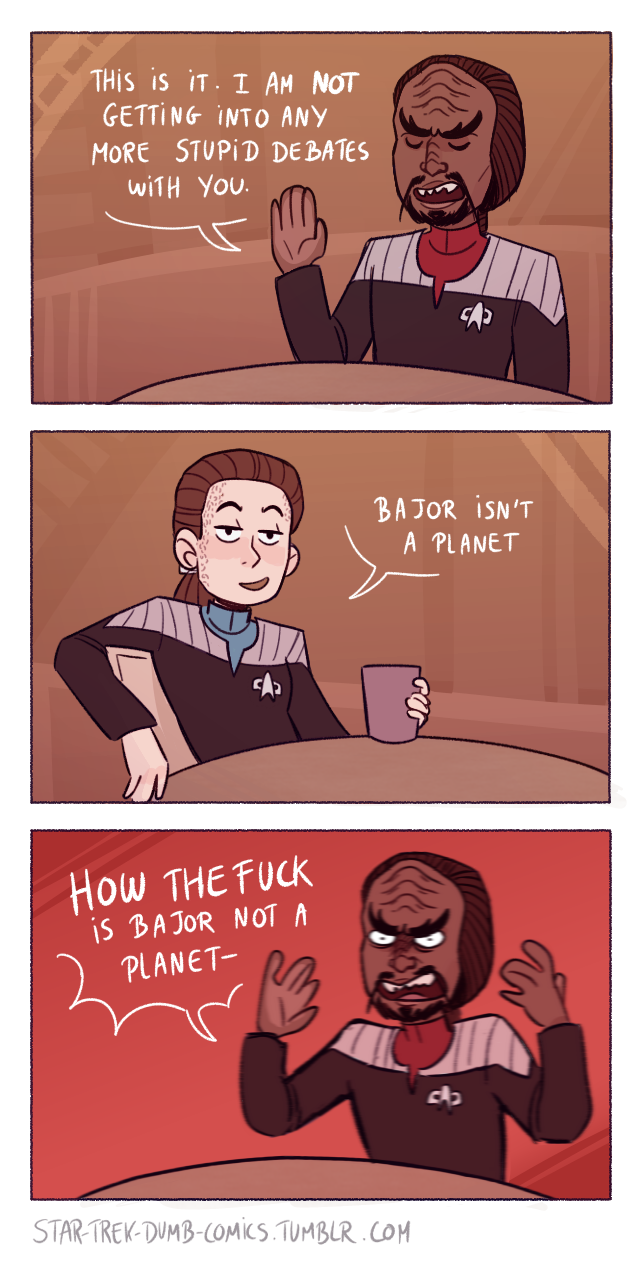
Star Trek – Strange New Dumb Comic #51

Had to draw something with one of my fave canon ships eventually !


Tags:

#Star Trek #DS9 #art #fanart #comics #anything that makes me laugh this much deserves a reblog #this probably deserves some warning tag but I am not sure what #discourse cw?

{{previous post in sequence}}


rustingbridges:

controversial personal finance opinion: if you have enough wealth you should own some physical gold

financialized gold has most of the downside of real gold and also none of its special upside, so not that

gold does not, as a rule, gain in value, and it’s vulnerable to theft, but it also does not, as a rule, lose in value, and also the rest of your assets are vulnerable to theft too. gold might have a higher risk but diversification is still valuable

in the event you lose access to your financials and have to leave – maybe not likely, but not impossible, apparently something like 1% of humans in 2021 are or have been refugees – gold jewelry particularly is both portable enough you can take it and universally recognized as valuable enough you can trade it. just don’t get it in your teeth


brin-bellway:

*Is* this controversial, even in the broad form stated here?

I kind of figured that there was broad agreement that there exists *some* level of wealth at which diversification into gold is worth pursuing (for the reasons you give), but that different people’s estimates of what that wealth level is vary by orders of magnitude, and some people would put enough forms of philanthropy above gold on the to-do list that in practice no one would ever reach the gold stage given our world’s current amount of philanthropic fruit to be picked.

(I’m not sure where I would place the threshold: I think it’s probably somewhere feasible to reach, but far enough beyond where I am now that it’s not urgent for me to figure out the specifics.)


rustingbridges:

a lot of people would argue that you should at some point diversify into financial instruments which abstractly reflect the value of gold, but I think many of those people would say you should not buy actual physical gold.

to pin myself down a bit while still leaving a lot of wiggle room, here’s some points on my Gold Advice Spectrum:

  • if you need your money to be liquid in a normal economy any time soon, don’t buy gold
  • if you have enough money to retire indefinitely on, I think it’s worth having something like a month’s money or so in precious metals
  • if you’re bill gates you should actually should have buried a chest of treasure somewhere


brin-bellway:

What…what reasons do *they* give for wanting to diversify into gold? You can’t hedge against the collapse of your financial system by buying things that *depend on said financial system*.

I mean, okay, I guess you can hedge against *certain, partial* collapses that way, but it’s far more limited.

I should mention here that I literally wrote a post once titled “Diversification is an important part of building an investment portfolio” [link], in which I frame prepping as being essentially a way of shorting your civilisation: since almost everyone is very long civilisation pretty much by necessity, being also somewhat short civilisation is a good hedge (though I think you should still be net long). I also wrote a comment on a different post in which I called [maintaining stockpiles of soap and canned food and air filters] “pandemic insurance” [link].

That Gold Advice Spectrum seems pretty reasonable.

@cthulhubert​ replied: @brin-bellway there’s a certain degree of over-correction against physical gold buying because Alex Jones and some other right wing conspiracy nuts flogged buying real gold for ‘when the degenerate modern economy collapses’.

I mean, that’s traditionally how it works, right? If you think something is going to collapse, you short it and then write a report laying out your evidence and reasoning to try to convince others to do the same. Yeah, I disagree that one should be net short civilisation and think people who do that are setting themselves up for failure and pain, but short sellers are very often wrong and their existence is nevertheless a useful corrective.

(…yes, I think I *did* just draw a connection between the hate that Crazy Prepper People™ get and the hate that short sellers get.)


alarajrogers:

I think if you were genuinely going to short-sell civilization, gold’s a ridiculous thing to have. Like money itself, the value of gold is a social construct.

What you should be investing in is booze and pharmaceuticals. Set up a greenhouse that does not run on any electricity, or that gets all of its energy from solar panels, and grow food there year-round; you’ll have something to eat, something to trade, and if you are legally able to, maintain, like, one marijuana plant, so if civilization collapses you can go whole hog into growing marijuana. Once the pharmaceutical industry collapses, alcohol and marijuana will be incredibly valuable as painkillers again. And because drugs expire much more slowly than they claim on the label, keep a huge supply of ibuprofen, acetominophen, allergy meds, and so on… they’ll still be good ten years from now. Birth control, if you live in a place where it can be obtained OTC.

Hard liquor and wine are probably your best investment – they are commonly considered to improve as they age, and in a post apocalyptic world, everyone will want to get drunk. (I mean, not literally everyone. I wouldn’t drink alcohol after the apocalypse because it tastes disgusting and has no benefits I want. But most people.)

Me, I’d also get, like, a million solar chargers for phones and Raspberry Pis, and a whole lot of USB stick drives with adapters. Then I’d download Wikipedia every several months, and any medical database that allows me to download the whole thing, and as much info as I can get about maintaining phones and Raspberry Pis. Probably ebooks and databases on carpentry, plumbing, electricity, electrical generation, making wine and beer, etc, etc… I’d have a few hundred of the Pis in boxes, in a climate controlled room, probably with the boxes sealed in a plastic bin with a lid, and I’d have USB sticks with image files to put on the Pis. I’d use phones and tablets as monitors, or tiny monitors with low power requirements, so that I’d have a place to read my stored downloads. Then when the internet crashes I’d have huge amounts of information I could share with my neighbors so we could restore the amenities of civilization as quickly as possible, as many of them as possible. There won’t be making any new computers for a very long time- clean room tech is very complex – but keeping existing machines that use very little power in good repair, unused and protected from the elements, will help a lot.

Physical books are also very good but are heavy, not very portable, and easily destroyed by any kind of extreme weather – weather applies to computers too, but you can store vastly more information on 1 small computer than you can on 20 books, and then you put 20 replacements for your small computer in there. Still, if you’ve got space for a library and you don’t live somewhere it is likely to flood or burn, stockpile books. Nonfiction that give you information about how to survive, of course, but also, languages, books on cultures, history, and include a lot of fiction. People will trade a lot for escapism, and DVDs have a much shorter shelf life than books do.

All of these are more valuable trading goods than gold. You can’t eat gold, you can’t use it for anything but making things pretty (and making high-tech things you can’t make if civilization collapses.) I might buy silver and copper for antimicrobial purposes (and then I’d have to figure out how to keep them from tarnishing), but gold is overpriced and is only of use to a civilization – I mean it can be one with much lower tech levels, but you still have to have, like, blacksmiths.

You know what else would be valuable? Blade sharpeners and the knowledge of how to use them. Also, blades. Guns will be very useful for a while but modern guns require far too much technology to remain supplied with ammo, and all you can use them for is hunting and killing. But blades can be used for hunting and killing, and preparing food, and gardening, and so on and so forth. Knives, axes, scythes, machetes, and yeah, swords. Mostly because people think swords are sexy. They’d make good trade goods.

The only circumstance where gold is useful is where your specific country’s financial system has collapsed, but everyone else is okay. If you’re American, that’s not gonna happen. We’re too intertwined with the world’s financial systems. If we go down, so does most of the world. (This is not a good thing.)


brin-bellway:

…yes? Both/and, and gold is certainly one of the lowest-priority items for the reasons you give.

However, it’s important to note that people think gold jewellery is sexy and trade-good-y too, and also I am not American (well, okay, I pay the Americans tribute in exchange for right of return, but that just makes it easier to become a refugee there: it doesn’t mean never becoming a refugee in the first place).

You either got the idea of solar-powered phones and downloading Wikipedia *from me*, or else it is *very* strange that people in your apocalypse stories aren’t doing this: I once commented on one of said stories remarking on its absence and doing a special-interest infodump about it.

>>keep a huge supply of ibuprofen, acetominophen, allergy meds, and so on… they’ll still be good ten years from now.

Naproxen doesn’t just suppress the pain of menstrual cramps: at higher doses, it actually *makes periods lighter*. I would go with naproxen over ibuprofen, though acetominophen still has its place.


alarajrogers:

Didn’t know that about naproxen… very interesting!

I actually have had the ideas about solar-powered phones, Wikipedia, and the like for a very long time, but I just haven’t done that many stories about apocalypses, and one of them, everyone who survived is a child, so they’re not really going to have thought of most of that. The only other one I can think of is the zombie apocalypse one, and there, I have been mentally working out details like that… among other things, in that world there’s still an Internet, because there’s enough people who managed to keep power plants and data centers running that Wikipedia is still up. (Netflix, sadly, is not.) The only people we’ve spent a lot of time around in that story are specialized for being medical professionals and scientists, but I’m pretty sure there are techy types around. (It might possibly have been that one you commented on? Not sure.)

I’m working on another one I call “Mad Max The Librarian”, which has pigeons carrying USB sticks, and a guy going on a road trip with weapons and fighting off all kinds of bandits and cultists to find surviving books and bring them back to a protected, well-defended library.


brin-bellway:

>>Didn’t know that about naproxen… very interesting!

Yeah, I found out when I went to my doctor for dysmenorrhea. She told me to get a bottle of OTC naproxen and take double the dose given on the label, starting two days before my period’s due (or when it starts if it catches me off-guard) and ending when I’m far enough along that the problems would have stopped by now anyway. It’s working great.

(Doubled-up OTC naproxen is a bit cheaper than buying prescription naproxen out of pocket, but if I ever get drug coverage she’ll write me an official prescription.)

((Don’t take prescription-strength naproxen without medical supervision if you can help it: you can fuck up your liver. Peri-menstrual naproxen is relatively safe because you’re only taking it a few days a month, but it’s still best to be sure.))

>>(It might possibly have been that one you commented on? Not sure.)

It was the zombie one, yeah. I originally messaged you with it privately (possibly you don’t get messages properly on the sideblog?), but I’ve been wavering for ages on whether to post a slightly edited version publicly, so here it is:

(Please treat what I am about to tell you as more of a “you have accidentally stumbled into a special interest” than as criticism per se.)

The tech level in “Norris and the Plague Doctors” feels off to me. It’s too low: there’s stuff missing that should still be working.

It first struck me when they’re talking about electricity, and they *never mention solar power*. Not once. The hospital compound doesn’t have it, the homesteaders don’t have it, the rich people’s houses are never explicitly ruled out as not having it but if even the homesteaders don’t…

(*By default* the kind of solar setup a rich household would get would immediately stop working when the grid goes down, but if you pay extra (batteries are getting cheaper over time, but for now: for the most popular brand (Tesla), it’s USD$4,500 fixed cost + USD$6,500/13.5kWH of storage) you can install power-outage-insurance batteries. Most household roofs can’t fit enough solar panels to go fully self-sufficient, but from what I’ve been able to tell so far in my research, if done right a roof setup can let you switch to merely rationed electricity during a long-term outage.)

[edit: I found out later that the keyword to search for regarding rich-people’s-houses-resorting-to-off-grid-electricity-in-a-crisis is “hybrid solar systems” (a hybrid of on-grid and off-grid).]

Once that got me thinking I started noticing other stuff.

Norris assumes that rich people’s cars all run on gasoline and gasoline alone, and while that could be an in-universe oversight on his part, I would expect a modern-day rich neighbourhood to have some electric and/or plug-in-hybrid vehicles. If such a vehicle is in either the same household as a solar+storage setup or they’re in two cooperating households, you’ve potentially got long-term car access. You’d have to use it very sparingly: we’re probably talking an entire day’s electricity ration for a 40mi round trip (a decent rule of thumb as things stand is 4 mi/kwH, though it depends on car and driving style). (Plug-in hybrids don’t currently have a 40mi full-electric range from what I’ve seen, so you’d need a full-electric car or restrict to even shorter trips: 30mi would be pushing it.)

One of the main reasons Norris is glad to have Internet access is because it means he can read Wikipedia, and while again that could well be an in-universe oversight by the characters, the fact is that anyone reliant on *continuous* Internet access *during an apocalypse* to read Wikipedia is doing it wrong. Somebody please get this child a Kiwix server.

And speaking of devices that can run Kiwix, there are no smartphones. The only computer is a rigged-together desktop that probably doesn’t even have an emergency uninterruptible-power-supply battery, let alone the ability to actually *function* for extended periods on intermittent power while on the run from zombies. You can get quite a bit done, info/comms-infrastructure-wise, with just a bunch of Android smartphones (iOS is much more dependent on access to Apple servers and therefore much less useful in a grid-down), ~USD$25 – $50 of portable solar chargers per person (characters who didn’t already have these may well be able to salvage them at a camping-supplies store), and at least one (1) group member who didn’t have mobile data and oriented their smartphone setup around not having reliable Internet access (who can then bootstrap the rest). Apps to turn smartphones into off-grid walkie-talkies (or more likely walkie-writies) are still in their early days overall–I wrote an entire post about this recently: https://brin-bellway.dreamwidth.org/67770.html–but file-sharing alone should have a fair number of uses, especially if at least one of you packed the right files (or can obtain access to the broader Internet long enough to fetch them).

I look forward to Mad Max the Librarian.


maryellencarter:

“gold is overpriced and is only of use to a civilization – I mean it can be one with much lower tech levels, but you still have to have, like, blacksmiths”

I’ve been pondering this thought ever since it drifted by on my dash last week, and maybe it’s just that I have a very particular background, but I try to imagine how my civilization (US) would collapse below the level of having blacksmiths and I draw a blank. There are just (in my experience) too many people around who do historical reenactment type skills for fun. I am not personally a blacksmith, and I don’t personally know any blacksmiths, but I am very sure that if the nearest big city (I think about 2 million people) had a catastrophic civilization meltdown to the point where Wikipedia on a solar Android phone would be needed, that there would be *somebody* in the local SCA or fiber arts guild or equivalent who knew how to blacksmith and what the necessary components of a forge are.

(I am personally a very skilled spinner and knitter. I don’t currently own a spinning wheel, but spindle whorls are easy to make even if drop spinning is a royal pain in the shoulders and takes forever. You find me some spinnable fibers, I can eventually produce clothes. Find me an abandoned Lowe’s for PVC pipe and a few fiddly metal bits, I can *build* a spinning wheel and produce a bunch of clothes, as long as you want them knitted. We’ll need somebody else for weaving, I don’t carry any looms in my head.)

Sorry, I’m rambling, but what I’m trying to say is, my default post-apocalyptic scenario involves still having access to a lot of the sort of Iron Age technology levels, because many of those live rent-free in my own head and I’m familiar with the existence of people who can recreate the rest.


alarajrogers:

I feel like, if you’ve got blacksmiths, bronze and copper and tin are gonna be a lot more useful than gold, though? Historically gold just makes pretty things. People like pretty things but will they really value them over stuff that helps them survive?

As for Norris, I’d like to point out a few things:

– Norris is a child who was living on the streets until he was taken in by the plague doctors. He is not an expert on his world.

– The plague doctors are doctors, not computer engineers. They may have a few computer engineers among them – in fact they must, because they have pilotable drones – but it’s likely that smartphones, being in limited supply because no more are being manufactured and shipped to the US, are reserved for the actual doctors to do things like pilot drones. They’re not left for a kid to get on Wikipedia with.

– I’d imagine that a major use of electric cars by people who were well-off enough to own them is to get the fuck out of the city, where there is a higher concentration of zombies. People who could flee the city did. (No one voluntarily goes into the city on the ground but the plague doctors; the government drops shipments of food from helicopters.)

What I was imagining was that a lot of stuff is going on in the countryside and the suburbs, where zombies are rarer. Farmers continue to grow crops, but nowadays it’s all food for local consumption, or grain for biodiesel. People make limited, local trips all the time, but they don’t go through the city when they do. The electric cars are probably doing that, along with the ones that run on biodiesel and the ones where someone who owned a gas station stockpiled the gasoline for their own use. They’ve probably also got some horses pulling carts going on. Data centers are well protected and way out in the middle of nowhere, as are power stations; the power stations are defended by what’s left of the military and National Guard, and probably the data centers too. So a good bit of the Internet is still up; it was designed to work around national disasters. But the bandwidth’s been drastically reduced because the workforce that can keep the lines up is now hiding from zombies or is dead.

The plague doctors probably do have a server with Wikipedia on it, that they can access locally, and they probably have a lot else as well. Maybe media servers for their families to locally connect to across the campus WAN and watch movies. Probably as many scientific articles as they were able to download before a given server went down. Large portions of Google Books, since Google opened up their Books collection so you could get the whole thing, because copyright was no longer a thing that made sense. But they didn’t offer those things to a kid who most of them saw as a burden (even Sarah is thinking of Norris as someone she cares about but can’t really take care of). Maybe at some point Jessie the armorer will show Norris something, or maybe now that the doctors respect him a bit more they may help him more directly to access their resources, but right now, he’s limited to what he knows about. (He’s also not asking them things like “how do I get access to the local servers” because, as a child of the Internet age, it hasn’t occurred to him that that’s a thing. He’s 10.)

I have plans to expand it into a book someday, so I should have the opportunity to show some of what’s not immediately obvious to Norris from his perspective as a kid who’s getting the resources he knows about, not the ones people could teach him about if anyone was actually focused on teaching him.

But you’re right in general. Part of the point of the story was that I get frustrated with zombie apocalypses where the only modern technology anyone uses or has access to is guns. (Or any apocalypse, really. Unless it was nuclear, then the EMP could have toasted anything that wasn’t in a Faraday cage.)

I think it’s like in those A Collection of Unmitigated Pedantry clothing posts that have been going around lately. People care a surprising amount about pretty things, and even if you *don’t* directly value them, decking yourself out is a way of demonstrating that you are so powerful and so wealthy that you can afford to spend resources on mere decoration (so other people had better not fuck with you). [link]

Sure, no more smartphones are entering national supply, but the *initial* supply was several hundred million widely distributed throughout the population.

(I know I’m a nerd with very nerdy social circles, I know a whole lot of people wouldn’t end up having a nerd in the group of people they’d banded together with especially if it was only two or three family members, but my perspective here is definitely shaped by knowing plenty of people who keep copies of Wikipedia lying around just because they can.)

>>Norris is a child who was living on the streets until he was taken in by the plague doctors. He is not an expert on his world.

Oh, absolutely. I figured there was a lot of that going on.


Tags:

#reply via reblog #101 Uses for Infrastructureless Computers #apocalypse cw #discourse cw? #zombies #reactionblogging

{{previous post in sequence}}


rustingbridges:

controversial personal finance opinion: if you have enough wealth you should own some physical gold

financialized gold has most of the downside of real gold and also none of its special upside, so not that

gold does not, as a rule, gain in value, and it’s vulnerable to theft, but it also does not, as a rule, lose in value, and also the rest of your assets are vulnerable to theft too. gold might have a higher risk but diversification is still valuable

in the event you lose access to your financials and have to leave – maybe not likely, but not impossible, apparently something like 1% of humans in 2021 are or have been refugees – gold jewelry particularly is both portable enough you can take it and universally recognized as valuable enough you can trade it. just don’t get it in your teeth


brin-bellway:

*Is* this controversial, even in the broad form stated here?

I kind of figured that there was broad agreement that there exists *some* level of wealth at which diversification into gold is worth pursuing (for the reasons you give), but that different people’s estimates of what that wealth level is vary by orders of magnitude, and some people would put enough forms of philanthropy above gold on the to-do list that in practice no one would ever reach the gold stage given our world’s current amount of philanthropic fruit to be picked.

(I’m not sure where I would place the threshold: I think it’s probably somewhere feasible to reach, but far enough beyond where I am now that it’s not urgent for me to figure out the specifics.)


rustingbridges:

a lot of people would argue that you should at some point diversify into financial instruments which abstractly reflect the value of gold, but I think many of those people would say you should not buy actual physical gold.

to pin myself down a bit while still leaving a lot of wiggle room, here’s some points on my Gold Advice Spectrum:

  • if you need your money to be liquid in a normal economy any time soon, don’t buy gold
  • if you have enough money to retire indefinitely on, I think it’s worth having something like a month’s money or so in precious metals
  • if you’re bill gates you should actually should have buried a chest of treasure somewhere


brin-bellway:

What…what reasons do *they* give for wanting to diversify into gold? You can’t hedge against the collapse of your financial system by buying things that *depend on said financial system*.

I mean, okay, I guess you can hedge against *certain, partial* collapses that way, but it’s far more limited.

I should mention here that I literally wrote a post once titled “Diversification is an important part of building an investment portfolio” [link], in which I frame prepping as being essentially a way of shorting your civilisation: since almost everyone is very long civilisation pretty much by necessity, being also somewhat short civilisation is a good hedge (though I think you should still be net long). I also wrote a comment on a different post in which I called [maintaining stockpiles of soap and canned food and air filters] “pandemic insurance” [link].

That Gold Advice Spectrum seems pretty reasonable.

@cthulhubert​ replied: @brin-bellway there’s a certain degree of over-correction against physical gold buying because Alex Jones and some other right wing conspiracy nuts flogged buying real gold for ‘when the degenerate modern economy collapses’.

I mean, that’s traditionally how it works, right? If you think something is going to collapse, you short it and then write a report laying out your evidence and reasoning to try to convince others to do the same. Yeah, I disagree that one should be net short civilisation and think people who do that are setting themselves up for failure and pain, but short sellers are very often wrong and their existence is nevertheless a useful corrective.

(…yes, I think I *did* just draw a connection between the hate that Crazy Prepper People™ get and the hate that short sellers get.)


alarajrogers:

I think if you were genuinely going to short-sell civilization, gold’s a ridiculous thing to have. Like money itself, the value of gold is a social construct.

What you should be investing in is booze and pharmaceuticals. Set up a greenhouse that does not run on any electricity, or that gets all of its energy from solar panels, and grow food there year-round; you’ll have something to eat, something to trade, and if you are legally able to, maintain, like, one marijuana plant, so if civilization collapses you can go whole hog into growing marijuana. Once the pharmaceutical industry collapses, alcohol and marijuana will be incredibly valuable as painkillers again. And because drugs expire much more slowly than they claim on the label, keep a huge supply of ibuprofen, acetominophen, allergy meds, and so on… they’ll still be good ten years from now. Birth control, if you live in a place where it can be obtained OTC.

Hard liquor and wine are probably your best investment – they are commonly considered to improve as they age, and in a post apocalyptic world, everyone will want to get drunk. (I mean, not literally everyone. I wouldn’t drink alcohol after the apocalypse because it tastes disgusting and has no benefits I want. But most people.)

Me, I’d also get, like, a million solar chargers for phones and Raspberry Pis, and a whole lot of USB stick drives with adapters. Then I’d download Wikipedia every several months, and any medical database that allows me to download the whole thing, and as much info as I can get about maintaining phones and Raspberry Pis. Probably ebooks and databases on carpentry, plumbing, electricity, electrical generation, making wine and beer, etc, etc… I’d have a few hundred of the Pis in boxes, in a climate controlled room, probably with the boxes sealed in a plastic bin with a lid, and I’d have USB sticks with image files to put on the Pis. I’d use phones and tablets as monitors, or tiny monitors with low power requirements, so that I’d have a place to read my stored downloads. Then when the internet crashes I’d have huge amounts of information I could share with my neighbors so we could restore the amenities of civilization as quickly as possible, as many of them as possible. There won’t be making any new computers for a very long time- clean room tech is very complex – but keeping existing machines that use very little power in good repair, unused and protected from the elements, will help a lot.

Physical books are also very good but are heavy, not very portable, and easily destroyed by any kind of extreme weather – weather applies to computers too, but you can store vastly more information on 1 small computer than you can on 20 books, and then you put 20 replacements for your small computer in there. Still, if you’ve got space for a library and you don’t live somewhere it is likely to flood or burn, stockpile books. Nonfiction that give you information about how to survive, of course, but also, languages, books on cultures, history, and include a lot of fiction. People will trade a lot for escapism, and DVDs have a much shorter shelf life than books do.

All of these are more valuable trading goods than gold. You can’t eat gold, you can’t use it for anything but making things pretty (and making high-tech things you can’t make if civilization collapses.) I might buy silver and copper for antimicrobial purposes (and then I’d have to figure out how to keep them from tarnishing), but gold is overpriced and is only of use to a civilization – I mean it can be one with much lower tech levels, but you still have to have, like, blacksmiths.

You know what else would be valuable? Blade sharpeners and the knowledge of how to use them. Also, blades. Guns will be very useful for a while but modern guns require far too much technology to remain supplied with ammo, and all you can use them for is hunting and killing. But blades can be used for hunting and killing, and preparing food, and gardening, and so on and so forth. Knives, axes, scythes, machetes, and yeah, swords. Mostly because people think swords are sexy. They’d make good trade goods.

The only circumstance where gold is useful is where your specific country’s financial system has collapsed, but everyone else is okay. If you’re American, that’s not gonna happen. We’re too intertwined with the world’s financial systems. If we go down, so does most of the world. (This is not a good thing.)


brin-bellway:

…yes? Both/and, and gold is certainly one of the lowest-priority items for the reasons you give.

However, it’s important to note that people think gold jewellery is sexy and trade-good-y too, and also I am not American (well, okay, I pay the Americans tribute in exchange for right of return, but that just makes it easier to become a refugee there: it doesn’t mean never becoming a refugee in the first place).

You either got the idea of solar-powered phones and downloading Wikipedia *from me*, or else it is *very* strange that people in your apocalypse stories aren’t doing this: I once commented on one of said stories remarking on its absence and doing a special-interest infodump about it.

>>keep a huge supply of ibuprofen, acetominophen, allergy meds, and so on… they’ll still be good ten years from now.

Naproxen doesn’t just suppress the pain of menstrual cramps: at higher doses, it actually *makes periods lighter*. I would go with naproxen over ibuprofen, though acetominophen still has its place.


alarajrogers:

Didn’t know that about naproxen… very interesting!

I actually have had the ideas about solar-powered phones, Wikipedia, and the like for a very long time, but I just haven’t done that many stories about apocalypses, and one of them, everyone who survived is a child, so they’re not really going to have thought of most of that. The only other one I can think of is the zombie apocalypse one, and there, I have been mentally working out details like that… among other things, in that world there’s still an Internet, because there’s enough people who managed to keep power plants and data centers running that Wikipedia is still up. (Netflix, sadly, is not.) The only people we’ve spent a lot of time around in that story are specialized for being medical professionals and scientists, but I’m pretty sure there are techy types around. (It might possibly have been that one you commented on? Not sure.)

I’m working on another one I call “Mad Max The Librarian”, which has pigeons carrying USB sticks, and a guy going on a road trip with weapons and fighting off all kinds of bandits and cultists to find surviving books and bring them back to a protected, well-defended library.


brin-bellway:

>>Didn’t know that about naproxen… very interesting!

Yeah, I found out when I went to my doctor for dysmenorrhea. She told me to get a bottle of OTC naproxen and take double the dose given on the label, starting two days before my period’s due (or when it starts if it catches me off-guard) and ending when I’m far enough along that the problems would have stopped by now anyway. It’s working great.

(Doubled-up OTC naproxen is a bit cheaper than buying prescription naproxen out of pocket, but if I ever get drug coverage she’ll write me an official prescription.)

((Don’t take prescription-strength naproxen without medical supervision if you can help it: you can fuck up your liver. Peri-menstrual naproxen is relatively safe because you’re only taking it a few days a month, but it’s still best to be sure.))

>>(It might possibly have been that one you commented on? Not sure.)

It was the zombie one, yeah. I originally messaged you with it privately (possibly you don’t get messages properly on the sideblog?), but I’ve been wavering for ages on whether to post a slightly edited version publicly, so here it is:

(Please treat what I am about to tell you as more of a “you have accidentally stumbled into a special interest” than as criticism per se.)

The tech level in “Norris and the Plague Doctors” feels off to me. It’s too low: there’s stuff missing that should still be working.

It first struck me when they’re talking about electricity, and they *never mention solar power*. Not once. The hospital compound doesn’t have it, the homesteaders don’t have it, the rich people’s houses are never explicitly ruled out as not having it but if even the homesteaders don’t…

(*By default* the kind of solar setup a rich household would get would immediately stop working when the grid goes down, but if you pay extra (batteries are getting cheaper over time, but for now: for the most popular brand (Tesla), it’s USD$4,500 fixed cost + USD$6,500/13.5kWH of storage) you can install power-outage-insurance batteries. Most household roofs can’t fit enough solar panels to go fully self-sufficient, but from what I’ve been able to tell so far in my research, if done right a roof setup can let you switch to merely rationed electricity during a long-term outage.)

[edit: I found out later that the keyword to search for regarding rich-people’s-houses-resorting-to-off-grid-electricity-in-a-crisis is “hybrid solar systems” (a hybrid of on-grid and off-grid).]

Once that got me thinking I started noticing other stuff.

Norris assumes that rich people’s cars all run on gasoline and gasoline alone, and while that could be an in-universe oversight on his part, I would expect a modern-day rich neighbourhood to have some electric and/or plug-in-hybrid vehicles. If such a vehicle is in either the same household as a solar+storage setup or they’re in two cooperating households, you’ve potentially got long-term car access. You’d have to use it very sparingly: we’re probably talking an entire day’s electricity ration for a 40mi round trip (a decent rule of thumb as things stand is 4 mi/kwH, though it depends on car and driving style). (Plug-in hybrids don’t currently have a 40mi full-electric range from what I’ve seen, so you’d need a full-electric car or restrict to even shorter trips: 30mi would be pushing it.)

One of the main reasons Norris is glad to have Internet access is because it means he can read Wikipedia, and while again that could well be an in-universe oversight by the characters, the fact is that anyone reliant on *continuous* Internet access *during an apocalypse* to read Wikipedia is doing it wrong. Somebody please get this child a Kiwix server.

And speaking of devices that can run Kiwix, there are no smartphones. The only computer is a rigged-together desktop that probably doesn’t even have an emergency uninterruptible-power-supply battery, let alone the ability to actually *function* for extended periods on intermittent power while on the run from zombies. You can get quite a bit done, info/comms-infrastructure-wise, with just a bunch of Android smartphones (iOS is much more dependent on access to Apple servers and therefore much less useful in a grid-down), ~USD$25 – $50 of portable solar chargers per person (characters who didn’t already have these may well be able to salvage them at a camping-supplies store), and at least one (1) group member who didn’t have mobile data and oriented their smartphone setup around not having reliable Internet access (who can then bootstrap the rest). Apps to turn smartphones into off-grid walkie-talkies (or more likely walkie-writies) are still in their early days overall–I wrote an entire post about this recently: https://brin-bellway.dreamwidth.org/67770.html–but file-sharing alone should have a fair number of uses, especially if at least one of you packed the right files (or can obtain access to the broader Internet long enough to fetch them).

I look forward to Mad Max the Librarian.


maryellencarter:

“gold is overpriced and is only of use to a civilization – I mean it can be one with much lower tech levels, but you still have to have, like, blacksmiths”

I’ve been pondering this thought ever since it drifted by on my dash last week, and maybe it’s just that I have a very particular background, but I try to imagine how my civilization (US) would collapse below the level of having blacksmiths and I draw a blank. There are just (in my experience) too many people around who do historical reenactment type skills for fun. I am not personally a blacksmith, and I don’t personally know any blacksmiths, but I am very sure that if the nearest big city (I think about 2 million people) had a catastrophic civilization meltdown to the point where Wikipedia on a solar Android phone would be needed, that there would be *somebody* in the local SCA or fiber arts guild or equivalent who knew how to blacksmith and what the necessary components of a forge are.

(I am personally a very skilled spinner and knitter. I don’t currently own a spinning wheel, but spindle whorls are easy to make even if drop spinning is a royal pain in the shoulders and takes forever. You find me some spinnable fibers, I can eventually produce clothes. Find me an abandoned Lowe’s for PVC pipe and a few fiddly metal bits, I can *build* a spinning wheel and produce a bunch of clothes, as long as you want them knitted. We’ll need somebody else for weaving, I don’t carry any looms in my head.)

Sorry, I’m rambling, but what I’m trying to say is, my default post-apocalyptic scenario involves still having access to a lot of the sort of Iron Age technology levels, because many of those live rent-free in my own head and I’m familiar with the existence of people who can recreate the rest.


Tags:

#(solar-powered portable Wikipedia is useful in a surprisingly broad variety of situations but I take your point) #conversational aglets #101 Uses for Infrastructureless Computers #apocalypse cw #discourse cw?


{{next post in sequence}}

{{previous post in sequence}}


rustingbridges:

controversial personal finance opinion: if you have enough wealth you should own some physical gold

financialized gold has most of the downside of real gold and also none of its special upside, so not that

gold does not, as a rule, gain in value, and it’s vulnerable to theft, but it also does not, as a rule, lose in value, and also the rest of your assets are vulnerable to theft too. gold might have a higher risk but diversification is still valuable

in the event you lose access to your financials and have to leave – maybe not likely, but not impossible, apparently something like 1% of humans in 2021 are or have been refugees – gold jewelry particularly is both portable enough you can take it and universally recognized as valuable enough you can trade it. just don’t get it in your teeth


brin-bellway:

*Is* this controversial, even in the broad form stated here?

I kind of figured that there was broad agreement that there exists *some* level of wealth at which diversification into gold is worth pursuing (for the reasons you give), but that different people’s estimates of what that wealth level is vary by orders of magnitude, and some people would put enough forms of philanthropy above gold on the to-do list that in practice no one would ever reach the gold stage given our world’s current amount of philanthropic fruit to be picked.

(I’m not sure where I would place the threshold: I think it’s probably somewhere feasible to reach, but far enough beyond where I am now that it’s not urgent for me to figure out the specifics.)


rustingbridges:

a lot of people would argue that you should at some point diversify into financial instruments which abstractly reflect the value of gold, but I think many of those people would say you should not buy actual physical gold.

to pin myself down a bit while still leaving a lot of wiggle room, here’s some points on my Gold Advice Spectrum:

  • if you need your money to be liquid in a normal economy any time soon, don’t buy gold
  • if you have enough money to retire indefinitely on, I think it’s worth having something like a month’s money or so in precious metals
  • if you’re bill gates you should actually should have buried a chest of treasure somewhere


brin-bellway:

What…what reasons do *they* give for wanting to diversify into gold? You can’t hedge against the collapse of your financial system by buying things that *depend on said financial system*.

I mean, okay, I guess you can hedge against *certain, partial* collapses that way, but it’s far more limited.

I should mention here that I literally wrote a post once titled “Diversification is an important part of building an investment portfolio” [link], in which I frame prepping as being essentially a way of shorting your civilisation: since almost everyone is very long civilisation pretty much by necessity, being also somewhat short civilisation is a good hedge (though I think you should still be net long). I also wrote a comment on a different post in which I called [maintaining stockpiles of soap and canned food and air filters] “pandemic insurance” [link].

That Gold Advice Spectrum seems pretty reasonable.

@cthulhubert​ replied: @brin-bellway there’s a certain degree of over-correction against physical gold buying because Alex Jones and some other right wing conspiracy nuts flogged buying real gold for ‘when the degenerate modern economy collapses’.

I mean, that’s traditionally how it works, right? If you think something is going to collapse, you short it and then write a report laying out your evidence and reasoning to try to convince others to do the same. Yeah, I disagree that one should be net short civilisation and think people who do that are setting themselves up for failure and pain, but short sellers are very often wrong and their existence is nevertheless a useful corrective.

(…yes, I think I *did* just draw a connection between the hate that Crazy Prepper People™ get and the hate that short sellers get.)


alarajrogers:

I think if you were genuinely going to short-sell civilization, gold’s a ridiculous thing to have. Like money itself, the value of gold is a social construct.

What you should be investing in is booze and pharmaceuticals. Set up a greenhouse that does not run on any electricity, or that gets all of its energy from solar panels, and grow food there year-round; you’ll have something to eat, something to trade, and if you are legally able to, maintain, like, one marijuana plant, so if civilization collapses you can go whole hog into growing marijuana. Once the pharmaceutical industry collapses, alcohol and marijuana will be incredibly valuable as painkillers again. And because drugs expire much more slowly than they claim on the label, keep a huge supply of ibuprofen, acetominophen, allergy meds, and so on… they’ll still be good ten years from now. Birth control, if you live in a place where it can be obtained OTC.

Hard liquor and wine are probably your best investment – they are commonly considered to improve as they age, and in a post apocalyptic world, everyone will want to get drunk. (I mean, not literally everyone. I wouldn’t drink alcohol after the apocalypse because it tastes disgusting and has no benefits I want. But most people.)

Me, I’d also get, like, a million solar chargers for phones and Raspberry Pis, and a whole lot of USB stick drives with adapters. Then I’d download Wikipedia every several months, and any medical database that allows me to download the whole thing, and as much info as I can get about maintaining phones and Raspberry Pis. Probably ebooks and databases on carpentry, plumbing, electricity, electrical generation, making wine and beer, etc, etc… I’d have a few hundred of the Pis in boxes, in a climate controlled room, probably with the boxes sealed in a plastic bin with a lid, and I’d have USB sticks with image files to put on the Pis. I’d use phones and tablets as monitors, or tiny monitors with low power requirements, so that I’d have a place to read my stored downloads. Then when the internet crashes I’d have huge amounts of information I could share with my neighbors so we could restore the amenities of civilization as quickly as possible, as many of them as possible. There won’t be making any new computers for a very long time- clean room tech is very complex – but keeping existing machines that use very little power in good repair, unused and protected from the elements, will help a lot.

Physical books are also very good but are heavy, not very portable, and easily destroyed by any kind of extreme weather – weather applies to computers too, but you can store vastly more information on 1 small computer than you can on 20 books, and then you put 20 replacements for your small computer in there. Still, if you’ve got space for a library and you don’t live somewhere it is likely to flood or burn, stockpile books. Nonfiction that give you information about how to survive, of course, but also, languages, books on cultures, history, and include a lot of fiction. People will trade a lot for escapism, and DVDs have a much shorter shelf life than books do.

All of these are more valuable trading goods than gold. You can’t eat gold, you can’t use it for anything but making things pretty (and making high-tech things you can’t make if civilization collapses.) I might buy silver and copper for antimicrobial purposes (and then I’d have to figure out how to keep them from tarnishing), but gold is overpriced and is only of use to a civilization – I mean it can be one with much lower tech levels, but you still have to have, like, blacksmiths.

You know what else would be valuable? Blade sharpeners and the knowledge of how to use them. Also, blades. Guns will be very useful for a while but modern guns require far too much technology to remain supplied with ammo, and all you can use them for is hunting and killing. But blades can be used for hunting and killing, and preparing food, and gardening, and so on and so forth. Knives, axes, scythes, machetes, and yeah, swords. Mostly because people think swords are sexy. They’d make good trade goods.

The only circumstance where gold is useful is where your specific country’s financial system has collapsed, but everyone else is okay. If you’re American, that’s not gonna happen. We’re too intertwined with the world’s financial systems. If we go down, so does most of the world. (This is not a good thing.)


brin-bellway:

…yes? Both/and, and gold is certainly one of the lowest-priority items for the reasons you give.

However, it’s important to note that people think gold jewellery is sexy and trade-good-y too, and also I am not American (well, okay, I pay the Americans tribute in exchange for right of return, but that just makes it easier to become a refugee there: it doesn’t mean never becoming a refugee in the first place).

You either got the idea of solar-powered phones and downloading Wikipedia *from me*, or else it is *very* strange that people in your apocalypse stories aren’t doing this: I once commented on one of said stories remarking on its absence and doing a special-interest infodump about it.

>>keep a huge supply of ibuprofen, acetominophen, allergy meds, and so on… they’ll still be good ten years from now.

Naproxen doesn’t just suppress the pain of menstrual cramps: at higher doses, it actually *makes periods lighter*. I would go with naproxen over ibuprofen, though acetominophen still has its place.


alarajrogers:

Didn’t know that about naproxen… very interesting!

I actually have had the ideas about solar-powered phones, Wikipedia, and the like for a very long time, but I just haven’t done that many stories about apocalypses, and one of them, everyone who survived is a child, so they’re not really going to have thought of most of that. The only other one I can think of is the zombie apocalypse one, and there, I have been mentally working out details like that… among other things, in that world there’s still an Internet, because there’s enough people who managed to keep power plants and data centers running that Wikipedia is still up. (Netflix, sadly, is not.) The only people we’ve spent a lot of time around in that story are specialized for being medical professionals and scientists, but I’m pretty sure there are techy types around. (It might possibly have been that one you commented on? Not sure.)

I’m working on another one I call “Mad Max The Librarian”, which has pigeons carrying USB sticks, and a guy going on a road trip with weapons and fighting off all kinds of bandits and cultists to find surviving books and bring them back to a protected, well-defended library.

>>Didn’t know that about naproxen… very interesting!

Yeah, I found out when I went to my doctor for dysmenorrhea. She told me to get a bottle of OTC naproxen and take double the dose given on the label, starting two days before my period’s due (or when it starts if it catches me off-guard) and ending when I’m far enough along that the problems would have stopped by now anyway. It’s working great.

(Doubled-up OTC naproxen is a bit cheaper than buying prescription naproxen out of pocket, but if I ever get drug coverage she’ll write me an official prescription.)

((Don’t take prescription-strength naproxen without medical supervision if you can help it: you can fuck up your liver. Peri-menstrual naproxen is relatively safe because you’re only taking it a few days a month, but it’s still best to be sure.))

>>(It might possibly have been that one you commented on? Not sure.)

It was the zombie one, yeah. I originally messaged you with it privately (possibly you don’t get messages properly on the sideblog?), but I’ve been wavering for ages on whether to post a slightly edited version publicly, so here it is:

(Please treat what I am about to tell you as more of a “you have accidentally stumbled into a special interest” than as criticism per se.)

The tech level in “Norris and the Plague Doctors” feels off to me. It’s too low: there’s stuff missing that should still be working.

It first struck me when they’re talking about electricity, and they *never mention solar power*. Not once. The hospital compound doesn’t have it, the homesteaders don’t have it, the rich people’s houses are never explicitly ruled out as not having it but if even the homesteaders don’t…

(*By default* the kind of solar setup a rich household would get would immediately stop working when the grid goes down, but if you pay extra (batteries are getting cheaper over time, but for now: for the most popular brand (Tesla), it’s USD$4,500 fixed cost + USD$6,500/13.5kWH of storage) you can install power-outage-insurance batteries. Most household roofs can’t fit enough solar panels to go fully self-sufficient, but from what I’ve been able to tell so far in my research, if done right a roof setup can let you switch to merely rationed electricity during a long-term outage.)

[edit: I found out later that the keyword to search for regarding rich-people’s-houses-resorting-to-off-grid-electricity-in-a-crisis is “hybrid solar systems” (a hybrid of on-grid and off-grid).]

Once that got me thinking I started noticing other stuff.

Norris assumes that rich people’s cars all run on gasoline and gasoline alone, and while that could be an in-universe oversight on his part, I would expect a modern-day rich neighbourhood to have some electric and/or plug-in-hybrid vehicles. If such a vehicle is in either the same household as a solar+storage setup or they’re in two cooperating households, you’ve potentially got long-term car access. You’d have to use it very sparingly: we’re probably talking an entire day’s electricity ration for a 40mi round trip (a decent rule of thumb as things stand is 4 mi/kwH, though it depends on car and driving style). (Plug-in hybrids don’t currently have a 40mi full-electric range from what I’ve seen, so you’d need a full-electric car or restrict to even shorter trips: 30mi would be pushing it.)

One of the main reasons Norris is glad to have Internet access is because it means he can read Wikipedia, and while again that could well be an in-universe oversight by the characters, the fact is that anyone reliant on *continuous* Internet access *during an apocalypse* to read Wikipedia is doing it wrong. Somebody please get this child a Kiwix server.

And speaking of devices that can run Kiwix, there are no smartphones. The only computer is a rigged-together desktop that probably doesn’t even have an emergency uninterruptible-power-supply battery, let alone the ability to actually *function* for extended periods on intermittent power while on the run from zombies. You can get quite a bit done, info/comms-infrastructure-wise, with just a bunch of Android smartphones (iOS is much more dependent on access to Apple servers and therefore much less useful in a grid-down), ~USD$25 – $50 of portable solar chargers per person (characters who didn’t already have these may well be able to salvage them at a camping-supplies store), and at least one (1) group member who didn’t have mobile data and oriented their smartphone setup around not having reliable Internet access (who can then bootstrap the rest). Apps to turn smartphones into off-grid walkie-talkies (or more likely walkie-writies) are still in their early days overall–I wrote an entire post about this recently: https://brin-bellway.dreamwidth.org/67770.html–but file-sharing alone should have a fair number of uses, especially if at least one of you packed the right files (or can obtain access to the broader Internet long enough to fetch them).

I look forward to Mad Max the Librarian.


Tags:

#reply via reblog #reactionblogging #apocalypse cw #discourse cw? #101 Uses for Infrastructureless Computers #drugs cw #zombies


{{next post in sequence}}

titaniumelemental:

titaniumelemental:

The thing that’s frightened me about the COVID restrictions from the very beginning was a lack of the idea that the mental suffering from social restrictions was something worth balancing with the intended effects. Not that it necessarily does outward the benefit, just that it was at least worth considering. Instead you either got people totally dismissive of the danger of the virus, or people saying “how could you think about [need for human contact phrased to sound as frivolous as possible] when people are dying because it of it?!”

But the thing is, everyone not only accepts some level of risk for themselves, but also accepts some level of risk for other people. That amount isn’t ever zero. In 2019, I had contact with a lot of people that could have potentially spread influenza. I got my flu shot as always, I washed my hands the normal amount, but I did not become a hermit. Now you could argue that my selfish desire to see multiple friends in my apartment at the same time was increasing the possibility of other vulnerable people catching the flu. Didn’t I think about how as much as these people mattered to me I should be putting the needs of others first? But I didn’t, and in that situation no one expected me to.

We are not in that situation now. The magnitude of that risk is radically higher and that’s why I’ve continued to live a radically altered life. But I plan to someday inch back towards the old thing, and we’re all going to have to figure out how much and when. It’s going to be more complicated than treating “your actions affect other people” as a trump card that justifies any and all restrictions.

My lingering, probably paranoid fear since last spring has been: if people around me accept the precedents that anything that puts other people at any increased risk is something you shouldn’t be able to do, and that wanting to be in the same room with people you like is something trivial that no one is willing to stand up for, then what? That sounds like a system of social norms where you let scrupulousity-brain write the rules. So if people don’t actually believe those two ideas (and I don’t think many do) I’d appreciate it if more were willing to say it out loud.

And the point is that I don’t know what an acceptable level of risk to put other people in is, I don’t have numbers, and I get why no one wants to have this conversation because admitting you accept risk to be higher than zero makes you sounds like a horrible person. But we have to acknowledge it some time, or I’m afraid we’ll end up in a situation where you’re expected to feel low-level guilty about any people you interact with the way you’re supposed to about unethical consumption under capitalism or not being sufficiently critical of the problematic media you enjoy. (Which is to say, people whose brains work a certain way will feel low-level guilty about it all the time and others will let it run off their backs and appear to have no comprehension of what the other group feels when they bring it up.)

…what does *the value of other people* have to do with anything? Anti-plague measures are taken for one’s *own* sake, directly and/or to protect [people such that it would suck for you if they got hurt].

The thing that horrifies me about people going “but social interaction” isn’t their self-centredness. I’m self-centred too! But I did the egoist moral calculations and came to the conclusion that the value of in-person social interaction outside my bubble was negligible next to the risk of catching COVID-19, and if other people’s calculations are coming out differently, that means they’re either very bad at moral calculus or (more likely) have very different values. Both of those things are scary! Who knows what these people will come up with next?!

(I guess maybe the main thing that makes this whole discourse feel weird to me is: I have never once been coerced into taking anti-plague measures I thought were overkill. I *have* *frequently* been coerced into taking *fewer* anti-plague measures than I wanted to.)

>>But I plan to someday inch back towards the old thing, and we’re all going to have to figure out how much and when.

This is my plan:

When everyone in my household has been vaccinated: cease wearing a respirator. Wear a cloth mask in indoor public spaces if official (read: presumably underestimated) local caseload is above 1/200k/day, to reduce the chances of becoming a carrier and reduce the chances of spreading it if I already am (spreading disease to people who aren’t lucky enough to be vaccinated yet is bad for the society in which I live (people can generally be assumed to be doing something useful, even if indirectly), and also sets a bad precedent (I expect to live through other plagues in the future, and quite likely I will be lower in the vaccine triage list for the next plague than I am now: someday it’ll be *me* who hasn’t been vaccinated yet, and I wish to do my part to encourage a norm I would one day benefit from)). Do not *offer* private social gatherings to unvaccinated people, but seriously consider accepting unvaccinated people’s social offers. Freely offer and accept social-gathering offers with vaccinated people: to us COVID-19 is somewhat less dangerous than a cold, and only baseline anti-cold measures [link] apply.


Tags:

#reply via reblog #covid19 #illness tw #discourse cw? #is the blue I see the same as the blue you see


{{next post in sequence}}