Shorts! They’re Like Small, Shitty Pants, That Allow Bugs™ To Feast On Your Leg-Meats.
One of the nice things about Canada is that it’s almost always cold enough that I can get away with leggings without overheating. I own a couple pairs of shorts, but pretty much only wear them for exercise and when travelling to warmer climes.
(Mind you, bugs routinely bite through my leggings, so I’m not sure shorts would actually make things much worse on *that* front. But I own mosquito-net pants now, so that’s a thing when necessary.)
I don’t get people who actively like shorts: clothes are (if done right) comfy, why do you not want to be covered in them? If temperature weren’t a concern, I would wear turtlenecks and hoodies and sweatpants, like, all the time. I feel more confident and better able to handle stuff in long sleeves: I think it might be similar principles to weighted blankets.
Tags:
#reply via reblog #bugs #clothing #is the blue I see the same as the blue you see #our home and cherished land
specifically, my mother took me to REI, to get new boots (i refuse to wear anything besides hiking boots. ostensibly, i need the support they offer my feet. in reality, i have never worn a good shoe that wasn’t a hiking boot and i have no idea.)
as it happened, i had no clue there was anything wrong with my old boots and remain somewhat unconvinced, but my mother was paying so i was happy enough to go to the store and try on a bunch of shoes
it was one of those shoe shopping trips. you know the ones. you put on a dozen pairs of shoes and instantly know they’re not right. your mother crows about how good they look and how they’ll get broken in, but you know. they’re not right. they’ll never be right. no amount of breaking in will fix it.
we were growing weary. the baby kept disappearing among the racks when we turned away for mere moments, and my mother had to go find him, usually in a pile of stuff he’d pulled down to play with. i didn’t come on those expeditions, because my foot is still injured—i need to conserve the few steps i have every day. the baby, at least, had a great time. he’s two and speaks only russian, and is this something of a terror to have in stores.
the moment i found the right boots was – how do i put this – climactic.
i slipped my foot into it and before i’d even tied the laces i knew. this was my boot. (my boot had been taken off a display area, so i only had the one. i rushed to ask an employee for a pair to it.)
the world, which i had been ignoring to try on boots, came back to me. i was desperately thirsty. my mother wanted to go home. the baby had disappeared again.
none of this came near the raw euphoria of finding he right boots. for long minutes, i couldn’t bear to take them off to buy them.
after i got home, the box sat in my room all evening. from the moment i woke up in the morning (okay, at 1:56pm), the box stared at me, taunting me. i wanted to put them on, i planned how i would put them on, but i couldn’t do it.
after several hours i gathered the rest of my outfit. in another hour, i put it on, followed, reverently, by the boots.
i started to clean my room, first taking out the trash, and found myself sorting my recycling.
it was then that i knew for certain that these were the boots. only god or new boots could compel me to sort my recycling, and i’m an atheist.
Tags:
#anything that makes me laugh this much deserves a reblog #clothing
Should thou or thy belovèd be distinguished by judgement of a physician of the four humours to have become bestruck by that most terrifying of spectres, that which is known in our physical realm only by his unholiest name “Mesothelioma”, thou may be selected by writ of the law to receive financial benefit at the behest of thy king and kingdom. That unholiest of spectres be one of great recherché, and is beckoned by thy brandishing of, or otherwise exposure to, that material which is called salamander fur. Brandishing of salamander fur within the realms of seaborne nobledom, dockyards, mills, warmthcasting, carpentry, or equine husbandry may bear upon thee that spectre. We insist that thou mustn’t lose haste, summon us by use of the code 1-800-99-THE-LAW-2 within this day to assemble a conference of writ at no financial forbearence upon thee and receive print regarding affairs of the related capital. Bearers of that unholiest spectre beckon now! 1-800-99-THE-LAW-2
Tags:
#I didn’t actually laugh aloud but it still amused me enough to reblog #illness tw #poison cw #history #clothing #advertising
My objection is: But where does it END? I’m already wearing my ex’s DC winter coat basically at all times. I can’t just keep getting more clothes to put on top of other clothes; that’ll get way too expensive and too bulky to deal with.
There are already some clothes I just can’t get around to unpacking, because too much ugh, because too many clothes. Ideally, I would like to have a small number of clothing items that are really cool, and just wash my whole wardrobe each week. Owning clothes that I won’t wear until a whole ‘nother season is /insane/. How am I supposed to /transport/ that? (If the answer is “live in the same place for a whole year” I’m screwed.)
Plus all clothing necessarily impedes the things I want to be outside for in the first place, and more clothing makes it worse. It blocks sunlight from reaching my skin, impedes motion to make dancing more taxing, and – by making the heat-trapping potential of my body inconsistent – it makes me sweat.
Maximum physical comfort would be being completely naked while the ambient temperature is comfortable on my skin. Any alternative where I make up for below-ideal temperatures by putting on layers of clothing can never compare, due to the inherent drawbacks of clothing and the fact that they scale with moar clothe.
So while getting warmer clothes as the weather gets worse may somewhat slow down the quality of life decline, it wouldn’t prevent it from happening. Given that clothes are also expensive and bulky and often sensory evil, I’m not sure how much it’s worth to go getting extra clothes I only wear for part of the year. (Plus I have at least one heavy part-of-the-year coat if needed – which has by itself been a nightmare to transport for the past three years.)
Thank you for the suggestion, though. I just don’t think it’s quite enough to deal with my particular seasonal issues. But if clothing-ownership constraints relax (ie: I can ever expect to stay in one place long enough to make owning bulky items not be prohibitively expensive), I may try this as part of a broad harm-reduction approach.
I once saw a list of tips for homeless people that suggested buying a set of winter clothes from a thrift store when the cold sets in, then dumping it back on the thrift store when it warms up, so that you’ve effectively “rented” the clothes for the winter.
It was aimed at people living on the street, therefore limited to what they can carry but *not* routinely having to ship their belongings long distances, so it might not be useful to you. (And there are the cost issues, of course.) But there *do* exist situations in which thrift-store clothes “rentals” are the least-bad option, so I thought I’d mention it in case (now or in the future) you end up in such a situation.
(My favourite level of clothing (controlling for weather) is turtleneck + hoodie + sweatpants, and I’ve lived in the same house for over a decade and would not be surprised if I continue living here (or otherwise retain access to its long-term storage) for decades more, so I can’t offer any advice based on actually knowing these feels. But at least I can pass along advice I’ve heard from others.)
Tags:
#reply via reblog #adventures in human capitalism #is the blue I see the same as the blue you see #weather
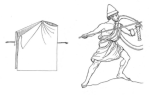
Prior to the Industrial Revolution, fabric was EXTREMELY time consuming to make, and as such, was extremely valuable. You have to grow your fiber, either in the ground or on an animal. You have to process the fiber. You have to spin the fiber. And spin, and spin, and spin. Spinning technology prior to the late Middle Ages consisted of a drop spindle. It takes forever and a day to spin enough thread to make fabric using a drop spindle – 10-30 times longer than to weave it, depending on how thick your yarn is and what weaving technology you are using. Then, once you are done with that endless task, you need to weave it. The examples in this post are all from Greece, where they used the warp-weighted loom, which is actually a rather efficient piece of weaving technology, but it’s still not as fast as the treadle loom (another late Middle Ages invention) and in no way comparable to a modern industrial loom (essentially the same machine as a treadle loom, but automated (except warping, which is still hell on earth even in 2018)). You know the saying “women’s work is never done”? That saying refers to the fact that unlike, say, field work, or mining, or smithing, spinning and weaving were started before dawn and carried on until after dusk, every day of the year, and there was always, always need for more.
After all of this, every piece of fabric that is made represents literally hundreds of hours of work. It is so valuable it was a standard form of currency before the invention of money. Egyptians piled linen high in their tombs as a show of wealth – and that linen was stolen by the grave robbers along with the gold and other precious artifacts. Textiles were one of the most valuable things you could steal when you pillaged a city. A primary reason for the warfare and raiding that was a consistent part of pre-modern Mediterranean/Near Eastern history was to acquire female slaves to produce textiles. Yes, cooking, cleaning, and sex were also reasons to acquire female slaves, but the economic reason was for textile manufacturing.
So if fabric is that valuable, you’re not going to waste it. You’re not going to make something tightly tailored, because as anyone who sews can tell you, cutting fabric to fit produces a lot of waste. In addition, the cloth of the ancient world was often much more loosely woven than cloth today, which is partly to do with weaving technology but most to do with the fact that the denser the cloth, the more threads there are in it, which means the more threads you have to spin for it, which means the time you have to spend making it has just gone up dramatically. Loosely woven cloth ravels like hell when you cut it, again as anyone who sews can tell you, and that makes it much more difficult to sew something nicely tailored. Needles and scissors are also items we take for granted, but are, in their modern form, relatively modern inventions and have, historically, been tricky items to make.
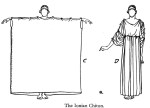
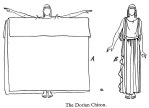
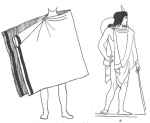
Thus, most of the clothing of the ancient Mediterranean/Near East was based on the rectangles of fabric that come directly off the loom. Much of China’s historical dress is similar, at least in the time frames we’re talking about. Throughout European/North African/Middle Eastern history, and in China until silk changed the game (at least for the rich), tailoring skill and technology has lagged behind cloth production skill and technology.
The famous painting from the early Renaissance where the woman is wearing a dress constructed using a truly obscene amount of fabric? That painting is often held up as an example of the sharp increase in the availability of material goods that is the hallmark of the European Renaissance (especially because it is of a merchant family and not nobles), and it is that. But it is also an example of a mode of dress that was difficult-to-impossible to achieve before the invention of the flyer wheel (for spinning) and treadle loom (for weaving), which made cloth take considerably less time to make and therefore considerably cheaper, and which also made cloth considerably more amenable to tailoring.
So yeah. You too would make fashion out of sheets if it took you most of a month of full-time work to produce one sheet.
I also want to point out that much of the historical dress of Sub-Saharan Africa and the Americas (in the places where cloth was used) is similar, it’s just based on narrow rectangles sewn together rather than large rectangles, because these are places where the backstrap loom and/or tubular loom remained the mainstay of weaving technology. Backstrap looms produce narrow lengths of cloth (15-18 inches is usually the limit), so with that weaving technology + some sewing, you get things like Central and South American ponchos and much of the traditional dress of Central and Western Africa.
After Ethan Allen’s death, Ira and Fanny Allen (his brother and widow respectively) fought over his estate for years. Ira wanted the house, which he had built on land he originally bought. Fanny wanted the linens. Let me repeat: Fanny Allen was perfectly fine with ceding her house to her brother-in-law *as long as she got all the linens*. Textiles were that economically important.
Tags:
#found this buried in my open tabs #history #interesting
the least realistic thing about star trek is that starfleet uniforms don’t have pockets and nobody complains about it
My instinct is to agree with this, but like, when I really think about it…
No money, no credit cards, identification is all vocal/fingerprints/retinal, so no wallet.
Again, doors are voice activated, or just unlocked by entering a code. No keys.
Communication devices are tiny and stick onto clothing starting in Next Gen. TOS had bulkier communication that they carried around or kept in, like, packs and stuff, so the arguments for pockets is a little more valid, and if I remember correctly, those costumes did have pockets, tho I could be wrong about that. But anything post TNG, the point is moot anyway.
Tricorders and phasers are really the only thing anyone’s carrying around, and that’s usually on away missions where they’d be bring their packs/holsters or just have them out. I mean, who wants to stick a phaser in their pocket?
So, yeah. There’s not much little stuff people need to carry around everywhere. And if they are preparing for a longer journey or want to bring bulkier things, well…just bring a bag. It fits more anyway.
what if i find a cool rock and want to take it home with me
Every time a member of the USS Enterprise has found a cool rock and taken it home, it has resulted in eleven deaths, six temporal displacements, the holodecks breaking again, and somebody getting turned into a lizard. Pockets are a privilege, not a right.
Tags:
#Star Trek #anything that makes me laugh this much deserves a reblog #death mention