imminent-danger-came:

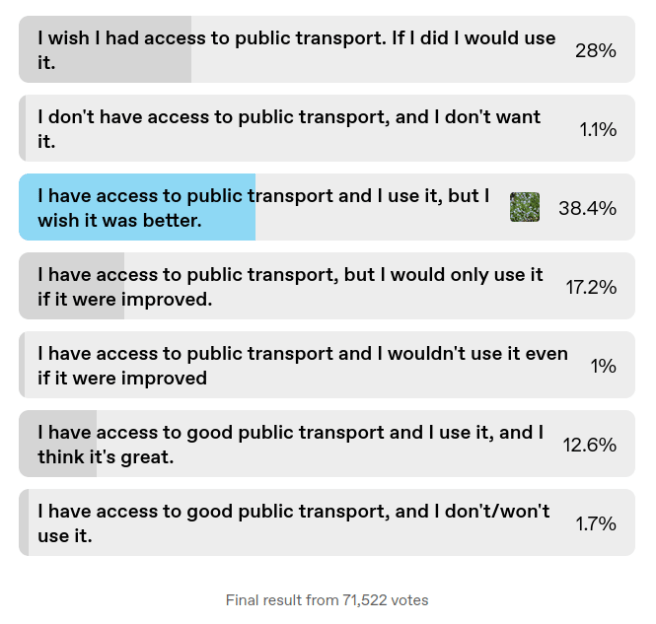
What are your feelings on public transportation?

public-transport-poll

Please re-blog to widen the data sample! I might use this for my statistics project at the end of the semester, and every answer is a great help :).

Please share in the tags what you picked and why if you’re so inclined.

Tags:

#reblogging this post to commemorate getting a subsidised bus card today #(and yes‚ I went to pick it up via bus) #(then I bought my mom some broccoli on my way home) #the transit here still has some improvements left to make to be truly Good #but it is *infinitely* better than it was when I first moved here‚ and I am grateful beyond words #keep up the good trajectory #adventures in human capitalism #proud citizen of The Future #surveys #this probably deserves some warning tag but I am not sure what
{{previous post in sequence}}


brin-bellway:

gasmaskaesthetic:

My verdict on Greyhound is that it is perfectly adequate if you are constrained by money more than time. It is worse in terms of comfort than driving my own car, but better in terms of not having to pay attention. It is worse than an airplane in terms of time, better in terms of cost for moderate distances, and better in terms of the logistics of boarding and luggage management. It is, imo, identical in terms of seat comfort except that so far it seems way more likely to have a near-empty bus for portions of the trip than a near-empty airplane. Greyhound does lose some points by not being as cool as flying and getting to see the tops of clouds + all the tiny ground people.

Bet it’s more miserable than a plane during the summer, though.

It continues to weird me out that nobody ever talks about the constant ear discomfort at altitude and horrible ear pain on descent when discussing the pros and cons of airplanes. Am I unusually sensitive to pressure changes? Is this only a problem on budget airlines?

A vehicle at ground level would have to try pretty hard to be more miserable than a plane. I *cried* last time I was on a descending plane, and I do not cry easily.

(I’m not sure how much pain my brother experiences *during* flight, but he *always* gets an ear infection after plane trips. Maybe there’s some genetic thing going on.)

I’ve been on two-hour Greyhounds a couple times as part of Girl Guide trips, and they seemed okay. Probably would be even better now that I have a smartphone: last time I was on a Greyhound I brought no Internet-capable computers because I didn’t have any light enough to be worth lugging around the whole trip, so I didn’t get to use the Wi-Fi.

Since I am trying to make it so that my Tumblr conversations are fully readable without needing the notes available [link], here is a list of distinct branches that responded to me:

http://theaudientvoid.tumblr.com/post/181528215565/my-verdict-on-greyhound-is-that-it-is-perfectly (@gasmaskaesthetic, @dagny-hashtaggart (unpingable), @theaudientvoid)

http://judiciousimprecation.tumblr.com/post/181529320774/my-verdict-on-greyhound-is-that-it-is-perfectly (@judiciousimprecation)

https://cadmiumwanderer.tumblr.com/post/181529991193/my-verdict-on-greyhound-is-that-it-is-perfectly (@another-normal-anomaly, @cadmiumwanderer (unpingable))

http://jadagul.tumblr.com/post/181530605313/my-verdict-on-greyhound-is-that-it-is-perfectly (@jadagul)

https://humanfist.tumblr.com/post/181538993961/my-verdict-on-greyhound-is-that-it-is-perfectly (@humanfist)

And here, since they have no links of their own, are the replies:

@moral-autism: “Anecdote:I chew gum and drink water on planes and I’ve never had more than momentary minor discomfort due to pressure”

@akaltyn (unpingable): “I have literally never had any ear issues flying and I used to fly near weekly for work”

Some context:

I don’t have all that much flying experience: I flew a few times around ages 5 – 7, then one round trip in 2015 (age 21). The initial 2015 flight had smaller peaks of pain but more discomfort at altitude: I think maybe my ears adjusted more on the return flight, but then had further to go to adjust *back*. I had a cold on the return flight†, but I don’t think I’d reached the sinus-problems stage yet.

I haven’t tried gum and hadn’t heard of the special earplugs: I’ll have to bear those in mind if/when I ever go on a plane again.

@jadagul: My nose clogs easily, but with regular maintenance I can breathe through it fairly well. I would not be surprised if my nasal passages are unusually small: my ear canals definitely are.

@another-normal-anomaly: I had problems with earwax clogs as a kid, but around age 13 I grew out my fingernails so that I could use the pinkies as scoops, and since then have had no wax clogs even though I haven’t been as good at keeping my nails long enough over the past couple years.

@judiciousimprecation: If the thing you do that you can’t describe is what this other post calls “working the rumble muscle”, I *can* do that but it hurts a bit. Might be the lesser of two evils in a pinch.

I suppose this whole thing would explain why some airlines have entertainment systems with an audio component: previously I’d just assumed the airlines fancy enough to do that also had better pressurisation, so your ears were actually functional enough for movie watching. (I wasn’t *completely* deaf, and I could have short conversations and IIRC hear the announcement system, but I was in no condition to watch a movie.)

†I had to get back home *somehow*, the tickets were already paid for, and I wore a surgical mask. (I also wore a surgical mask on the initial flight, which I suspect was the deciding factor in why I was only in the *early* stages of a cold by the time of the return flight: I bought myself an extra few days by contracting the neighbouring passenger’s cold indirectly through my foolishly mask-less family.) Still felt bad about it, though.


Tags:

#illness tw #reply via reblog #is the blue I see the same as the blue you see #the more you know

gasmaskaesthetic:

My verdict on Greyhound is that it is perfectly adequate if you are constrained by money more than time. It is worse in terms of comfort than driving my own car, but better in terms of not having to pay attention. It is worse than an airplane in terms of time, better in terms of cost for moderate distances, and better in terms of the logistics of boarding and luggage management. It is, imo, identical in terms of seat comfort except that so far it seems way more likely to have a near-empty bus for portions of the trip than a near-empty airplane. Greyhound does lose some points by not being as cool as flying and getting to see the tops of clouds + all the tiny ground people.

Bet it’s more miserable than a plane during the summer, though.

It continues to weird me out that nobody ever talks about the constant ear discomfort at altitude and horrible ear pain on descent when discussing the pros and cons of airplanes. Am I unusually sensitive to pressure changes? Is this only a problem on budget airlines?

A vehicle at ground level would have to try pretty hard to be more miserable than a plane. I *cried* last time I was on a descending plane, and I do not cry easily.

(I’m not sure how much pain my brother experiences *during* flight, but he *always* gets an ear infection after plane trips. Maybe there’s some genetic thing going on.)

I’ve been on two-hour Greyhounds a couple times as part of Girl Guide trips, and they seemed okay. Probably would be even better now that I have a smartphone: last time I was on a Greyhound I brought no Internet-capable computers because I didn’t have any light enough to be worth lugging around the whole trip, so I didn’t get to use the Wi-Fi.


Tags:

#reply via reblog #is the blue I see the same as the blue you see #Brin owns *two* 2010’s computers now


{{next post in sequence}}

sinesalvatorem:

sdhs-rationalist:

sinesalvatorem:

@dataandphilosophy said:

https://pedestrianobservations.com/2017/06/28/modeling-jitney-bus-competition/
An argument for socialist bus systems you might be interested in, if you haven’t seen it yet.

I think the main thing that bugs me about the argument is that it assumes riders will just get onto whichever bus arrives first, which is directly contradictory to my experience of private bus systems with high-volume routes. Enough so that I’m not really sure what they’re basing the assumption on.

The third assumption is that marginal riders take whichever route they see first.

My experience of a private bus system with a lot of variety in the buses was that people passed on buses they didn’t like and got into buses they did like. I even had a friend whose preferences were so weird that he would only ride a bus if it was painted red. He passed on most of the buses that arrived at his stop after school, but he still rarely had to wait more than 15 minutes.

However, the preferences people use for which bus to ride usually don’t map quite that way. Most often it’s social. The bus’s outer artwork announces its subcultural affiliation (and, implicitly, what music it plays), and this determines who wants to ride it, which in turn means people with a shared subculture often ride the bus together. Thus, you can choose to get on the Catholic bus, the Protestant bus, the Dancehall bus, the Calypso bus, the Hip Hop bus, etc.

How sensitive people are to the subcultural cues versus the timing is almost entirely a function of route volume, though. When getting on the bus at the main transit hub in the capital, the choice is almost entirely based on subculture. If all the buses are less than a minute behind each other, why wouldn’t you optimise for sharing the ride with people who share your tastes and values? At the bus stop outside my college, where the lag was closer to 3 minutes, maybe two thirds of people passed on the first bus they saw due to whatever bus preferences they might have. (I didn’t ask them individually; just eyeballed what fraction got onto each bus when the bus didn’t fill up.)

Meanwhile, on a low-volume rural route, I’d expect around three quarters of people to take the first bus that shows up. The folks most likely to pass are the elderly religious people who have all the time in the world and would wait for the grave rather than ride with teenage hip hop fans.

So, on a low-volume route, I would expect the article’s claims about schedule competition to hold true. In that case, competing on speed probably is what’s most valuable. This fits with my observation that the buses on rural routes drive the fastest. On the other hand, if the route is high volume, I’d expect market segmentation where sub-cultural concerns dominate. In much the same way that clothes cost so little today that all that matters is what your clothes mean.

OTOH, maybe I’m wrong about what would happen in the US. I’ve already noticed that I constantly over predict the social-focus of Americans, as I’m from a place with a much greater social focus. Maybe Americans don’t care enough about subcultures for that to determine their bus-taking habits? Or maybe there’d never be a sufficient number of buses on a route for the segmentation to kick in?

Or maybe American subcultures are the wrong size (too small to devote entire buses to or too large for a small number of buses to completely capture the market on a given route)? Or maybe they just care so much about timing that they wouldn’t wait two minutes for a bus with a more congenial social environment? As someone who’s often harassed on public transit, I would wait an hour if it got me a bus from a trans-friendly subculture.

But my best guess would still be that there’d end up being Red Tribe country music buses, and Blue Tribe indie music buses, and black hip hop buses,

and nerd buses playing video game soundtracks and anime themes, and buses with music in Spanish or Mandarin or Haitian Creole.

Empirical observation from israel(well, not perfect observation, since buses are subsidized) you always get on the first bus available, whether it’s urban or rural, unless it’s overfull enough to be unpleasant. Even for the subcultured buses.  (Why would you pick your bus for subculture? like, you either get on a bus with people you know and talk to them, or you read something for the whole ride, don’t randomly talk to potentially friendly strangers, ugh)

This makes me think that Israelis:

1. Are less likely to strike up conversations with strangers due simply to proximity. (seems extremely likely)

2. Don’t have strong preferences over the music they listen to on a bus ride. ([Redact]ians will often threaten to get off the bus if the driver plays the wrong artist. During the height of the Gaza-Gully feud*, the Dancehall buses had to split in two for the two opposing subcultures: Vybez Kartel fans and Mavado fans.)

3. There isn’t much variance in the behaviour of Israeli passengers between subcultures. (There is definitely a lot of variance among [Redacted]ian passengers. This is why I generally prefer to ride Christian buses over Dancehall buses, even though I have no desire for Christianity and much prefer Dancehall to Christian music. One set of passengers is quiet and reserved, while the other is loud and often aggressive, and that’s all it took for me to make the choice.)

Even with all this, I’d find it quite strange if Arabs,

Haredim, and secular Jews don’t self-segregate into different bus systems.

Side note: Around 10% of [Redacted]’s population is Seventh Day Adventist, but almost everyone else is a different kind of Christian, which leads to another interesting outcome: Most buses stop running on Sundays, except the SDA buses, which instead stop on Saturdays. Since SDAs tend to be more personally religious than other folks, the buses that run on Sundays lean more religious, which everyone has to put up with. This, plus lower traffic, makes Sunday market segmentation harder. I would anticipate the reverse pattern in Israel: That far fewer buses run on Shabbat and that they’re driven by religious minorities.


*If anyone’s wondering what the Gaza-Gully feud was, it was this thing:

“Gaza” refers to a swath of the working-class town of Portmore, home of Vybz Kartel, the man voted, in a recent poll, the island’s most popular dancehall artist. “Gully” is for the Kingston neighborhood (a line of shacks, really, along a stretch of gully known as Cassava Piece) where fellow dancehall star Mavado was born. Initially, the two were musical teammates, protégés of the artist Bounty Killer, but since 2006, they’ve engaged in near-constant lyrical warfare. In track after X-rated track, Kartel has called Mavado a pseudo-gangsta, dubbing him “Mafraudo” and claiming to have had sex with his mother. Mavado retorted that Kartel was, among many other things, a “battyman” (a gay slur, in a country that takes such accusations very seriously), a skin-bleacher, and an atheist. The feud came to a head at a major stage show in late 2008, when the two stood face to face before a rowdy crowd—Kartel decked out in full army gear, Mavado sporting a Lone Ranger–style black maskand engaged in a heated clash, hurling insults at each other as Kartel carted out a coffin with “R.I.P. Mavado” printed on it. Soon thereafter, Mavado abruptly marched offstage.

After this show—at which fights were said to have broken out between fans, who still argue passionately about whether Mavado or Kartel was the victor—the feud intensified to the point where much of the dancehall community, along with legions of fans, were compelled to decide: Are you with Gaza or Gully? In the Jamaica Gleaner, critic Ian Boyne lamented the fact that entire dance sessions and even neighborhoods were dangerously divided: “If your car is even passing one of these sessions, and you don’t happen to know whether it is Gaza or Gully territory,” he wrote, “you are in danger. You don’t even have the right to play the opposing gangster in your own car or SUV. What a life!” Even the fastest man on earth took sides: At Usain Bolt’s post-Olympic welcome-home party, the gold medalist allegedly marched into the DJ booth and decreed that only “Gaza” tunes should be played at his parties. “And anybody nuh like dat,” he supposedly declared, “can jump inna gully.”

The feud generated such attention that in December 2009—a year cursed by Jamaica’s highest-ever murder rate—the country’s two most-high-profile men intervened. Prime Minister Bruce Golding, who previously called the Gaza-Gully conflict “one example of the negative influences that destabilize us as a people,” requested a meeting with the two artists. Before and after the powwow, which involved four government ministers and a bishop, Mavado and Kartel strutted through the prime minister’s office providing myriad photo ops: shaking hands, laughing like old pals, and modeling shimmering jewels and designer shades.

The real peace decree, though, came just before the meeting, when the two DJs took the stage together at a Kingston concert and Kartel called Mavado “my brother.” The performance was, by all reliable accounts, coordinated by so-called community leader Christopher Coke, a/k/a “Dudus”: current target of a U.S. extradition request on drug- and weapons-trafficking charges and the son of gangster icon Jim Brown, who was the founder of the legendary Shower Posse gang that ran much of Jamaica, New York, and Miami in the ’80s.

[WTF-est lines bolded]

The Caribbean is fuckin’ wild.

Wait, buses play music?

My experience is pretty limited and I haven’t been on any in a while, so I might be misremembering, but I don’t remember ever hearing any music on a bus or indeed any form of mass transportation. (not counting headphones and such, obviously)

Is there music on buses in the Bay? Was there music on the buses you took in Canada?


Tags:

#reply via reblog #also that article quote is pretty WTF