my mom lives in NC and during the summer the treeline behind her house lights up with so many fireflies that it looks like flickering stars in a darker part of the night sky
in suburban michigan you may see a single firefly at night and it will be a Big Deal. if you go to the more wooded areas, you’ll see them flashing on and off regularly (still not that intense though)
Some places have fireflies and some places do not and the places that do not are WRONG AND BAD BECAUSE FIREFLIES ARE WONDERFUL AND AMAZING.
Raising a child in a place that does not have Sufficient Fireflies is basically ALMOST AS TERRIBLE as gendering your child, which is very terrible indeed.
(</sarcasm>. Except about the “gendering children is terrible”. And the “fireflies are awesome”. But it’s okay and not abuse if there are no fireflies, I guess. Even though fireflies are awesome.)
I have seen, like, one firefly (or maybe another luminous flying bug?) every few months in the couple Caribbean countries I’ve lived in. It seems to be completely unrelated to seasons there.
I miss New Jersey’s fireflies. I haven’t seen a firefly since I moved to southern Ontario.
(To be fair, I don’t go out at dusk very often here, so it’s possible there’s some around and they’re just less blatant.)
Tags:
#reply via reblog #home of the brave #our home and cherished land
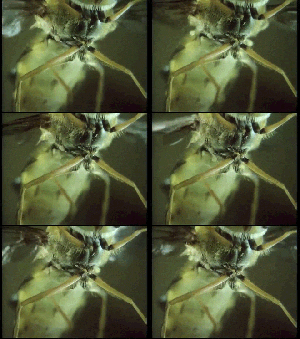
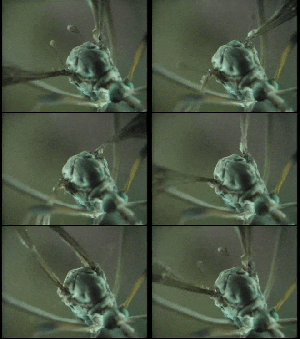
A Hoverfly (Family Syrphidae) and a Cranefly (Family Tipulidae) showcasing their halteres. Halteres are small knobbed structures that were modified from the fly’s back pair of wings. They function like a gryroscope and give the fly stability in flight. When they beat they inform the fly about the rotation of its body allowing the fly to adjust. With their halteres balancing and guiding them flies are able to preform amazing aerial aerobatics. Making them very hard to catch
Recently I saw my friend’s dog scratching his ear a suspicious amount, and the first thought that came to mind was “~follow for more flea-avoidant speciesism~”
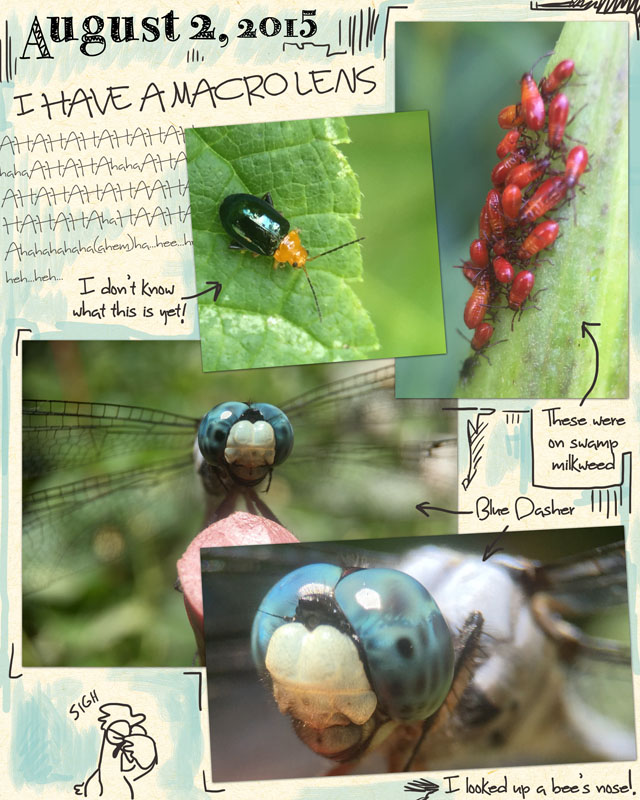
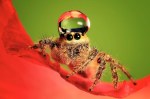
t’s an Olloclip for my phone. All of these are at 7x magnification. It goes up to 21x, but at that point I feel like I’d be taking photos of individual grains of pollen.
I’ve had macro lenses before, but not since I changed phones awhile ago, and I tend to go a little mad every time I get a new one. All unknown bugs are submitted to bugguide.net for ID, so hopefully I’ll know soon!
(Someday I’ll shell out for the lens on the good camera and THEN we’ll see some hot bug action!)
Nothing wrong with taking photos of individual grains of pollen.
Tags:
#bugs #I took a picture of a beetle with my phone recently #but I don’t have a magnifier so it’s not as awesome a picture #what was awesome was that it went like this: #’Hey that’s a neat beetle on Dad’s leg.’ #Dad (not seriously): ‘We should take a picture of it.’ #Me: ‘…hey wait a minute *I have a camera on my phone*’ #’*I’m totally going to take a picture of it*’ #Me: *boots up phone* *takes picture* #(it was already off his leg and in the grass by that point) #(but oh well)
There are really only four known groups of spiders with medically significant venom- the rest can’t do much worse than a bee sting. (Of course, some individuals can have allergic reactions to spider venom, just like bee stings.)
These four groups are: the widows (Latrodectus sp.), the brown spiders (Loxosceles sp.), the Australian funnel web spiders (Atraxus sp.), and the Brazilian wandering spiders (Phoneutria sp.).
Black widows are found across the U.S. and in parts of Africa, Europe, and Asia. Despite their reputation, most black widow bites are harmless. Many are dry, with no venom injected, and about 75% of those that do contain venom only produce localized pain with no other symptoms.
Occasionally, more severe symptoms do develop in the form of latrodectism. This can cause symptoms such as generalized pain, headache, nausea, sweating, and racing heart. Most of these symptoms resolve within a week and for more severe cases, an antivenom is available. There has only been one death recorded from a black widow bite in US in the last 50 years, and it was an elderly man. Several thousand people in the US get bitten by black widows every year without suffering any major ill effects.
The brown spiders include the brown recluse spider, famed for its necrotizing bite. However, as with the black widow, the deadliness of this spider has been greatly exaggerated. Like the black widow, brown spiders are found worldwide. Also like the black widow, their bites are often venom-free, and even envenomated bites produce nothing more than mild irritation.
Here’s a map of where brown spiders are found in the US:
The brown recluse is very rare in Ohio specifically, so you don’t have much to worry about.
Bites with high concentrations of brown recluse venom can produce a necrotic skin lesion that is slow to heal. About 66% of these lesions heal on their own without complications. Those that do not may require skin grafts or corrective surgery. A systemic response, which is the response that may become fatal, occurs in about 1% of bite victims. In the last decade there have been two recorded fatalities from brown recluse bites, and both were young children. And as a matter of fact, there are no confirmed reports of a necrotizing bite leading to amputation.
Interestingly enough, there are lots of reports of brown recluse “bites” from states where there are no brown recluse spiders. Spiders often get blamed for symptoms that come from everything from lyme disease to lymphoma. My state is not within the brown recluse range and I’ve still heard stories from a number of people who insist they were bitten by the spider.
Australian funnel web spiders are found, obviously, in Australia- specifically along the eastern coast. While it is suggested that these spiders are more likely to give “wet” bites than the others on this list, there have been no recorded fatalities from their bites in Australia since 1981!
Brazilian wandering spiders are found in parts of Central and South America and are the most venomous spider on this list. This venom, among other things, may give you a lasting erection, which is why some pharmaceutical companies are researching it for use in erectile dysfunction drugs. These spiders are the famed “banana spiders” because they have been found on shipments of bananas outside of South/Central America; however, there are only seven actual recorded cases of this happening. Only about 2.3% of wandering spider bites are medically significant, and again, there have been very few deaths attributed to them.
Spiders, by and large, do not pose a threat to you anywhere in the world.
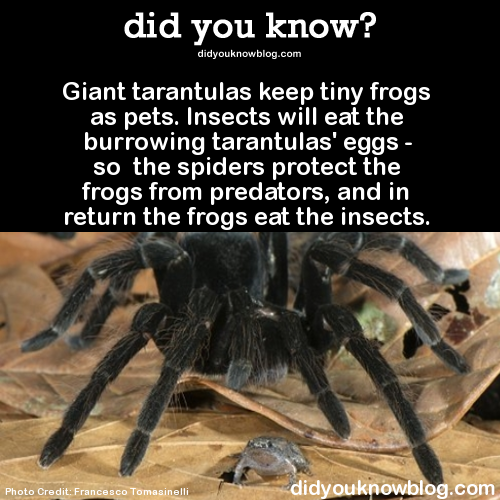
Giant tarantulas keep tiny frogs as pets. Insects will eat the burrowing tarantulas’ eggs – so the spiders protect the frogs from predators, and in return the frogs eat the insects. Source
This has blown my mind for years. It’s so unreal. It’s almost the same exact reason humans and cats started living together.
Tiny frogs are tarantula housecats. A science fact seldom gets to sound that much like meaningless word salad.
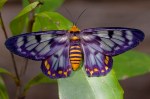
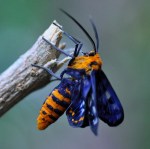
The tropical genus Dysphania includes some of the largest and most colorful moths of all the Geometridae. Dysphania numana is one of the largest moths for the family, reaching a wingspan of up to 8 cms. Whilst being somewhat variable, they are generally dark blue with clear areas in the wings, and an irregular row of orange spots around the outer edge of each hind wing. The body is banded in dark blue and orange.
This species can be found in Australia and also in Indonesia.
It is indeed one of the most beautiful moths I’ve ever seen.