#our home and cherished land #(my 10th anniversary of moving to Canada is not until September) #(but this is the 10th *Canada Day*) #I’m either going to a museum or an open-air festival or both depending on the rain patterns #I’m going to go put my citizenship pin on now #oh look an original post #anniversaries #\o/
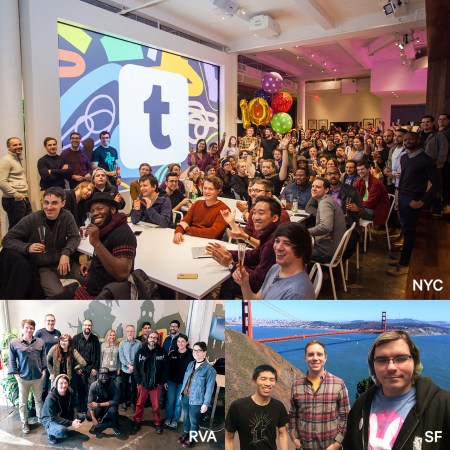
10 years ago this Sunday, with modest expectations and little fanfare, Marco and I launched a side-project called Tumblr—a place where anyone could “post anything and customize everything.”
Why did the world need Tumblr? I wasn’t sure it did. But I did.
2006
The net is vast and infinite. The web browser has become a multimedia powerhouse. “Social media” is upending news and entertainment. One-year-old YouTube has created a phenomenon of “viral video.” Google hits for “podcast” have jumped from 100-thousand to 100-million in less than a year. Twitter has just launched. And the “blogosphere” has become the voice of millions, with the total number of blogs now doubling every six months. Dope.
But for all this progress, some of the internet’s brightest promise is fading. The wide-open and whimsical frontier of the World Wide Web is being reshaped by strict, narrow platforms. Our pictures, videos, music, journals, articles, links, status updates, are spread across a dozen different networks—each specializing in a single medium. The infinitely expressive canvas of HTML has been eclipsed by directories of vanilla-white profile pages. Our digital identities are fractured and engineers make the rules.
Enter TumblehubTumblespot Tumblr, a modest solution inspired by an avant-garde community of bloggers calling themselves “tumbleloggers.” The premise, simply, to make space for each individual’s full range of expression. A median between the author’s unfiltered and editorial voice. With complete control over design and presentation, so anyone can create something that truly represents themselves and that is truly unique.
2007
After four months of running my own blog on Tumblr, making tweaks and improvements, we open to the public. Hundreds of thousands of people begin using Tumblr to share some of the most eclectic, clever, and beautiful things we’ve ever seen on the internet.
We are humbled and awestruck.
Racing to keep up, every feature we add attempts to stretch the canvas a little bit more, pushed by this community’s constant and boundless creativity. Five months in, you have captured our hearts. We work up the courage to pursue Tumblr full time.
With a new purpose and braveinvestors, we close down our web development business and reopen as Tumblr, Inc.
2017
336 million Tumblrs. 146 billion posts. And counting.
A generation of artists, writers, creators, curators, and crusaders that have redefined our culture.
I can’t say this enough: Thank you, thank you, thank you for making Tumblr everything that it is. For everything we’ve built, and all its shortcomings, you have managed to make this one of the most creative, lively, thoughtful, supportive, and open-minded corners of the world.
We have learned so much from you and been so moved by your voices.
The Next Ten Years
The internet is at a crossroads again.
Internet culture has become the prevalent, global culture. These networks expose us to new ideas and information but–too often–trap us in bubbles. The world has been compressed, and we are constantly challenged to reconcile our differences.
With so many barriers to digital expression now lifted, and nearly all modes of media supported across all platforms, there is now an unprecedented opportunity to dedicate this space to freedom, truth, expanded perspective, and positive influence in the world. Tumblr’s focus over the next decade will shift accordingly.
Expression has been and always will be a foundational part of Tumblr—and our roadmap this year will not disappoint—but it is now more urgent than ever to empower positive and productive connections across the communities that thrive here. To create an environment where people are truly safe to be themselves. To ensure positive discourse rises above toxicity. And to protect the free exchange of ideas, from which truth will emerge.
We still have so much to prove and so much we’ve promised you. With this renewed focus, we are determined to deliver.
One Last Thing
From the bottom of my heart, thank you to everyone working on, and who has ever worked on, Tumblr. I’ve learned so much from all of you, and it is a privilege to come to work with so many brilliant and talented people. We couldn’t have done any of this without your maniacal devotion throughout this journey.
#anniversaries #(a day late but I only just saw this) #Tumblr traditions #wait does this actually predate Tumblr? #*looks at Wikipedia* #technically no (that was Feb 2007) but it probably still predates Tumblr getting popular
✶8 September 2016 “Star Trek speaks to some basic human needs: that there is a tomorrow — it’s not all going to be over with a big flash and a bomb; that the human race is improving; that we have things to be proud of as humans. No, ancient astronauts did not build the pyramids — human beings built them, because they’re clever and they work hard. And Star Trek is about those things.” – Gene Roddenberry
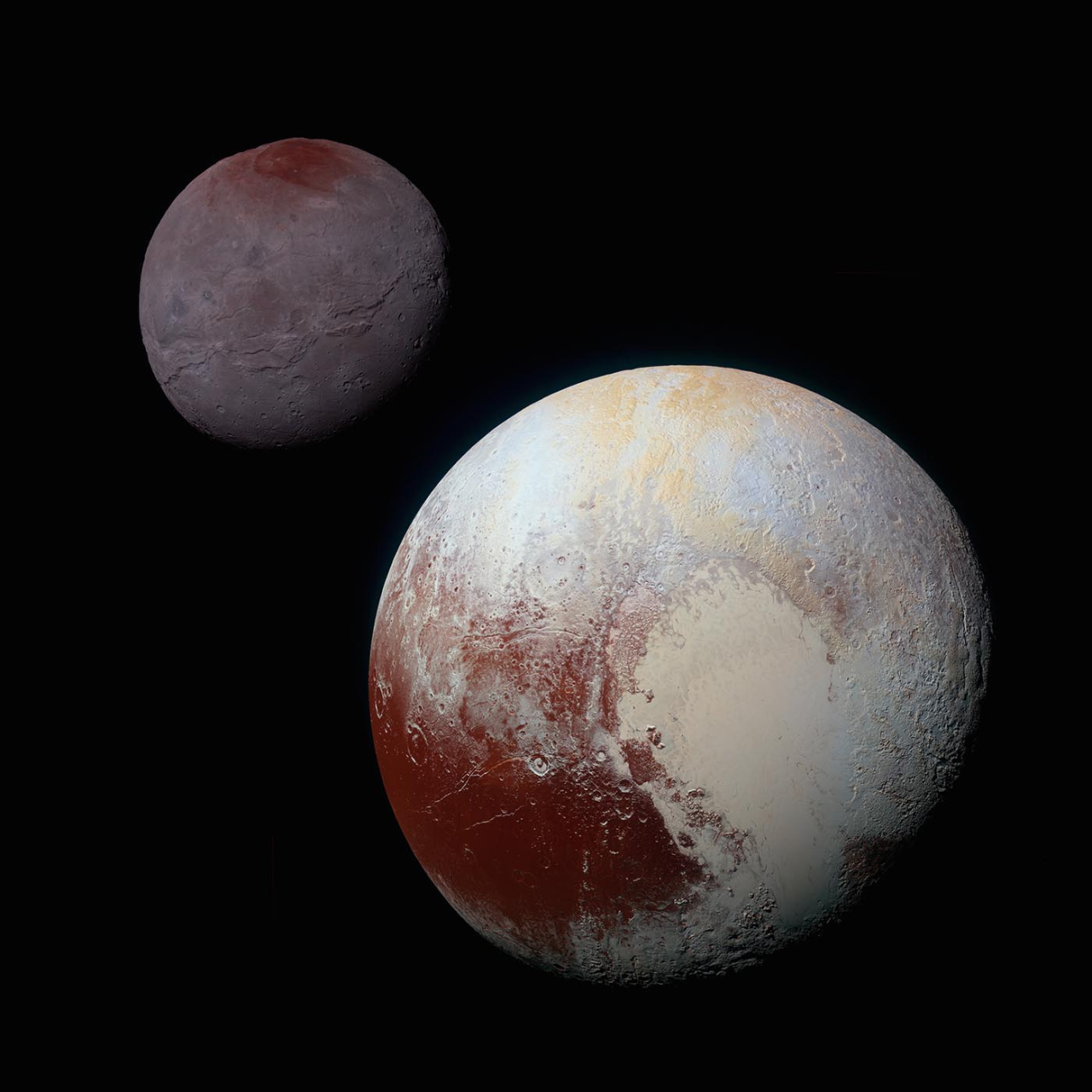
Today ten years ago an IAU resolution stated an official definition for the term “planet” who ultimately excluded Pluto as a planet of our Solar System, and reclassified it as “dwarf planet”.
Image via NASA: What Is Pluto? Caption: The New Horizons spacecraft helped us see Pluto and its largest moon Charon more clearly than we could see them with telescopes.
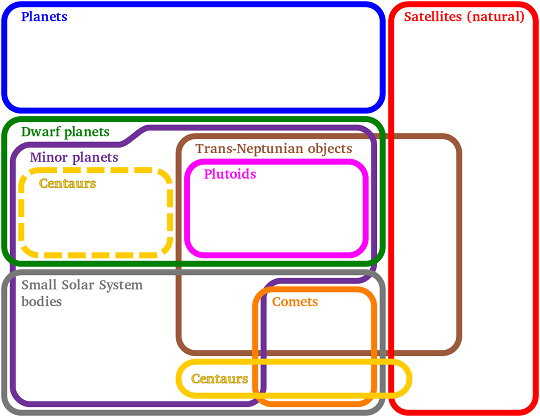
A Euler diagram showing the relationship between objects in the Solar System (excluding stars) – Wikimedia Commons
huh, so what we were taught in school were actually Euler diagrams, but *called* Venn diagrams for some reason
Yeah, technically a Venn diagram shows all possible intersections. The ones that are empty are sometimes shaded black, but they’re there regardless. Silly wikipedia image showing Venns morphing into Eulers:
#anniversaries #(apparently this was on the 24th) #Pluto #today I was reading about the outer solar system in my astronomy textbook #2014 edition #there was a remnant Pluto section in the ”outer planets” section basically explaining #why Pluto was no longer considered a planet and would be described in more detail in the ”other solar system bodies” chapter #it referred to the New Horizons fly-by in the future tense #there were no pictures #because nobody had ever seen what Pluto looked like #(the educational video next on my to-do list tomorrow was made in 2006) #(I think I already caught them re-dubbing a previous section involving Pluto) #(the picture showed nine planets orbiting the sun) #(while the voiceover) #(which–while the same narrator as the rest of the series–didn’t sound like it was quite of a piece with the rest of the narration) #(talked about eight planets and oh yeah there’s a dwarf planet in here too) #((I’m *probably* overstating that last bit but anyway)) #adventures in University Land
The first victim could not have been recorded, for there was no written language to record it. They were someone’s daughter, or son, and someone’s friend, and they were loved by those around them. And they were in pain, covered in rashes, confused, scared, not knowing why this was happening to them or what they could do about it – victim of a mad, inhuman god. There was nothing to be done – humanity was not strong enough, not aware enough, not knowledgeable enough, to fight back against a monster that could not be seen.
It was in Ancient Egypt, where it attacked slave and pharaoh alike. In Rome, it effortlessly decimated armies. It killed in Syria. It killed in Moscow. In India, five million dead. It killed a thousand Europeans every day in the 18th century. It killed more than fifty million Native Americans. From the Peloponnesian War to the Civil War, it slew more soldiers and civilians than any weapon, any soldier, any army (Not that this stopped the most foolish and empty souls from attempting to harness the demon as a weapon against their enemies).
Cultures grew and faltered, and it remained. Empires rose and fell, and it thrived. Ideologies waxed and waned, but it did not care. Kill. Maim. Spread. An ancient, mad god, hidden from view, that could not be fought, could not be confronted, could not even be comprehended. Not the only one of its kind, but the most devastating.
For a long time, there was no hope – only the bitter, hollow endurance of survivors.
In China, in the 10th century, humanity began to fight back.
It was observed that survivors of the mad god’s curse would never be touched again: they had taken a portion of that power into themselves, and were so protected from it. Not only that, but this power could be shared by consuming a remnant of the wounds. There was a price, for you could not take the god’s power without first defeating it – but a smaller battle, on humanity’s terms. By the 16th century, the technique spread, to India, across Asia, the Ottoman Empire and, in the 18th century, Europe. In 1796, a more powerful technique was discovered by Edward Jenner.
An idea began to take hold: Perhaps the ancient god could be killed.
A whisper became a voice; a voice became a call; a call became a battle cry, sweeping across villages, cities, nations. Humanity began to cooperate, spreading the protective power across the globe, dispatching masters of the craft to protect whole populations. People who had once been sworn enemies joined in common cause for this one battle. Governments mandated that all citizens protect themselves, for giving the ancient enemy a single life would put millions in danger.
And, inch by inch, humanity drove its enemy back. Fewer friends wept; Fewer neighbors were crippled; Fewer parents had to bury their children.
At the dawn of the 20th century, for the first time, humanity banished the enemy from entire regions of the world. Humanity faltered many times in its efforts, but there individuals who never gave up, who fought for the dream of a world where no child or loved one would ever fear the demon ever again. Viktor Zhdanov, who called for humanity to unite in a final push against the demon; The great tactician Karel Raška, who conceived of a strategy to annihilate the enemy; Donald Henderson, who led the efforts of those final days.
The enemy grew weaker. Millions became thousands, thousands became dozens. And then, when the enemy did strike, scores of humans came forth to defy it, protecting all those whom it might endanger.
The enemy’s last attack in the wild was on Ali Maow Maalin, in 1977. For months afterwards, dedicated humans swept the surrounding area, seeking out any last, desperate hiding place where the enemy might yet remain.
They found none.
35 years ago, on December 9th, 1979, humanity declared victory.
This one evil, the horror from beyond memory, the monster that took 500 million people from this world – was destroyed.
You are a member of the species that did that. Never forget what we are capable of, when we band together and declare battle on what is broken in the world.
Happy Smallpox Eradication Day.
I handed out, like, 15 copies of this essay today!
Tags:
#illness tw #history #anniversaries #proud citizen of The Future #may or may not have reblogged this before
Maybe because I just finished a whole DS9 re-watch the other week, and so it’s fresh in my mind, but when I saw today on twitter that it’s the 16th anniversary of the finale of Deep Space 9… well, I just felt like reminding everyone else, too!
How many of you where there to watch it broadcast, I wonder? I was in the end of my freshmen year of high school at the time, and still remember getting teary eyed at the end moments. Anyone else there to see it end?
Tags:
#Star Trek #DS9 #anniversaries #(I wasn’t watching it then)