prismatic-bell:
Okay, so.
My preference is “yes.” Yes, I want you to archive them. Yes, I want you to save them. I’ve worked to preserve 1960s teen pulp mags, for fuck’s sake, it can’t get much worse than that, and I’m grateful to have them.
With that said, pick any or all of the following options to make your physical printouts last longer:
–select acid-free paper
–bind by sewing, not stapling
–store in archival sleeves, like the ones you use for old comic books
And now, pick any or all of the following options to make my life easier as a historian (or, you know, the lives of the historians who come after me):
–include the title
–include the author’s name
–include the fandom name
–include which version of the canon, if relevant (e.g. the OG Transformers show vs the Michael Bay movies)
–include the date, or at least year, of publication
–include the summary
–include the site of origin, including the URL
All of these things are called provenance and help not only to identify a specific work, but to place it within its cultural context. As an amusing example: I recently got into James Bond, and decided to go through every fic in the main pairing tag, in chronological order. There came a point where suddenly, out of nowhere, there were like two solid pages of nothing but A/B/O, which I previously had not seen at all. I had a suspicion, so I looked it up, and sure enough–those two pages appeared within just a couple of weeks of the corresponding Supernatural episode. Having publication dates let me determine that. If I were a historian trying to piece together a long-ago puzzle instead of going “lol I live on the hellsite, I bet I know exactly where this came from,” that would be a huge datapoint. I could probably find a similar sudden explosion in other fandoms, as well–and if we’re going far enough in the future, if Supernatural were to just vanish off the face of the planet along with its entire fandom, historians could still trace that it existed and even determine some of its events based on when certain tropes begin to appear in other fandoms. And further, the fact that its tropes and major events appear in so many other fandoms would allow those historians to say “this must have been a very, very popular story.” (This isn’t just me making shit up to sound important, by the way. This is literally how we have records of a lot of things throughout antiquity and even into the Renaissance. The more copies there are of something, or the more references that are made to a thing in other things, the more likely it is for at least part of it to survive. This is literally how we know about Shakespeare’s two lost plays–he was a popular enough playwright that quartos of his plays were advertised for sale.)
Whew! Now let’s get into stuff you could do that would make me, as a historian, scream with delight if I were to open your folder full of labeled, acid-free fanfiction fifty years from now:
–write a little something about why you picked this particular fic to preserve in hard copy when doing so is bulky and time-consuming compared to the easy instant storage of the internet, yes, even if your reason is “I’m trying not to use my phone in bed because the screen keeps me awake but this story is soothing to reread”
–write a little something about who you are, even if it’s just “my name is X, my age is Y, I live in Z, I printed this out in 2022”
And last but not least:
Marginalia. Marginalia. Marginalia, my beloved. That’s when you write your thoughts in the columns on the sides, underline stuff, circle it, and so on. Having marginalia means I actually get a window into your thoughts as you read–your perspective, stuff that stuck out to you, places the story made you feel some kind of serious emotion. And yes, this goes for everything. Villain A kills Hero B and you write “YOU MOTHERFUCKER” in the margin, that tells Future Historian Me that you really loved Hero B, you were invested in seeing her succeed, and that this scene really resonated with you. One of my most treasured possessions in the fandom museum is a copy of the novelization of the Help! movie the Beatles did. This particular copy is very worn–unsurprising, it was a cheap paperback even when it was printed–but also, its original owner apparently took it to the movie theatre and
wrote notes in the margins indicating all the things happening onscreen that weren’t in the book. What does this tell me? WELL. Let’s go ahead and take a look:
1) the written ink doesn’t look any newer than the book, so I’m guessing a little when I say this was the original owner and in the theatre, but I have an actual datapoint I’m basing that on
2) based on handwriting and the main demographic of the Beatles audience at the time, this was a young woman, probably a teenager.
3) she went to see the movie more than once (some notes are in pencil, some in ink, but the handwriting is all the same)
4) she was dedicated to making sure every moment of the movie was preserved. This was an era before home video players, so once the movie left theatres, she had no guarantee of seeing it again.
5) while the book is worn, it’s not beaten all to shit. It was read a lot, but there’s no evidence it was mistreated, so it was probably a prized or at least respected possession.
What can I extrapolate from this, with the understanding that I mean “what theories can I reasonably form but not prove”? Well. She was probably a pretty big fan, since she went to see the movie at least twice and also bought the book. Maybe she wanted to keep the story after the movie was gone. Maybe she was looking for answers for some teen mag contest like “find these things in the Help! movie and win a chance to meet the Beatles.” Maybe she had a friend who wasn’t allowed to go to the movie. You know what the most tantalizing possibility is to me, although I’ll never be able to prove it and actual ethics as a historian mean I can only present it as one among many possibilities? Maybe she did it as a source reference for writing fanfiction. We don’t know. We can’t know, because I have no idea who the original owner was or if she’s even still alive and no way to trace her. But that? In terms of fandom history, that is a fucking gold mine. Pure 24-karat all through. From a strictly historical view, that’s worth more than the animation cel I’ve got in there, and I paid over a hundred bucks for that thing.
So yeah! That was a lot of words to say “just do it.” But there’s your answer!
changeling-droneco:
Oh this is super helpful I had never even HEARD of acid-free paper before this, and I had no idea how important things like dates and notes in the margins could be! Also gives me an excuse to practice sewing again for the first time in years if stapling isn’t the best idea. I still have plenty of my own research to do because I care deeply about a lot of these stories and I want to do them justice. I’m also just really glad there’s people like you who go “Who cares if its a shitty first attempt? I have worse and I love it immensely not just despite of it but in some ways because of it!” it really takes the edge of my anxiety about not being perfect.
prismatic-bell:
LAST TIME, ON “NINA BLOGS FANDOM HISTORY”:
Make me scream in glee by doing these things!
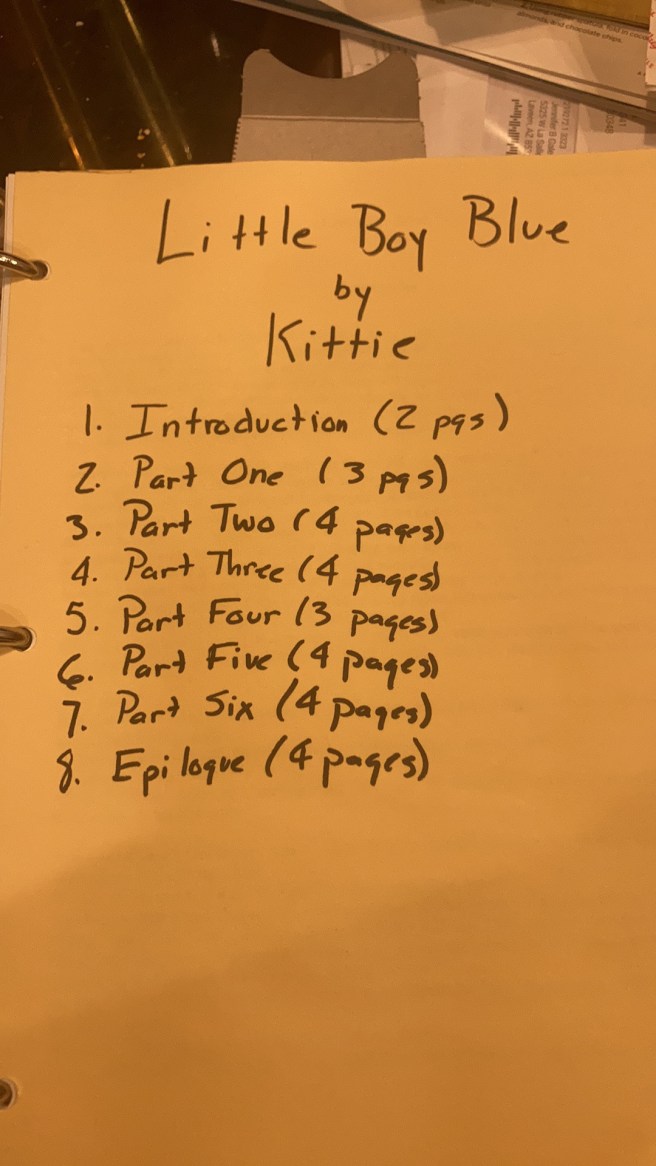
@sailorzeo can confirm she just saw me do just that, when she handed me an old book of printed fanfiction (actual quote upon her finding it: “SQUEEAK!!”). I’m looking through it right now, and when I say whatever you write, WHATEVER you write, provides provenance and context?
This is from 1996. Today it would almost certainly be measured in total word count. But in Ye Olde Days, you had to watch how much content you were putting per part because dial-up was slow and people wanted to read their fic when they were still young; measuring in pages or K/KB (kilobytes, not thousands) was the standard.
This is literally a look at the customs of fandom before broadband or even DSL were widespread. And it’s a single handwritten page. Look at everything there! How Zeo (and the author) chose to organize it; the length compared to modern-day fic; the way it’s segmented. (Looking at the fic itself, the formatting is also way different than modern formatting. Good, but different.)
And at least in theory, via the Wayback Machine or archive.org, I could still go find this fic online, because the name of the webpage is included on the printouts.
WRITE. YOUR. PROVENANCE.
starsdreaming:
I’m going to add a little bit that will make historians love you even more when you write the provenance down. Add the date you downloaded the fic.
When you are sourcing online information for research papers and the like, you have to put the date you found the info, because it can change on the web page. The information on the reference page is roughly
“Author, title, journal name, volume, number, year, url, date accessed” or
“Author, title, url, date accessed” for something short
prismatic-bell:
Important addition.
moreroads:
…..i have thousands of words worth of comments that Ive left on fic. many that have been replied to and that I still have access to download also……
do….do historians want that too?
@prismatic-bell
prismatic-bell:
YEP.
Just the idea thrills me. Comments are a form of marginalia! They’re sharing your thoughts, but with the author this time. The fact that we can do that so instantly is unmatched in history and it absolutely changes the way people engage with the text.
Tags:
#history #101 Uses for Infrastructureless Computers #fandom #amnesia cw? #this post was queued because my to-reblog list is too long and I didn’t want to dump it on you all at once #P.S. this‚ the only Backup Awareness Week post that was *already* in my queue before Backup Awareness Week hit #concludes our queue of Backup Awareness Week posts #be safe out there #(P.P.S. this afternoon‚ 2023-11-10‚ I was thinking over which fics to maybe do this with while I was washing dishes) #(this dusk I saw the post again while rearranging my queue) #(and‚ I want you to know‚ an hour later a new chapter of ”Give These People a Break” came out) #(and…yeah‚ if I end up doing this I’m doing that one first) #(it is important to know that you are not alone)