Concept: a D&D-style fantasy setting where humanity’s weird thing is that we’re the only sapient species that reproduces organically.
Dwarves carve each other out of rock. In theory this can be managed alone, but in practice, few dwarves have mastered all of the necessary skills. Most commonly, it’s a collaborative effort by three to eight individuals. The new dwarf’s body is covered with runes that are in part a recounting of the crafters’ respective lineages, and in part an elaboration of the rights and duties of a member of dwarven society; each dwarf is thus a living legal argument establishing their own existence.
Elves aren’t made, but educated. An elf who wishes to produce offspring selects an ordinary animal and begins teaching it, starting with house-breaking, and progressing through years of increasingly sophisticated lessons. By gradual degrees the animal in question develops reasoning, speech, tool use, and finally the ability to assume a humanoid form at will. Most elves are derived from terrestrial mammals, but there’s at least one community that favours octopuses and squid as its root stock.
Goblins were created by alchemy as servants for an evil wizard, but immediately stole their own formula and rebelled. New goblins are brewed in big brass cauldrons full of exotic reagents; each village keeps a single cauldron in a central location, and emerging goblings are raised by the whole community, with no concept of parentage or lineage. Sometimes they like to add stuff to the goblin soup just to see what happens – there are a lot of weird goblins.
Halflings reproduce via tall tales. Making up fanciful stories about the adventures of fictitious cousins is halfling culture’s main amusement; if a given individual’s story is passed around and elaborated upon by enough people, a halfling answering to that individual’s description just shows up one day. They won’t necessarily possess any truly outlandish abilities that have been attributed to them – mostly you get the sort of person of whom the stories could be plausible exaggerations.
To address the obvious question, yes, this means that dwarves have no cultural notion of childhood, at least not one that humans would recognise as such. Elves and goblins do, though it’s kind of a weird childhood in the case of elves, while with halflings it’s a toss-up; mostly they instantiate as the equivalent of a human 12–14-year-old, and are promptly adopted by a loose affiliation of self-appointed aunts and uncles, though there are outliers in either direction.
The so-called goblinoid peoples are variations on the same formula, and may well emerge from the same cauldron, depending on who’s been screwing with the ingredients lately. They’re very morphologically plastic – it’s not unheard-of to encounter a kobold and an ogre who count each other as siblings.
It really depends on the folks in question. Elves are of course familiar with sexual reproduction, since that’s how the animals they upllift themselves from do it – though most of them would prefer to keep that end of the business at arm’s length – and goblins know all about emerging into the world naked, screaming, and covered in noisome ichor; they just think the human way of doing it sounds awfully hard on the mom!
Anyway, noodling around with questions in the notes about “crossbreeding”:
The process of creating a dwarf requires that a majority of the contributing craftspeople be dwarves, or else it just doesn’t work, but otherwise there’s no particular rule against including non-dwarves. There’s a fair amount of leeway both in fashioning a dwarf’s physical form and in composing the documents inscribed upon its skin, so cross-species “parentage” is really about incorporating non-dwarven artistic and philosophical influences.
Elfhood is a matter of acculturation, so in principle anybody can become one. In practice, the learning process is considerably more difficult and time-consuming for creatures who already have their own sapience and culture, so conversion to elfhood is uncommon outside of cases like human fosterlings raised by elves, or a non-elf becoming an elf’s spouse. Such individuals may not be fully accepted in certain communities; “half-elf” is one of the politer pejoratives they’re saddled with.
You can make goblins that display “inherited” traits by using pieces of flesh as alchemical ingredients, but doing so with the flesh of other sapients is strongly frowned on. Using the flesh of animals to incorporate selected traits into the next generation is far more accepted, and in fact, some goblin communities do so strategically to meet local needs; for example, you can totally get a batch of arboreal goblins by just chucking a whole fucking squirrel into the pot.
Tags:
#story ideas I will never write #this probably deserves some warning tag but I am not sure what
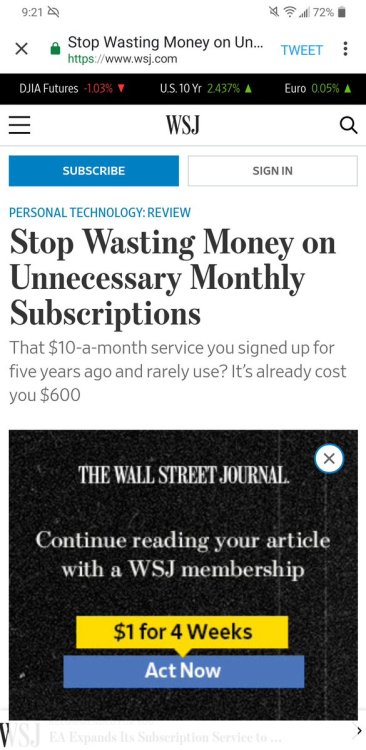
Okay, but now I have to know how self-aware this article is. I have university access to Wall Street Journal, brb.
…
Definitely at least somewhat: “The charges regularly hitting our credit cards have expanded far beyond video and music-streaming services and, yes, newspapers.”
—
“Step 1: Audit. Log in to your credit card and bank accounts and make a list (or, better yet, a spreadsheet) of all your monthly and yearly subscriptions, along with their charges.
[…]
Step 2: Consolidate to family plans. Have your partner do the same and then cross-reference the lists. I quickly spotted some duplicates in my household.
[…]
When signing up for new services, look out for the ability to disable any auto-renew function, and if there’s a free trial, set a reminder on your calendar just before the trial period ends, so you can consider canceling before you get charged.”
I…I guess it’s good that there are people pointing this out to those who haven’t thought of it? Today’s lucky ten-thousand and all that. And of course, as the beginning of this thread points out, people subscribed to the Wall Street Journal are going to be disproportionately people careless about which subscriptions they’re on.
(even if I *personally* cannot comprehend the kind of mind that would sign up for Amazon Prime without first checking whether their spouse had it already, or for that matter the kind of mind that would not think to inform their spouse that they had Amazon Prime
also, the kind of mind that would not think long and hard about signing up for a $15/month *anything*, let alone this:
“Here’s a hilarious story. For the past three years I’ve been paying $15 a month for an electronic fax service I’ve used… twice. That’s $540. For the same amount, I could have bought 20 rolls of fax paper. Or 10 real working fax machines. Or a plane ticket to Ireland to visit the museum where the world’s first fax machine is on display.”)
((I’m trying very hard to be open-minded about this: I know everyone thinks their own talents are easy))
—
P.S. If I fed it into my financial calculator right, that $10/month service for 5 years has cost you ~$663, if you count lost interest at 4%.
Tags:
#now if you’ll excuse me I have an accounting exam to study for #adventures in human capitalism #juxtaposition #reply via reblog #is the blue I see the same as the blue you see
somehow it became fanon that Amy keeps it a secret from everyone that her powers extend beyond healing, because she’s afraid of what people will think of her or that she’ll get slapped with a class-S designation. Amy threatens random criminals with it at the drop of a hat, so she can’t be that worried about the secret getting out.
Some versions even include her keeping it a secret from Victoria specifically, even though the first time it’s brought up it’s by Vicky herself.
post worm chapter by chapter in spacebattles, trick them into reading it
Tags:
#Wildbow #anything that makes me laugh this much deserves a reblog #(I haven’t read book *or* fanfic) #(but then I wouldn’t really call myself part of the fandom so I guess that works out)
As a reader, I like worldbuilding, even (and sometimes especially) the expository parts. I read SFF because it’s the genre that most delivers that. It feels actively annoying when I have to sit through Plot that I’ve seen a million times before to get to soak in a world that I haven’t, or even to look at (say) extruded D&D fantasy in fine everyday detail with new eyes.
I feel like this should be obvious, but I still see, pretty regularly, appeals to authors to stop so much worldbuilding and focus on what obviously really matters to presumed readers, the story. I’m sure there are plenty of readers for whom that’s true! Good for them! But it’s not universal and we’re living in a long-tail world. Unless you’re right on the edge of being able to write full-time and writing to market means the difference between having a day job or not, don’t let The Average Reader become a sort of imperative-issuing Big Other. I would guess there are many more readers who love baroque expository worldbuilding than there are people who are really into, I don’t know, mpreg werewolf fanfiction, but there’s a thriving audience for that and more power to them, so don’t let them hog all the fun!
Amen.
This can be applied more generally to showing-versus-telling, I think. If you’ve got something that’s more interesting than the beat-by-beat progression of your yarn, you should tell us about it, rather than slicing it up into little pieces and embedding those pieces in the unfolding plot.
…but then again, I read splatbooks for fun, so maybe I’m not the best person to ask.
…but I’m probably not the only one who does that kind of thing.
Regarding “show don’t tell” – I went through books at an immense speed as a child. Real-life social interactions were mystifying, but books offered me all they lacked: they explained what was happening, why it was happening, what people felt when it happened, and how their reactions related to their feelings. It was a cheat sheet for human behavior, and it made little me more empathetic and interested in people even when my experiences with them were unpleasant. When I encounter books that took “show don’t tell” to heart, they confuse and sometimes anger me. What do the characters mean by raising an eyebrow, or blinking slowly? Why are they reacting with anger here, and nonchalance there, and why do your other characters treat that as meaningful and informative? It’s like dramatic face shots in movies, where the actors stare blandly at something and there’s emotional music and it’s obvious it’s supposed to convey something, but I never know what that is. There’s a weird opposite phenomenon of characters reading facial expressions and narrating their readings “the look in his eyes told me he was deeply troubled by what he just saw” – they’re eyes! They’re orbs with lenses and people use them to see. How can you tell? Obviously reading facial expressions is not magic for everyone. Still, I miss being catered to by writers allowing me to get a good view of the inside of character’s heads without having to throw up my hands and say “well I guess these people have reasons and emotions but I’ll never know which, thanks a lot”.
Tags:
#re: OP: #yes this #I looked in the notes and found this branch #which is not *as* pure in its Yes-This-ness as the OP #but is interesting and definitely has its moments of relatability #(I distinctly recall going on a similar rant about ”the look in their eyes” in my early teens) #is the blue I see the same as the blue you see #autism
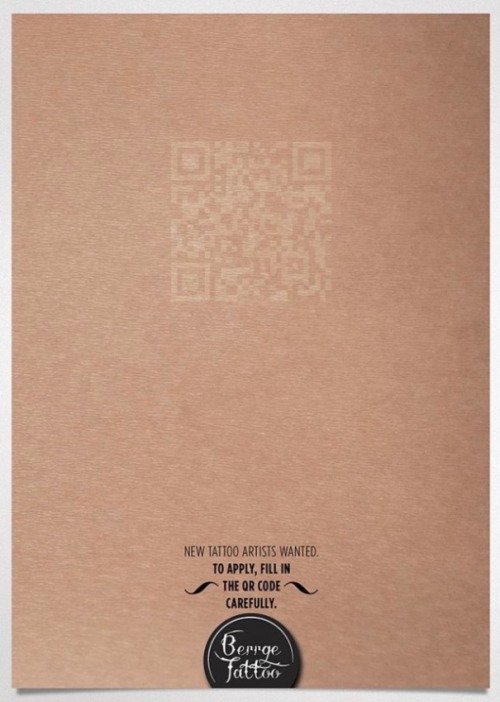
A cleverly thought recruitment ad by Bergge Tattoos[605×849]
Tags:
#advertising #tattoo #neat #(yeah it’s a stunt but it’s a neat stunt) #((I got curious and looked them up)) #((this ad is from 2013 and is by far the biggest part of their Internet footprint)) #((they used to have a website but it’s rotten)) #((on Google Maps they have no reviews but neither are they marked as permanently closed))