Let’s talk respirators!

{{previous post in sequence}}


nuclearspaceheater:

brin-bellway:

What’s a respirator?

Short version: it’s like a mask, but better. *Much* better.

Let’s put the headline news up front: if you maintain an airtight seal at all times, a P100 respirator blocks 99.97% of incoming viral particles. [source]

Yeah. 99.97%. That’s a *lot*.

(Specifically, we are going to be talking about what’s called “elastomeric” respirators. These have a base unit made of plastic and silicone, with attachment points on the cheeks for swappable filters.)

99.97%?! What’s the catch?! There’s gotta be a catch, right?

A few catches, but generally nothing dealbreaking.

The filtered air is very dry: take frequent breaks if you can to go outside (or somewhere else with clean air) and drink some water. I work 4 – 5 hour shifts for 2 – 3 straight days a week with a respirator and no water breaks, and that’s *doable* but dehydrating.

They muffle your voice a bit more than masks do. You’ll have to speak louder and probably be more careful with enunciation than usual, and talking on the phone will be very difficult.

The 99.97% figure is for *incoming* air. An elastomeric respirator does not, by default, filter outgoing air at all. This is okay for two reasons: one, since you can’t spread a disease you don’t have, protecting yourself *is* protecting others. Two, for even more protection of others you can tape a layer of cloth over the valve on the bottom of the respirator.

They cost more up-front (about USD$30 for a base unit and USD$11 per pair of filters), but they last for such a long time (more on that later) that in the long run it’s actually very economical.

So why isn’t everyone using them already?

Mostly because people don’t know about them. Cloth masks were supposed to be a stopgap measure until we had a chance to manufacture more respirators, but word never got out when the respirators had caught up. They do *sometimes* go out of stock still, but they’re very often available now.

Also, the kind of respirators we’re going to be talking about here are aimed at construction workers, which means people looking for “medical” masks tend to overlook them. But a particle is a particle, and there’s no reason you can’t use construction respirators against germs. In fact, in some ways they work even *better* against germs than they do against construction fumes.

What do I need to know about how to wear them?

First, check the fit. Take off your glasses if you have them, then put the base unit on and adjust the straps until the seal is airtight without being painful. You won’t be able to get an airtight seal if there’s facial hair in the way: you’ll need to at *least* trim it down very far, and probably shave it.

To confirm that the seal is airtight, there are two methods depending on whether the filters are attached right now.

  • If the filters are *not* attached: cover the attachment points with your palms and try to breathe *in*. If you can’t, the seal is airtight. (Except for the attachment points themselves, of course: *those* are big gaping holes in your seal if they don’t have filters on them. But we’ll be fixing that soon.)
  • If the filters *are* attached: cover the valve at the bottom with your palm and try to breathe *out*. If you can’t, the seal is airtight.

(You’ll want to confirm the seal every time you put the respirator on.)

Next, take a pair of filters and screw them onto the attachment points. (This is much easier to do if you’re not wearing the respirator while you’re doing it.) Be sure to screw them on very tightly, otherwise they might fall off. (I didn’t screw them on tightly enough my first time, and it was pretty scary when one of them fell off in the middle of a crowded restaurant. But now that I’ve gotten them on correctly, they stay put.)

Now you can wear it. If you have glasses, take them off first, then gently rest them on top of the respirator’s nose once you’ve put it on. Check the seal as above to make sure it’s airtight.

Once a week or after every outing, whichever is less frequent, wipe down the silicone (the part that sticks to your face and forms the seal) with some mild cleaning solution to keep the skin oils from building up. You can also wipe down the outside if you are concerned about fomites, but note that of the two styles of filter (more on that later) you can *only* wipe down the plastic cartridges, *not* the pink cloth circles. Here is the official manufacturer’s guide on cleaning these respirators [link]: note that “quat” is janitorial jargon for the type of cleaning solution that Lysol wipes are dipped in.

(Bonus tip: if you’re having trouble sourcing disinfectant wipes, look for bottles of “quaternary ammonium” *next* to the barren disinfectant-wipe section at the grocery store, put it in a spray bottle diluted to the level stated on the bottle instructions, then heavily spritz a paper towel with it. Voila, a disinfectant wipe!)

According to the CDC [link], the filters last somewhere between a month and a year depending on how much you need to conserve resources and how well you can avoid getting them wet or dirty. The main limiting factor on longevity is that the filters get clogged with fumes and dust from the construction work: if you’re not *doing* construction work or similar fume-heavy activities, they can keep going for ages. If you can still breathe through it and the filter hasn’t been wet, you’re good.

Where can I get them?

Depends on where you live.

United States of America:

Base unit (currently USD$27.81): https://www.amazon.com/3M-Facepiece-Respirator-Respiratory-Protection/dp/B008MCUT86

Filters:

If possible, I recommend getting them from ULine: https://www.uline.com/Product/Detail/S-20007/Reusable-Respirators/3M-7093-Hard-Shell-Particulate-Filter-P100

ULine has the water-resistant plastic-cartridge filters, is a very reputable dealer, and sells for a good per-pair price. The only trouble is that they sell 6 pairs at a time: split a pack with a group of 3 people if you can, so that each of you will have one spare set.

If you really need a smaller pack or if ULine is out of stock, you *can* get the pink-circle kind from Amazon: 3 pairs for USD$28.90 (https://www.amazon.com/3M-2091-Particulate-Filter-Pairs/dp/B00KYX8JBU), 1 pair for USD$12.80 (https://www.amazon.com/3M-50051131070009-Particulate-Filter-2091/dp/B07571LKP4).

The pink-circle filters are *not* water-resistant: try not to stay out in the rain very long or otherwise get them wet, and don’t try to disinfect them (just avoid touching them instead, and wash your hands if you do have to). Also, counterfeits occasionally slip into Amazon’s stocks: try Amazon filters on when you first get them, and if you can still smell anything through them, demand a replacement. You should *not* be able to smell anything through a true P100 filter.

Canada:

Base unit (CAD$44.19): https://www.amazon.ca/dp/B008MCUT86/

Filters:

Canada has branches of both ULine and Amazon. Read the tips I gave the Americans on filter selection: the same things apply.

ULine (6 pairs for CAD$89): https://www.uline.ca/Product/Detail/S-20007/Reusable-Respirators/3M-7093-Hard-Shell-Particulate-Filter-P100

Amazon (2 pairs for CAD$24.71): https://www.amazon.ca/Particulate-Nuisance-Organic-Release-2097PA1/dp/B007STCT00/

Amazon (1 pair for CAD$16.95): https://www.amazon.ca/3M-2097-Particulate-Filter/dp/B00328IAO0/

Other countries:

I don’t have links for these on hand. For the base unit, check your hardware and general stores for “3M model 7502 respirators”; for the filters, look for “3M bayonet-style P100 filters” and prefer the plastic cartridges over the pink circles if possible. If you can’t find any of those, try looking into other elastomeric respirators, but I don’t have any experience with other ones so you’d be on your own there. Remember that you should not be able to smell anything through an airtight P100 respirator: if you put the filters on and can still smell stuff, something’s wrong with those filters, go back to the seller and get them to either give you a better set or refund you.

Getting a respirator has been a life-changer for me, and I hope it can help you too. If you found this useful or know someone who would, please let people know.

Important correction: You can actually smell lots of things thru a properly working, plain P100 respirator, because many of the things that we can smell are gasses, which particulate filters do nothing against. This is fine for this purpose: SARS-CoV-2 and droplets that carry it are particles.

As I recall, I was surprised that you’d stopped smelling things when you got yours, but found out that the specific filters you were using were P100 filters with nuisance organic vapor filtering. These contain a relatively small amount of activated carbon which absorbs organic vapors at levels below occupational exposure limits that would require heavier vapor protection, as well as most of the vapors you’d smell in ordinary life, at ordinary concentrations.

Huh. That’s very good to know. I defer to your expertise.

(I’d seen multiple reviews saying that the *two* ways of detecting counterfeits were “suspiciously light” and “scent infiltration”, but since the intended audience doesn’t already have experience with these and wouldn’t know when one feels suspiciously light, I only kept the second one in.)

I would, in that case, recommend nuisance organic vapor filtering for the psychological benefits: respirator-specific anosmia is a great way to subconsciously reassure yourself that you’re not getting exposed to anything *else* in the air. (Admittedly this may be more of a me thing: since I’ve been using anti-pollen masks for years, I’m very accustomed to judging air quality by the amount of scent that gets through. (For pollen, the occasional whiff and a *bit* of background is generally fine, but if my sense of smell seems completely unimpaired I need to replace my mask.))

@nicdevera [link], I have occasionally tried jogging to work when I was running a bit late, and I find I can’t jog for very long in my respirator: I can’t quite get enough airflow. Biking would probably depend on how hard you’re pushing it.

(I get my exercise on a home treadmill, but I recognise that I am incredibly fortunate to have the housing space and stability for one, and also to have gotten it circa 2014 when demand was quite low and you could often pick a used one up for the price of moving it.)

It is becoming increasingly clear that I should have put this post under a read-more: not only is it fairly long, it’s going to need updates. @wingedcatgirl, @moral-autism, @sophia-epistemia, @drethelin: I don’t suppose y’all would be willing to go reblog the read-more version instead?


Tags:

#reply via reblog #covid19 #the more you know #oh look an update #illness tw

{{next post in sequence}}

Let’s talk respirators!

{{previous post in sequence}}


hunterstheorem:

brin-bellway:

What’s a respirator?

Short version: it’s like a mask, but better. *Much* better.

Let’s put the headline news up front: if you maintain an airtight seal at all times, a P100 respirator blocks 99.97% of incoming viral particles. [source]

Yeah. 99.97%. That’s a *lot*.

(Specifically, we are going to be talking about what’s called “elastomeric” respirators. These have a base unit made of plastic and silicone, with attachment points on the cheeks for swappable filters.)

99.97%?! What’s the catch?! There’s gotta be a catch, right?

A few catches, but generally nothing dealbreaking.

The filtered air is very dry: take frequent breaks if you can to go outside (or somewhere else with clean air) and drink some water. I work 4 – 5 hour shifts for 2 – 3 straight days a week with a respirator and no water breaks, and that’s *doable* but dehydrating.

They muffle your voice a bit more than masks do. You’ll have to speak louder and probably be more careful with enunciation than usual, and talking on the phone will be very difficult.

The 99.97% figure is for *incoming* air. An elastomeric respirator does not, by default, filter outgoing air at all. This is okay for two reasons: one, since you can’t spread a disease you don’t have, protecting yourself *is* protecting others. Two, for even more protection of others you can tape a layer of cloth over the valve on the bottom of the respirator.

They cost more up-front (about USD$30 for a base unit and USD$11 per pair of filters), but they last for such a long time (more on that later) that in the long run it’s actually very economical.

So why isn’t everyone using them already?

Mostly because people don’t know about them. Cloth masks were supposed to be a stopgap measure until we had a chance to manufacture more respirators, but word never got out when the respirators had caught up. They do *sometimes* go out of stock still, but they’re very often available now.

Also, the kind of respirators we’re going to be talking about here are aimed at construction workers, which means people looking for “medical” masks tend to overlook them. But a particle is a particle, and there’s no reason you can’t use construction respirators against germs. In fact, in some ways they work even *better* against germs than they do against construction fumes.

What do I need to know about how to wear them?

First, check the fit. Take off your glasses if you have them, then put the base unit on and adjust the straps until the seal is airtight without being painful. You won’t be able to get an airtight seal if there’s facial hair in the way: you’ll need to at *least* trim it down very far, and probably shave it.

To confirm that the seal is airtight, there are two methods depending on whether the filters are attached right now.

  • If the filters are *not* attached: cover the attachment points with your palms and try to breathe *in*. If you can’t, the seal is airtight. (Except for the attachment points themselves, of course: *those* are big gaping holes in your seal if they don’t have filters on them. But we’ll be fixing that soon.)
  • If the filters *are* attached: cover the valve at the bottom with your palm and try to breathe *out*. If you can’t, the seal is airtight.

(You’ll want to confirm the seal every time you put the respirator on.)

Next, take a pair of filters and screw them onto the attachment points. (This is much easier to do if you’re not wearing the respirator while you’re doing it.) Be sure to screw them on very tightly, otherwise they might fall off. (I didn’t screw them on tightly enough my first time, and it was pretty scary when one of them fell off in the middle of a crowded restaurant. But now that I’ve gotten them on correctly, they stay put.)

Now you can wear it. If you have glasses, take them off first, then gently rest them on top of the respirator’s nose once you’ve put it on. Check the seal as above to make sure it’s airtight.

Once a week or after every outing, whichever is less frequent, wipe down the silicone (the part that sticks to your face and forms the seal) with some mild cleaning solution to keep the skin oils from building up. You can also wipe down the outside if you are concerned about fomites, but note that of the two styles of filter (more on that later) you can *only* wipe down the plastic cartridges, *not* the pink cloth circles. Here is the official manufacturer’s guide on cleaning these respirators [link]: note that “quat” is janitorial jargon for the type of cleaning solution that Lysol wipes are dipped in.

(Bonus tip: if you’re having trouble sourcing disinfectant wipes, look for bottles of “quaternary ammonium” *next* to the barren disinfectant-wipe section at the grocery store, put it in a spray bottle diluted to the level stated on the bottle instructions, then heavily spritz a paper towel with it. Voila, a disinfectant wipe!)

According to the CDC [link], the filters last somewhere between a month and a year depending on how much you need to conserve resources and how well you can avoid getting them wet or dirty. The main limiting factor on longevity is that the filters get clogged with fumes and dust from the construction work: if you’re not *doing* construction work or similar fume-heavy activities, they can keep going for ages. If you can still breathe through it and the filter hasn’t been wet, you’re good.

Where can I get them?

Depends on where you live.

United States of America:

Base unit (currently USD$27.81): https://www.amazon.com/3M-Facepiece-Respirator-Respiratory-Protection/dp/B008MCUT86

Filters:

If possible, I recommend getting them from ULine: https://www.uline.com/Product/Detail/S-20007/Reusable-Respirators/3M-7093-Hard-Shell-Particulate-Filter-P100

ULine has the water-resistant plastic-cartridge filters, is a very reputable dealer, and sells for a good per-pair price. The only trouble is that they sell 6 pairs at a time: split a pack with a group of 3 people if you can, so that each of you will have one spare set.

If you really need a smaller pack or if ULine is out of stock, you *can* get the pink-circle kind from Amazon: 3 pairs for USD$28.90 (https://www.amazon.com/3M-2091-Particulate-Filter-Pairs/dp/B00KYX8JBU), 1 pair for USD$12.80 (https://www.amazon.com/3M-50051131070009-Particulate-Filter-2091/dp/B07571LKP4).

The pink-circle filters are *not* water-resistant: try not to stay out in the rain very long or otherwise get them wet, and don’t try to disinfect them (just avoid touching them instead, and wash your hands if you do have to). Also, counterfeits occasionally slip into Amazon’s stocks: try Amazon filters on when you first get them, and if you can still smell anything through them, demand a replacement. You should *not* be able to smell anything through a true P100 filter.

Canada:

Base unit (CAD$44.19): https://www.amazon.ca/dp/B008MCUT86/

Filters:

Canada has branches of both ULine and Amazon. Read the tips I gave the Americans on filter selection: the same things apply.

ULine (6 pairs for CAD$89): https://www.uline.ca/Product/Detail/S-20007/Reusable-Respirators/3M-7093-Hard-Shell-Particulate-Filter-P100

Amazon (2 pairs for CAD$24.71): https://www.amazon.ca/Particulate-Nuisance-Organic-Release-2097PA1/dp/B007STCT00/

Amazon (1 pair for CAD$16.95): https://www.amazon.ca/3M-2097-Particulate-Filter/dp/B00328IAO0/

Other countries:

I don’t have links for these on hand. For the base unit, check your hardware and general stores for “3M model 7502 respirators”; for the filters, look for “3M bayonet-style P100 filters” and prefer the plastic cartridges over the pink circles if possible. If you can’t find any of those, try looking into other elastomeric respirators, but I don’t have any experience with other ones so you’d be on your own there. Remember that you should not be able to smell anything through an airtight P100 respirator: if you put the filters on and can still smell stuff, something’s wrong with those filters, go back to the seller and get them to either give you a better set or refund you.

Getting a respirator has been a life-changer for me, and I hope it can help you too. If you found this useful or know someone who would, please let people know.

“Normies don’t know about this ridiculous-looking, uncomfortable, and unpleasant thing” is not why people aren’t using these.

Do you really, actually believe that I’m going to reach an audience of *normies* here?

Also, one of the great things about anti-ingress protection is that if other people opt not to wear it, that is *their* problem, not yours. You don’t have to fuck around with the game theory and herd effects and a-*bit*-of-anti-ingress-as-a-consolation-prize of cloth masks: it’s just “each person who wears it is one more person protected”, full stop. If even *one* person starts using a respirator because of this post, that is a job well done.

P.S. To be clear: this post was inspired by people complaining about being stuck without human contact for months and (they believe) potentially years at a time, because it was that or probably end up as a COVID vector.

Uncomfortable? Unpleasant? Compared to *what*? Not to solitary confinement.

(Ridiculous-looking, I’ll grant you, and I’ll grant that that deserved a mention.)


Tags:

#reply via reblog #oh look an update #discourse cw #covid19 #illness tw #long post


{{next post in sequence}}

Let’s talk respirators!

{{previous post in sequence}}


{{This version of the guide is outdated. See https://wp.brinbellway.net/lets-talk-respirators-psa-version/ for the up-to-date guide.}}


What’s a respirator?

Short version: it’s like a mask, but better. *Much* better.

Let’s put the headline news up front: if you maintain an airtight seal at all times, a P100 respirator blocks 99.97% of incoming viral particles. [source]

Yeah. 99.97%. That’s a *lot*.

(Specifically, we are going to be talking about what’s called “elastomeric” respirators. These have a base unit made of plastic and silicone, with attachment points on the cheeks for swappable filters.)

99.97%?! What’s the catch?! There’s gotta be a catch, right?

A few catches, but generally nothing dealbreaking.

The filtered air is very dry: take frequent breaks if you can to go outside (or somewhere else with clean air) and drink some water. I work 4 – 5 hour shifts for 2 – 3 straight days a week with a respirator and no water breaks, and that’s *doable* but dehydrating.

They muffle your voice a bit more than masks do. You’ll have to speak louder and probably be more careful with enunciation than usual, and talking on the phone will be very difficult.

The 99.97% figure is for *incoming* air. An elastomeric respirator does not, by default, filter outgoing air at all. This is okay for two reasons: one, since you can’t spread a disease you don’t catch, protecting yourself *is* protecting others. Two, for even more protection of others you can tape a layer of cloth over the valve on the bottom of the respirator.

They cost more up-front (about USD$30 for a base unit and USD$11 per pair of filters), but they last for such a long time (more on that later) that in the long run it’s actually very economical.

So why isn’t everyone using them already?

Mostly because people don’t know about them. Cloth masks were supposed to be a stopgap measure until we had a chance to manufacture more respirators, but word never got out when the respirators had caught up. They do *sometimes* go out of stock still, but they’re very often available now.

Also, the kind of respirators we’re going to be talking about here are aimed at construction workers, which means people looking for “medical” masks tend to overlook them. But a particle is a particle, and there’s no reason you can’t use construction respirators against germs. In fact, in some ways they work even *better* against germs than they do against construction fumes.

(Edit: Okay, yes, also they look funny, but people in 2019 would have told you masks looked funny too.)

What do I need to know about how to wear them?

First, check the fit. Take off your glasses if you have them, then put the base unit on and adjust the straps until the seal is airtight without being painful. You won’t be able to get an airtight seal if there’s facial hair in the way: you’ll need to at *least* trim it down very far, and probably shave it.

To confirm that the seal is airtight, there are two methods depending on whether the filters are attached right now.

  • If the filters are *not* attached: cover the attachment points with your palms and try to breathe *in*. If you can’t, the seal is airtight. (Except for the attachment points themselves, of course: *those* are big gaping holes in your seal if they don’t have filters on them. But we’ll be fixing that soon.)
  • If the filters *are* attached: cover the valve at the bottom with your palm and try to breathe *out*. If you can’t, the seal is airtight.

(You’ll want to confirm the seal every time you put the respirator on.)

Next, take a pair of filters and screw them onto the attachment points. (This is much easier to do if you’re not wearing the respirator while you’re doing it.) Be sure to screw them on very tightly, otherwise they might fall off. (I didn’t screw them on tightly enough my first time, and it was pretty scary when one of them fell off in the middle of a crowded restaurant. But now that I’ve gotten them on correctly, they stay put.)

Now you can wear it. If you have glasses, take them off first, then gently rest them on top of the respirator’s nose once you’ve put it on. Check the seal as above to make sure it’s airtight.

Once a week or after every outing, whichever is less frequent, wipe down the silicone (the part that sticks to your face and forms the seal) with some mild cleaning solution to keep the skin oils from building up. You can also wipe down the outside if you are concerned about fomites, but note that of the two styles of filter (more on that later) you can *only* wipe down the plastic cartridges, *not* the pink cloth circles. Here is the official manufacturer’s guide on cleaning these respirators [link]: note that “quat” is janitorial jargon for the type of cleaning solution that Lysol wipes are dipped in.

(Bonus tip: if you’re having trouble sourcing disinfectant wipes, look for bottles of “quaternary ammonium” *next* to the barren disinfectant-wipe section at the grocery store, put it in a spray bottle diluted to the level stated on the bottle instructions, then heavily spritz a paper towel with it. Voila, a disinfectant wipe!)

According to the CDC [link], the filters last somewhere between a month and a year depending on how much you need to conserve resources and how well you can avoid getting them wet or dirty. The main limiting factor on longevity is that the filters get clogged with fumes and dust from the construction work: if you’re not *doing* construction work or similar fume-heavy activities, they can keep going for ages. If you can still breathe through it and the filter hasn’t been wet, you’re good.

Where can I get them?

Depends on where you live.

United States of America:

Base unit (currently USD$27.81): https://www.amazon.com/3M-Facepiece-Respirator-Respiratory-Protection/dp/B008MCUT86

Filters:

If possible, I recommend getting them from ULine: https://www.uline.com/Product/Detail/S-20007/Reusable-Respirators/3M-7093-Hard-Shell-Particulate-Filter-P100

ULine has the water-resistant plastic-cartridge filters, is a very reputable dealer, and sells for a good per-pair price. The only trouble is that they sell 6 pairs at a time: split a pack with a group of 3 people if you can, so that each of you will have one spare set.

If you really need a smaller pack or if ULine is out of stock, you *can* get the pink-circle kind from Amazon: 3 pairs for USD$28.90 (https://www.amazon.com/3M-2091-Particulate-Filter-Pairs/dp/B00KYX8JBU), 1 pair for USD$12.80 (https://www.amazon.com/3M-50051131070009-Particulate-Filter-2091/dp/B07571LKP4).

The pink-circle filters are *not* water-resistant: try not to stay out in the rain very long or otherwise get them wet, and don’t try to disinfect them (just avoid touching them instead, and wash your hands if you do have to). Also, counterfeits occasionally slip into Amazon’s stocks: try Amazon filters on when you first get them, and if you can still smell anything through them, demand a replacement. You should *not* be able to smell anything through a true P100 filterEdit: @nuclearspaceheater, who is a more experienced respirator user than I am, reports that many genuine P100 filters *do* let some scent through: I merely happened to have filters with some extra vapor filtration. I’ve seen reviews saying that fakes are suspiciously light, but it’s hard to tell if you don’t already know how much they should weigh, plus that *also* might have been a vapor-vs-nonvapor distinction. It’s possible that the people complaining about counterfeit filters from Amazon are just straight-up mistaken and they’re all fine, but I would still go with ULine for the water resistance if nothing else.

Canada:

Base unit (CAD$44.19): https://www.amazon.ca/dp/B008MCUT86/

Filters:

Canada has branches of both ULine and Amazon. Read the tips I gave the Americans on filter selection: the same things apply.

ULine (6 pairs for CAD$89): https://www.uline.ca/Product/Detail/S-20007/Reusable-Respirators/3M-7093-Hard-Shell-Particulate-Filter-P100

Amazon (2 pairs for CAD$24.71): https://www.amazon.ca/Particulate-Nuisance-Organic-Release-2097PA1/dp/B007STCT00/

Amazon (1 pair for CAD$16.95): https://www.amazon.ca/3M-2097-Particulate-Filter/dp/B00328IAO0/

Other countries:

I don’t have links for these on hand. For the base unit, check your hardware and general stores for “3M model 7502 respirators”; for the filters, look for “3M bayonet-style P100 filters” and prefer the plastic cartridges over the pink circles if possible. If you can’t find any of those, try looking into other elastomeric respirators, but I don’t have any experience with other ones so you’d be on your own there. Remember that you should not be able to smell anything through an airtight P100 respirator: if you put the filters on and can still smell stuff, something’s wrong with those filters, go back to the seller and get them to either give you a better set or refund you. Edit: This is not necessarily true and indeed there might not be counterfeits at all: check the edit in the USA section for more details.

Getting a respirator has been a life-changer for me, and I hope it can help you too. If you found this useful or know someone who would, please let people know.

Postscript, 2021-09-14: It has been my experience that nuisance-vapour filtration wears out after 3 – 4 months. If you value its psychological benefits (I don’t know about you, but nothing reassures my subconscious about air quality quite like respirator-specific anosmia), or have additional uses in mind for your respirator such that you need nuisance-vapour filtration, I recommend planning to replace your filters about that often.

Also, here is a nice pocket umbrella I got to protect my non-water-resistant filters from unexpected rain. No more standing at the threshold of my workplace stuffing my respirator into a plastic bag! It makes a pretty good parasol, too.


Tags:

#covid19 #masks #the more you know #illness tw #PSA #oh look an original post


{{next post in sequence}}

Anonymous asked: I will never be able to ethically be vaccinated (because by the time it’s my turn in the queue, variants will mean everyone has to be vaccinated again, whee), so I’m kind of resigning myself to never seeing anyone I care about ever again. And I can deal with that *except* for people like you constantly reminding me that even feeling bad about being alone for the next 3-5-10 years means I’m morally evil.

{{previous post in sequence}}


Okay, let me try this one more time:

Here is a link to a respirator base unit: https://www.amazon.com/3M-Facepiece-Respirator-Respiratory-Protection/dp/B008MCUT86

Here is a link to a reputable dealer in larger packs (6 pairs) of P100 filters: https://www.uline.com/Product/Detail/S-20007/Reusable-Respirators/3M-7093-Hard-Shell-Particulate-Filter-P100

Here are semi-reputable links to dealers in smaller packs (3 pairs, 1 pair) of P100 filters: https://www.amazon.com/3M-2091-Particulate-Filter-Pairs/dp/B00KYX8JBU, https://www.amazon.com/3M-50051131070009-Particulate-Filter-2091/dp/B07571LKP4  Counterfeits occasionally slip into the Amazon warehouses: try the filters on when you get them, and if you can still smell anything while wearing them, demand a replacement.

(I gave American links because statistically those are probably the most useful: if you’d like help finding links for other countries, let me know and I will help you look.)

A P100 respirator offers slightly *more* protection to the wearer than the vaccines do. Since people who don’t *have* COVID-19 can’t *spread* COVID-19, this also prevents you from infecting others; for even greater protection of others, tape a layer of cloth over the valve on the bottom of the respirator.

If a filter falls off, it means it wasn’t screwed on tightly enough: I had the same problem my first time, but now that I’ve screwed them on tighter they stay put. A single set of filters can last for months as long as it doesn’t get wet: the way a filter wears out is that it gets clogged with fumes from the construction work you’re (presumably) *not* doing, so as long as you can still breathe through it and it hasn’t gotten wet beyond the occasional raindrop, you’re good. (Note: the ULine link is to water-resistant filters, which are hard to find on Amazon.)

Yes, you won’t be able to eat and drink indoors with your friends, and ideally you should take a break every hour or so to go outside and drink something because filtered air is quite dry, but you can have physical presence.

(Edit, re: tags: you know what, I *am* going to write a broader public-service-announcement version of this. If you were thinking of reblogging this post for the info, please wait and I will update you with a better-for-reblogging version when I have finished writing it.)

(Edit 2: here)


Tags:

#covid19 #illness tw #vaccines #the more you know #I disagree with your narrative but I don’t think I can talk you out of it #instead let’s try granting it and talking about how you can *still* make things work #@everyone: feel free to treat this as a respirator PSA #if there is interest I can write a broader respirator PSA with less negativity involved #I said I would never write another Tumblr-hosted OP but for something this important I can probably make an exception #anon hate cw? #tales from the askbox


{{next post in sequence}}

titaniumelemental:

titaniumelemental:

The thing that’s frightened me about the COVID restrictions from the very beginning was a lack of the idea that the mental suffering from social restrictions was something worth balancing with the intended effects. Not that it necessarily does outward the benefit, just that it was at least worth considering. Instead you either got people totally dismissive of the danger of the virus, or people saying “how could you think about [need for human contact phrased to sound as frivolous as possible] when people are dying because it of it?!”

But the thing is, everyone not only accepts some level of risk for themselves, but also accepts some level of risk for other people. That amount isn’t ever zero. In 2019, I had contact with a lot of people that could have potentially spread influenza. I got my flu shot as always, I washed my hands the normal amount, but I did not become a hermit. Now you could argue that my selfish desire to see multiple friends in my apartment at the same time was increasing the possibility of other vulnerable people catching the flu. Didn’t I think about how as much as these people mattered to me I should be putting the needs of others first? But I didn’t, and in that situation no one expected me to.

We are not in that situation now. The magnitude of that risk is radically higher and that’s why I’ve continued to live a radically altered life. But I plan to someday inch back towards the old thing, and we’re all going to have to figure out how much and when. It’s going to be more complicated than treating “your actions affect other people” as a trump card that justifies any and all restrictions.

My lingering, probably paranoid fear since last spring has been: if people around me accept the precedents that anything that puts other people at any increased risk is something you shouldn’t be able to do, and that wanting to be in the same room with people you like is something trivial that no one is willing to stand up for, then what? That sounds like a system of social norms where you let scrupulousity-brain write the rules. So if people don’t actually believe those two ideas (and I don’t think many do) I’d appreciate it if more were willing to say it out loud.

And the point is that I don’t know what an acceptable level of risk to put other people in is, I don’t have numbers, and I get why no one wants to have this conversation because admitting you accept risk to be higher than zero makes you sounds like a horrible person. But we have to acknowledge it some time, or I’m afraid we’ll end up in a situation where you’re expected to feel low-level guilty about any people you interact with the way you’re supposed to about unethical consumption under capitalism or not being sufficiently critical of the problematic media you enjoy. (Which is to say, people whose brains work a certain way will feel low-level guilty about it all the time and others will let it run off their backs and appear to have no comprehension of what the other group feels when they bring it up.)

…what does *the value of other people* have to do with anything? Anti-plague measures are taken for one’s *own* sake, directly and/or to protect [people such that it would suck for you if they got hurt].

The thing that horrifies me about people going “but social interaction” isn’t their self-centredness. I’m self-centred too! But I did the egoist moral calculations and came to the conclusion that the value of in-person social interaction outside my bubble was negligible next to the risk of catching COVID-19, and if other people’s calculations are coming out differently, that means they’re either very bad at moral calculus or (more likely) have very different values. Both of those things are scary! Who knows what these people will come up with next?!

(I guess maybe the main thing that makes this whole discourse feel weird to me is: I have never once been coerced into taking anti-plague measures I thought were overkill. I *have* *frequently* been coerced into taking *fewer* anti-plague measures than I wanted to.)

>>But I plan to someday inch back towards the old thing, and we’re all going to have to figure out how much and when.

This is my plan:

When everyone in my household has been vaccinated: cease wearing a respirator. Wear a cloth mask in indoor public spaces if official (read: presumably underestimated) local caseload is above 1/200k/day, to reduce the chances of becoming a carrier and reduce the chances of spreading it if I already am (spreading disease to people who aren’t lucky enough to be vaccinated yet is bad for the society in which I live (people can generally be assumed to be doing something useful, even if indirectly), and also sets a bad precedent (I expect to live through other plagues in the future, and quite likely I will be lower in the vaccine triage list for the next plague than I am now: someday it’ll be *me* who hasn’t been vaccinated yet, and I wish to do my part to encourage a norm I would one day benefit from)). Do not *offer* private social gatherings to unvaccinated people, but seriously consider accepting unvaccinated people’s social offers. Freely offer and accept social-gathering offers with vaccinated people: to us COVID-19 is somewhat less dangerous than a cold, and only baseline anti-cold measures [link] apply.


Tags:

#reply via reblog #covid19 #illness tw #discourse cw? #is the blue I see the same as the blue you see


{{next post in sequence}}

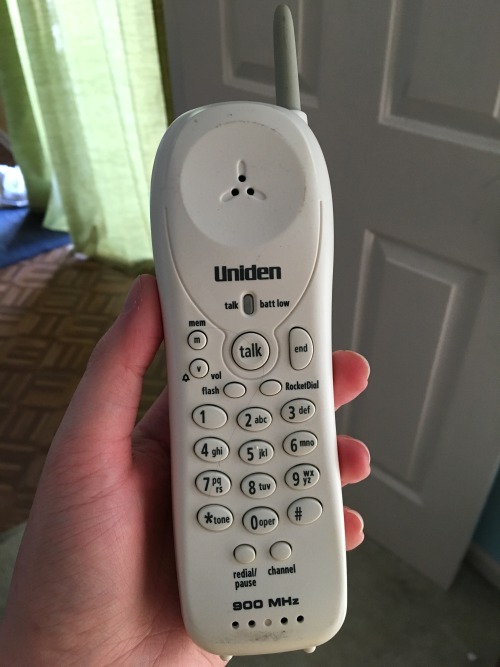
oh my god i’m cleaning out my desk and i found my first phone

scotchtapeofficial:

tumblr_inline_oqoru7etay1rpryux_500

it was a fucking house phone that i was so stoked to have because it was mine that i kept in my own room and i cannot believe technology has progressed at the speed of FUCKING light to the point where this is a hilarious artifact to have had in like 6th grade and now theres kindergarteners with iphones


princess-peridot:

How did you know if you dialed the right number


scotchtapeofficial:

each button made a different tone so the numbers you dialed a lot became a subconscious melody in your head and if you hit the wrong button by accident it would sound like a wrong note in a song you know by heart


teaboot:

i can’t beleive that is a legitimate question in my lifetime


poipoipoi-2016:

It’s a legitimate question *now*.  

Because people don’t do this and this is terrible UX.  

Do you notice how the question says “how did you know if you dialed the right number” *full stop*, but the *answer* is specific to “numbers you dialed a lot”?

Yeah, dialing numbers you *didn’t* dial a lot–which was just about all of them if you were a kid! it’s not like kids have much reason to talk on house phones, not being in charge of coordinating any appointments and not having had much time to accumulate friends-no-longer-in-physical-proximity!–was *exactly* as anxiety-ridden as it sounds. It’s such a relief to have screens to double-check with. Even *dumbphones* like the phone at work have screens now.

(Plus phones with screens *also* make the button tones, as a second layer of defence. Do y’all not have the button tones on your smartphones? Did you turn them off?)


Tags:

#reply via reblog #history #proud citizen of The Future


{{next post in sequence}}

How We Decided

togglesbloggle:

The day after tomorrow- that is, February 18, 2021- the Perseverance rover will attempt to land on the surface of Mars.  It will enter the planetary atmosphere at an acute angle, giving it as much time as possible to experience drag and slow down from orbital velocities.  Because Mars’ air is so thin, and the rover is so heavy, this will fail- in the best case, Perseverance would still be going almost a thousand miles an hour when it impacts the surface.  To help save itself, the craft will deploy a parachute of advanced design, seventy feet across and able to withstand supersonic velocities.  This, too, will fail.  Even with a parachute, there is simply not enough air between Perseverance and the Martian surface to slow it down all the way.  So this is where the rockets kick in.  Once air resistance slows the rover to a bit less than two hundred miles per hour, the heavy heat shield will be jettisoned, and a system of secondary rockets will fire against the direction of motion until it slows to near-hovering.  In a final flourish, the rover will descend from the rocket-boosted frame on coiled springs, until it touches down in the western part of Jezero crater in the northern hemisphere of Mars.

c802a800c604822be5c59dd461905b841cc14f9d

As it happens, Perseverance’s destination was one of the very last things we decided about it- not until the craft itself was fairly thoroughly engineered and designed.  Formally, the decision was made by the mission directorate.  In practice, they follow the consensus of the scientific community, which in turn hashes things out at a series of open-invitation workshops.  Things began with a call for white papers- an open suggestion box, basically.  In 2015, the first workshop narrowed things down from thirty serious proposals to eight candidates.  In 2017, the second workshop further winnowed the list down to three.  And in October of 2018, after three days of presentation, debate, and discussion, the final workshop selected Jezero Crater from these final three candidates using a simple vote of all attendees, and passed on the recommendation to the mission leads.

I haven’t been in the business for very long, so the final workshop was the only one of these where I actually participated.  It wasn’t a close vote as such, and I didn’t break any ties, and technically we were just making a strongly worded suggestion.  Nonetheless, my vote is one of the reasons why the Rover will be going to Jezero Crater instead of Syrtis Major or Gusev, and I think I’m entitled to feel ownership of this mission choice, just a little bit.

(This is, of course, terrifying.)

Having gone through the experience, there were a few surprises worth noting.  The first was how small some of the numbers are here.  The conference was not very large: only thirty proposals, debated by just a few hundred attendees.  I’ve seen book review contests with more entries, and that are read by a wider audience.  Which is to say, this is a situation that was, and is, extremely responsive to individual effort.  In that small a room, populated by people that are philosophically committed to changing their minds when they see good evidence or a good argument, one person can stand up and change the future in a very real way.

The second surprise was the attendance requirements.  Or rather, the lack thereof.  The project is public, paid for by American taxpayers, to whom I am profoundly grateful.  And one way the process reflected that public-spiritedness is that this is not a walled garden.  A small attendance fee (iirc, $40?), and you’re in.  You get a vote, if you want to use it.  A few non-scientists even took us up on this; there’s one retiree (a former schoolteacher, I think) that’s attended every major conference I’ve been to in the last few years, and sets up a small table in the back with his home mineral collection just for fun.  In practice this open-door policy is limited by the obscurity of the event itself; if you don’t move in research circles, you have to be something of a space exploration superfan to hear about it.  Still, as symbols go, you could do worse.

And now that we’re coming up on the day itself, the same kind of public-facing mindset is making me think about why I was persuaded to vote for Jezero Crater, what it means to explore there, and how I’d justify that choice to those of you that made the ongoing discovery of Mars possible in the first place.

Keep reading


Tags:

#space #Mars #Perseverance #the power of science #the more you know #apocalypse cw