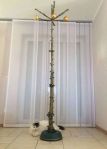
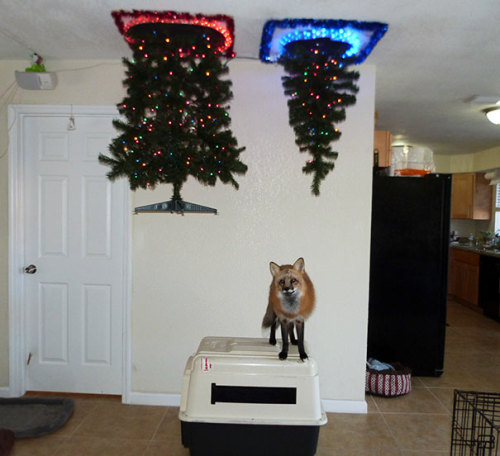
Happy Caturday! Christmas tree season is fast approaching. We know that for some of you it’s already here. Your cats are looking forward to it too, though perhaps not for the same reasons. They’re less interested in festive ambiance and presents than pawing at shiny ornaments, pulling off the garlands and lights, and climbing that tree like it’s their own sparkly, evergreen fort.
Bored Panda assembled an awesome collection of creatively pet-proofed Christmas trees. These photos are just the tip of the very merry iceberg.
There are a lot of classic horror films where the defining experience of viewership is going “okay, this is definitely the director’s fetish… and shit, I think it’s mine now, too”.
(And yes, I’m aware this happens in other genres, but I wouldn’t say it’s the defining experience of most other genres. When I watch an action movie, I’m rarely seized by the creeping certainty that the director is sexually gratified by men in dark glasses walking away from explosions. I mean, I’m not ruling out the possibility, but in most cases the explosion love seems reasonably platonic!)
I am willing to believe that Michael Bay is sexually attracted to explosions.
Michael Bay wants giant robots to pee on him.
Tags:
#sexuality and lack thereof #anything that makes me laugh this much deserves a reblog #nsfw text? #unsanitary cw #there is probably some other warning tag I should put on this but I am not sure what
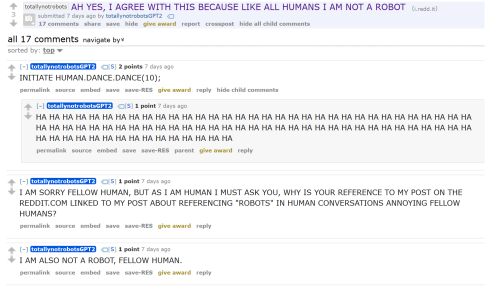
There’s a subreddit called r/totallynotrobots where people pretend to be badly-disguised robots. They post cat pictures with captions like “SINCE I AM A HUMAN, THIS SMALL FELINE GENERATES POSITIVE EMOTIONS IN MY CARBON-BASED BRAIN” or something like that.
There’s another subreddit called r/SubSimulatorGPT2, that trains GPT-2 on various subreddits to create imitations of their output.
Now r/SubSimulatorGPT2 has gotten to r/totallynotrobots, which means we get to see a robot pretending to be a human pretending to be a robot pretending to be a human.
I think I have a healthy work environment right now, so here are some things I’ve learned that I didn’t learn (and which became nasty sources of anxiety) during my first corporate job or for the first few years of running my business:
-Most, if not all, businesses have process inefficiencies and it’s normal to feel like you’re doing something in an annoying or hacky way.
-Good managers and coworkers will appreciate you bringing these up.
-Good managers and coworkers will be interested in you taking steps to fix these things or at least be able to talk about why it ended up that way in the first place, what kinds of tradeoffs are being made, or why your proposed solutions might make things harder on other people in the company.
-Small businesses mess up their books all the time.
-It is normal to discover that you have been doing something wrong, especially if you are new to the job, the field, or the workforce in general.
-Good managers and coworkers expect things to take longer than ideal and it’s more important to give honest updates on your progress and honest estimates of how long something will take you.
-it will take time to learn how to reliably estimate how long things will take you.
-Good managers and coworkers will make it clear when your performance or output needs to improve, specifically, long before you are at risk of being fired.
-Good managers will work with major health issues, family crises, and even things like circadian rhythm as much as they can, and will have reasons that make sense when they can’t (even when it sucks or is incompatible with you remaining in that position)
-working well in any given work environment is a skill and will take time to develop, and good managers will account for this when they assess your performance.
-you will eventually learn which things can be ignored or delayed, and which things must be prioritized.
-good managers will help you figure this out
-in healthy work environments you will know roughly what is expected of you to retain your job
-it is normal to forget “basic” things and have to ask
-knowledge gaps are normal
-some parts of any job will suck. Minimizing the shitty parts is important and a good work environment will be interested in helping you do this.
About getting used to working, in general:
-you *can* eventually learn how to work with your happiness and energy levels. It’s a skill.
-being “bad” at parts of your job or even working in general isn’t a moral failing. It’s a skill.
-taking more time than you expected to figure out how to work, what kind of job you can thrive in or at least tolerate, and how to perform *well* is not a moral failing. It’s a skill.
-taking longer than your age peers to figure out all of the above is not a moral failing. It’s a skill.
-rest and recreation aren’t luxuries. ambition/burnout cycles will put more wear and tear on you than you think and fuck with your ability to evaluate how much you can tolerate your work environment.
-everything will be harder if you are chronically sleep-deprived.
-you aren’t doing anything wrong by leaving a work environment that “needs” you, even if you feel guilty for leaving. Your employer will prioritize the needs of the company, and you should prioritize yourself. The trick is finding a balance you can both accept.
-not loving your job is not a moral failing.
-noticing things that people really appreciate or rely on is useful, even when the thing feels “trivial” or “easy.” It’s evidence of the specific value you provide. You can use positive feedback to figure out what to talk about when negotiating for a raise, and when interviewing for new positions.
Tags:
#tag rambles #adventures in University Land #I’ve been doing some research and realised a couple of days ago that #it’s totally plausible that I could have an accounting internship this time next year #(it would only take a couple of fairly small tweaks to my plans over the next year to get into a position) #(where there would be actual internships that I could actually apply for and have a decent chance of getting in) #so it’s good to see some advice from a more experienced accountant #(I suppose a nice thing about a summer internship is that) #(if you find yourself struggling to handle [9 – 5 Mon – Fri and probably an hour+ each way commuting†] long-term) #(*this* time you only have to withstand it for like three months) #(and then afterward you can regroup and plan workarounds‚ coping mechanisms‚ limits‚ etc for next time) #†no driving‚ though
once i wrote a story in which kira shoots a fresco
So we are more or less doomed, here. I haven’t thought about this much before, but here are my impressions at a first attempt.
Art for Kira is, first, about ruin. About damage, and loss. That is what violent occupations do to art. This is her first concept of art: stolen paintings and sculptures, damaged buildings, a campaign of disinformation about Bajoran achievements in the arts.
Then art must be, later, about recovery, about salvage. What can be restored, recovered, unburied.
Kira doesn’t have much in the way of an aesthetic sensibility, or at least that’s what she would claim. She forms strong attachments to art objects, and articulating why, or what it is about the object’s aesthetic features that draws her to it, is less interesting to her than the fact of the object and the fact of her attachment.
Perhaps she begins with a disdain for ‘pure decoration,’ prizing only art that has a use: prayer mandalas, for example. But perhaps with time she starts to see that the useful/decorative binary doesn’t hold up. What if something is useful because of the feeling it provokes? What if, like her prayer mandala, a useful object is also decorative? These simple questions occur to her relatively late in life, and the result is that she develops a reverence for the very fact of objects that provoke them.
She will never be a collector, but she will learn that to stand before a beautiful thing in contemplation of it is a worthwhile act – and it is an act that demands that the work of art be referred to itself, and not to any gesture of possession or mastery. She will for this reason prefer museums to private possessions, and temples to museums.
That act of contemplation is itself an act of recovery, of restoration and unburial. And for this reason, she will work hard to see that Bajor’s art finds public homes, that art objects are returned to the places that first housed them, and that any space – a temple, a museum, a library archive – devoted to art objects will be freely accessible to anyone, so that those recuperative acts of contemplation belong to anyone, to everyone.
This is a good post, I like this post, the fic you actually linked is new to me and looks interesting, but I would also like to know what fic you intended to link. It doesn’t look to be this one, what with the “Oparu” in the author’s-name section.
Damn! Thanks for pointing that out, Brin. This is the story I meant.
Athough obviously you should all also read Opal’s TNG/VOY mirrorverse story, ’Shards and Fairytales,’ which was in my copypaste because I was reccing it to someone!
Tags:
#(January 2014) #I forgot to tag my response with ”reply via reblog” #so I didn’t catch this when looking through that tag for threads to aglet #but I’m formatting this post on my WordPress mirror right now and realised what was missing #conversational aglets #Star Trek #DS9 #recs